
For years, the idea of Major League Baseball coming to Portland has lived somewhere between “this could actually happen” and “sure, maybe someday.”
We’ve seen the renderings. We’ve seen different stadium sites. We’ve heard the pitches, watched the Portland Diamond Project keep plugging away, and wondered whether Major League Baseball would ever expand. Then another year would pass, another problem would pop up somewhere else in baseball, and Portland’s MLB dream would slide right back onto the “we’ll see” pile.
This time feels different.
Major League Baseball appears closer to expansion than it has been in decades. ESPN’s Jeff Passan reported last week that one major obstacle disappeared when Hillsborough County approved public funding for a new Tampa Bay Rays ballpark. With the Athletics headed toward Las Vegas and the Rays’ stadium situation finally moving toward a resolution, the biggest remaining hurdle is baseball’s next collective bargaining agreement. After that, Passan reports, MLB is expected to finally begin an expansion process that hasn’t happened in more than 30 years.
That’s where Portland comes in.
And that’s also where things get a little uncomfortable.
Passan identified Portland as one of six leading expansion candidates. More importantly for us, he described Salt Lake City as the favorite for the western franchise, with Portland positioned as its biggest potential challenger. Portland has a stadium site and a financing plan. Salt Lake has those things, too, along with something Portland still doesn’t have publicly attached to its bid: an owner.
That’s not a small detail. That’s important when what you’re trying to buy could cost around $2.5 billion before you even start paying for everything else.
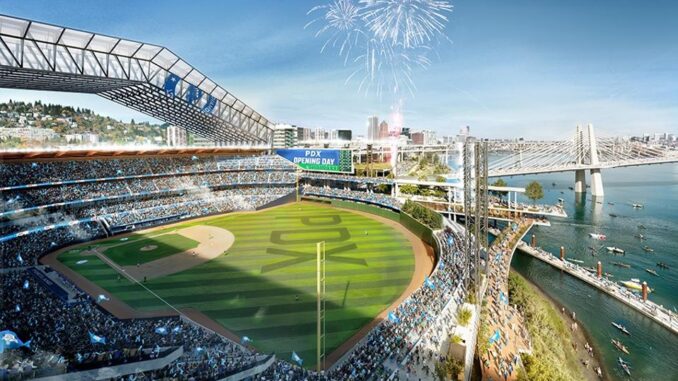
Portland has made enormous progress over the past couple of years. The Portland Diamond Project signed a letter of intent giving it a path to purchase Zidell Yards, a 33-acre site along the Willamette River. Oregon also approved a financing mechanism that could provide up to $800 million toward a ballpark if Portland lands a team. ESPN now lists Portland as having both stadium funding and a stadium site.
Think about how different that is from where this effort once stood. For years, Portland’s MLB campaign seemed to have more possible stadium locations than actual answers. Now you can point to Zidell Yards and say, “There. That’s where the ballpark would go.”
And honestly, it’s hard not to love the location.
A baseball stadium on the Willamette could be spectacular. Craig Cheek, the founder and president of the Portland Diamond Project, made that exact case to ESPN, talking about home runs headed toward the river, the Cascade Range in the distance, and Portland’s summer weather. If somebody can figure out a way to make Mount Hood visible while I’m eating a hot dog and complaining about a reliever walking the bases loaded, I’m interested.
The bigger point is that a Zidell Yards stadium could actually feel like Portland.
That’s important. Portland doesn’t need some generic ballpark dropped into the suburbs, surrounded by 14 acres of parking. Put baseball near the river, connect it to the city and transit, and build something around it that people want to visit even when the team isn’t playing. You suddenly have a much more interesting proposal.
Portland can make a pretty good market argument, too. ESPN lists Portland’s combined statistical area at more than 3.2 million people and its media market at No. 23 nationally. Salt Lake City’s combined statistical area is smaller, and its media market ranks No. 28.
Then there’s the Mariners factor.
I’ve always thought that’s one of the most underrated parts of Portland’s case. Seattle is close enough to create an instant rivalry, but not so close that Portland would become an extension of Mariners territory. Oregon already has plenty of Mariners fans, which means a Portland franchise would start with somebody to dislike before it even played its first game.
Give us Portland versus Seattle for 13 games a year and see how long everyone remains friendly.
My guess is about three innings.
Portland has also shown repeatedly that it will support sports. The Trail Blazers have been part of the city’s identity for decades. The Timbers and Thorns have built passionate fan bases. The Portland Fire’s return has created another major professional franchise in the market. This isn’t some theoretical sports town waiting to see whether people will show up.
Portland’s problem isn’t proving that people like sports.
It’s proving somebody with several billion dollars likes Portland baseball enough to own it.
That’s where Salt Lake has a major advantage, and Passan’s piece made that pretty clear. The Larry H. Miller Company is already attached to Utah’s bid. The Miller family owned the Utah Jazz for more than three decades, and the group has the sports ownership experience and financial credibility MLB owners will care about. Salt Lake also has up to $900 million in state funding and the Power District stadium site already identified.
In Passan’s assessment, Salt Lake is currently the most advanced expansion bid. He described it as the closest thing MLB has to a “turnkey operation,” and that’s really the problem Portland has to solve. Salt Lake doesn’t need MLB owners to imagine what its bid could eventually become. Most of the important pieces are already sitting there.
Portland isn’t far behind.
Actually, that’s probably the biggest reason for optimism.
Passan wrote that if Portland were located in another time zone, it might be the favorite for the other expansion franchise. He also noted that with the stadium site and public financing secured, the missing anchor investor is essentially what separates Portland from becoming the most serious challenger to Salt Lake.
That’s a pretty remarkable place to be considering where this conversation started.
Portland doesn’t need another stadium rendering. It doesn’t need another “Wouldn’t baseball be great here?” campaign. It doesn’t need to prove that people in Oregon know what baseball is.
It needs an owner.
That’s it.
Well, “that’s it” makes finding a billionaire willing to spend several billion dollars sound slightly easier than it probably is. I checked my bank account and, unfortunately, I won’t be stepping up.
But at least the problem is obvious now.
For years, Portland needed to answer a dozen different questions before anyone could seriously imagine Major League Baseball coming here. Where would they play? How would a stadium get financed? Would local and state leaders support it? Would MLB even expand?
Most of those questions now have answers, or at least much better answers than they did a few years ago.
The ownership question is the giant one that’s left.
And the clock is starting to matter.
Manfred has said he wants two expansion cities, one in the West and one in the East, decided by the time he retires in January 2029. Passan believes an expansion committee could potentially be in place as soon as next year, after baseball gets through its upcoming labor negotiations.
That doesn’t mean Portland will have an MLB team in 2027. Passan notes that the actual expansion franchises might not begin playing until around 2032. But the competition to win those franchises could happen much sooner.
Which means Portland can’t spend the next several years admiring how pretty Zidell Yards would look with a baseball stadium on it.
Salt Lake City isn’t waiting.
Utah has the owner. It has the stadium location. It has the financing structure. And according to one of the most connected baseball reporters in the country, it currently has the inside track on the western expansion spot.
Portland, though, is right there.
That’s what makes this so fascinating. For most of the Portland Diamond Project’s existence, getting an MLB team felt like the long shot. Now I’m not sure Portland’s biggest obstacle is MLB anymore.
It might simply be Salt Lake City.
Portland has gotten close enough that this no longer feels like a fun hypothetical. There’s a legitimate stadium site, real public financing, and a respected expansion effort that MLB clearly takes seriously.
Now Portland needs the billionaire.
Find that person, and this gets very interesting.
Don’t, and we may spend the 2030s watching a brand-new team take the field in Utah while wondering what a ballpark on the Willamette would have looked like.


Stop relying on a single billionaire and their outsized egos. Adapt the public non-profit model of the Green Bay Packers!
https://en.wikipedia.org/wiki/Green_Bay_Packers,_Inc.
Unfortunately, the Packers were sortvof “grandfathered in” because of their publicly-owned status and none of the major sports leagues will change their stances requiring a critical private owner spearheading the financial backing of a franchise. Portland will probably have a key owner with several well-heeled minority owners willing to invest. My hope is that Nike and Phil Knight, after being stiffed by the Blazers, will see the wisdom of cementing their legacy around here by at least investing in a baseball team, even if they are not the primary owners. Nike’s participation would make MLB to PDX all but guaranteed.