
A month ago, Oregon couldn’t score 20 points against UCLA. Two weeks ago, the Ducks managed just 10 against Illinois. Now they’re throwing touchdown passes all over the field against one of the best defenses in college football.
Apparently, somebody found the missing pages of the offensive playbook.
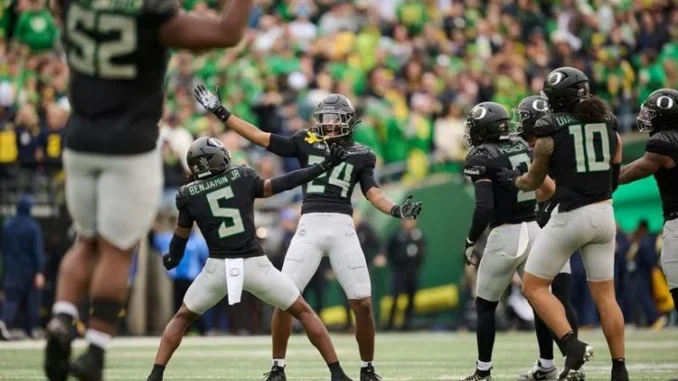
Oregon hammered Michigan 31-7 on Saturday afternoon at Autzen Stadium, giving the Ducks their third consecutive victory and another reason to believe this season might actually have a happy ending. Dylan Raiola threw four touchdown passes, Oregon’s defense made life miserable for Michigan’s quarterbacks, and the Wolverines spent most of the afternoon looking like they would rather be somewhere else.
The Ducks improved to 7-3 overall and 5-2 in Big Ten play. They’re still facing an uphill battle to reach the College Football Playoff, but the team that struggled through October looks considerably different from the one we’re watching in November.
And perhaps most encouraging, Oregon didn’t need another dramatic comeback to get the job done.
Here are three takeaways from Saturday’s convincing victory.
1. Dylan Raiola Has Gone From A Liability To Oregon’s Biggest Weapon
Remember Raiola’s performance against UCLA? The turnovers, the missed opportunities, the general feeling that Oregon’s offense was going absolutely nowhere?
That seems like a long time ago.
Raiola completed 20 of 28 passes for 341 yards and four touchdowns against Michigan. He didn’t throw an interception, and three of his touchdown passes covered at least 49 yards. That’s an impressive afternoon against just about anybody, let alone a Michigan defense that entered Saturday ranked fourth nationally in total defense.
The Wolverines hadn’t allowed more than 21 points or 332 total yards in a game this season. Oregon surpassed both marks, finishing with 467 yards and making Michigan’s defense look surprisingly ordinary.
And the Ducks wasted almost no time getting started.
On Oregon’s opening possession, Raiola found Jeremiah McClellan for a 60-yard touchdown. The Ducks needed just four plays to cover 75 yards, immediately putting Michigan in a position it desperately wanted to avoid.
Later in the first quarter, Raiola connected with Da’Jaun Riggs for a two-yard touchdown, extending Oregon’s lead to 14-0. By that point, the quarterback who struggled so badly earlier this season looked completely comfortable running the offense.
But my favorite throw came just before halftime.
Michigan had trimmed Oregon’s lead to 14-7, and the Ducks were facing the possibility of letting the Wolverines hang around. Instead, Raiola escaped pressure and found Dakorien Moore for a 59-yard touchdown with just seconds remaining.
That play changed the entire feeling of the game.
Instead of heading into halftime with a narrow seven-point advantage, Oregon walked into the locker room leading 21-7. Michigan had spent much of the second quarter trying to settle things down, only to watch one throw undo all that work.
Moore finished with seven catches for 101 yards, while McClellan added four receptions for 105 yards. That’s two receivers surpassing 100 yards against a defense that had been one of the nation’s toughest all season.
Raiola deserves plenty of credit, but Oregon’s receiving corps is finally looking like the dangerous group everyone expected. McClellan’s return from a foot injury has given the Ducks another legitimate deep threat, and Moore continues to demonstrate why he’s one of the most exciting young players in the conference.
The offensive line deserves recognition, too. Raiola has looked much more comfortable as Oregon’s protection and timing have improved, allowing him to get the ball to his playmakers instead of constantly worrying about the pass rush.
There are still things to clean up. Oregon’s offense disappeared for stretches in the second and third quarters, and six conversions on 15 third-down attempts aren’t going to impress anybody.
But compared with what we watched in October, this is practically a different sport.
Raiola doesn’t need to be perfect for Oregon to win. He just needs to make good decisions and give his receivers opportunities to make plays.
Right now, he’s doing considerably more than that.
2. Oregon’s Defense Didn’t Miss A Beat Without Teitum Tuioti
Losing Teitum Tuioti for the season was a brutal development for Oregon. He’s one of the Ducks’ most experienced defensive players, and replacing his leadership and production isn’t something a coaching staff can accomplish overnight.
Naturally, there were questions about how Oregon would respond against Michigan.
The answer? Pretty well, actually.
The Wolverines finished with just seven points and 286 total yards. Their quarterbacks combined for only 71 passing yards, and Michigan converted just four of 13 third-down opportunities.
That’s a miserable offensive afternoon, even by the standards Michigan has established this season.
To be fair, the Wolverines did manage 215 rushing yards. Freshman running back Savion Hiter broke free for a 70-yard touchdown early in the second quarter, briefly making things interesting.
But remove that one explosive run, and Michigan’s offense managed just 216 yards for the entire game. That’s not exactly the kind of production that keeps opposing defensive coordinators awake at night.
Oregon’s pass rush deserves much of the credit.
Matayo Uiagalelei recorded two sacks, continuing his climb toward the program’s career record. He now has 28 career sacks, putting him within striking distance of one of Oregon’s most impressive defensive milestones.
And with Tuioti unavailable, the Ducks needed that kind of performance.
Dylan Williams led Oregon with 10 tackles, while Devon Jackson added nine. Freshman Jett Washington also made a crucial defensive play in the third quarter, helping stop Michigan on fourth down near Oregon’s goal line.
That possession could have changed the game.
Oregon was still leading 21-7, and Michigan had an opportunity to make things uncomfortable with a touchdown. Instead, the Ducks held firm and forced the Wolverines to turn the ball over on downs.
It’s the kind of defensive stand that doesn’t always receive the same attention as a spectacular touchdown pass, but it was every bit as important.
Oregon also forced two fumbles in the second half, eliminating whatever realistic comeback opportunities Michigan still had.
The Ducks weren’t flawless. That 70-yard touchdown run was an ugly breakdown, and Michigan’s rushing total suggests there’s still work to do against physical offensive lines.
But Oregon didn’t need anyone to replace Tuioti individually. It needed the defense to function as a complete unit, with different players stepping up when opportunities presented themselves.
That’s exactly what happened.
And considering the Ducks still have Michigan State and Washington remaining on the regular-season schedule, they’ll need that same collective effort moving forward.
3. Oregon’s Playoff Hopes Are Still Alive, But There’s Absolutely No Room For Another Mistake
Here’s something I didn’t expect to be writing after Oregon lost to Illinois on October 24.
The Ducks might actually have a shot at the College Football Playoff.
I’m not suggesting anyone should start booking flights for postseason games just yet. Oregon has three losses, and the selection committee isn’t going to forget about those simply because the Ducks have started playing better football.
But consider what’s happened over the last three games.
Oregon rallied from a 14-point deficit to beat Northwestern, walked into Columbus and stunned Ohio State 41-28, and then dismantled Michigan by 24 points.
That’s a pretty impressive three-week stretch.
More importantly, the Ducks aren’t just winning. They’re demonstrating that they can win in different ways.
Against Northwestern, Oregon needed a comeback and some late offensive heroics. Against Ohio State, the Ducks overcame another terrible start before scoring 38 consecutive points. Against Michigan, they took control early and never seriously allowed the Wolverines back into the game.
That’s the kind of versatility good teams need in November.
Oregon entered Saturday ranked No. 16 in the College Football Playoff standings, making the Ducks the highest-ranked three-loss team. Saturday’s victory certainly won’t hurt their argument, although beating a struggling Michigan team isn’t going to carry the same weight as last week’s victory over Ohio State.
The bigger problem is that Oregon doesn’t control everything.
Indiana’s victory over USC on Saturday made the Ducks’ path to the Big Ten Championship Game even more difficult. And with several other teams competing for at-large playoff spots, Oregon will need some favorable results around the country.
But none of that matters if the Ducks don’t take care of their own business.
Next up is a Friday night trip to Michigan State, followed by the regular-season finale against Washington at Autzen Stadium on November 28.
Those are two games Oregon should be capable of winning, especially if the offense continues performing at its current level.
But should be capable and actually doing it are two very different things. Just ask anyone who watched the UCLA or Illinois games.
The Ducks also need to clean up some of the smaller mistakes that could become much bigger problems against stronger opponents.
Oregon committed seven penalties for 69 yards Saturday, all in the second half. The offense went through an extended scoring drought after halftime, and the Ducks missed a field goal before eventually putting the game away.
Those mistakes didn’t matter much against Michigan. Against a better team, they absolutely could.
Still, it’s difficult to complain too much about a 24-point victory over a program with Michigan’s history, particularly when the Ducks made one of the nation’s better defenses look so vulnerable.
Three weeks ago, Oregon’s season seemed headed toward disappointment. The offense couldn’t finish drives, the quarterback situation looked shaky, and the College Football Playoff felt like something other teams would be discussing.
Now the Ducks have won three straight games, their quarterback is playing his best football of the season, and the defense continues to make important stops despite significant injuries.
The turnaround has been impressive, but the real test is whether Oregon can maintain it.
There’s no guarantee that winning the final two regular-season games will be enough to reach the playoff. The Ducks might need some help, and even then, the committee could decide that three losses are simply too many.
But Oregon has done something important over the last few weeks.
It’s made the rest of the season worth watching again.
And after the way October went, that’s a pretty remarkable accomplishment.


Be the first to comment