FIFA has done a masterclass in getting many football fans to ignore the issues surrounding the 2026 World Cup — ticket prices, heat, Trump — and replace them with something true football fans have united in their disgust over: hydration breaks.
Yes, those pesky three-minute breaks implemented at or around the 22nd and 67th minutes have the football world up in arms.
While hydration breaks have been used in football before, this is the first time FIFA has mandated them for all games. It is also the first time that all hydration breaks are set times, rather than simply opportunities for players to take on fluids and get back to the action.
Of course, this is America. Capitalism rules. Hydration breaks are not, in fact, hydration breaks, but commercial breaks for TV broadcasters. The cry from the British is that this is further Americanization of football. This is now soccer — which, by the way, was a term coined by the British to differentiate rugby football from association football.
Channels in the US and Ireland are taking advantage of the breaks to sell ad time. Boos have rained down in stadiums, with fans opposed to the ad breaks, er… I mean hydration breaks. If you’re watching on US television, you won’t know that fans are booing because broadcasters cut straight to commercials. Thus, once again, it gives people in the US the impression that everyone is happy. It’s the filtering of news, similar to how FOX News ensures its viewers only see what they want them to see.
Meanwhile, channels in the UK are using the time to break away to pundits like Emma Hayes for tactical breakdowns, which I love, especially because she is doing them old-school with a blackboard and chalk. Of course, just like the hydration breaks, there are football “purists” (out-of-touch men) calling for Hayes to stop giving tactical breakdowns because “women’s football sucks!”
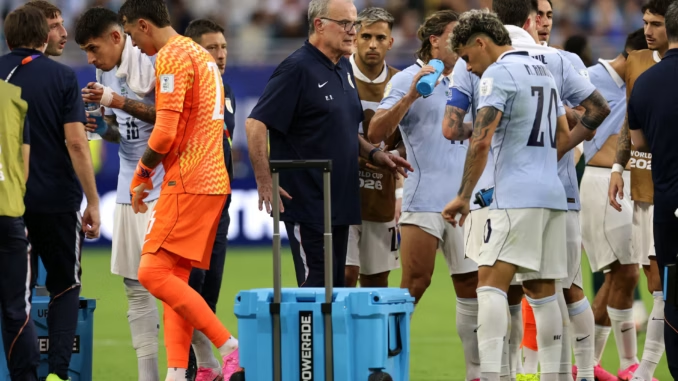
On the pitch, hydration breaks have become time-outs, allowing coaches a teaching moment to alter tactics. In this way, the breaks have been embraced by coaches. Players have also accepted them. Jordan Pickford has said the humidity has been incredible and that the hydration breaks are preparing England for playing outdoors in their next two games.
We’ve talked for the last decade about there being too much football. We’ve talked about the need for better player welfare. FIFA is selling the hydration breaks as better player welfare. Temperatures are over 32 degrees Celsius (90 degrees Fahrenheit) at many stadiums hosting World Cup matches.
Have hydration breaks changed games? Absolutely. The momentum shifts in matches have been apparent. Indeed, Australia used its hydration break in the first half against Turkey to stop the latter’s momentum and quickly score a goal.
For small nations like Cape Verde and DR Congo, who were forced to defend for much of their games against Spain and Portugal, respectively, the breaks offered a chance to regroup and batten down the hatches for the remainder of the game.
Germany was rocked by Curacao when the underdogs made it 1-1. However, the hydration break killed Curacao’s momentum, allowing Germany to retake control. Brazil’s Vinicius Jr scored within 10 minutes of a hydration break to equalize against Morocco, which had outplayed the Brazilians up to that point.
Time-outs in basketball are used to stop teams that go on scoring runs. In football, the hydration breaks — or time-outs, whichever you prefer — can do the same thing, killing the momentum of the team on top. Or it can create momentum with a tactical tweak.
Hydration breaks have been the catalyst for goals. According to ITV, there were eight goals in the opening 16 matches of the 2026 FIFA World Cup in the 10 minutes following a hydration break. I don’t believe this is a coincidence at all. Giving coaches and teams a time-out allows messages to get to players and tactical tweaks to be made.
This is likely to see coaches, especially in the biggest leagues around the globe, gradually accept hydration breaks as part of the game. Coaches are now becoming even more important. They get the chance to speak to players during an in-game time-out. Football will become a four-quarter sport rather than a game of two halves.
Yes, it breaks up the game. Yes, I don’t personally like it. Yet football isn’t just for me. It’s for people all over the world. Unfortunately, the game is often marketed towards people who aren’t die-hard fans. It is advertised to casual people who are on the fence about football. Perhaps adding a break midway through each half will attract those fans, giving them a chance to use the toilet or get a beer. Or perhaps just the opportunity to step away from the match and try to digest it.
Football isn’t for the older fans. They are already fans and aren’t going to leave the game. There are millions, even billions, of younger fans out there. FIFA is always trying to find new ways to connect with these people. Rather than making football more accessible to watch by lowering the cost of TV or stadium tickets, a variety of ideas have been kicked around and tried. The four-quarter model has been discussed previously.
I’ve already speculated on social media that MLS will be one of the first leagues to adopt mandatory hydration breaks. Indeed, I believe MLS will begin using them when the league reconvenes in July after the World Cup ends.
If MLS makes new fans, which I question if they will following the World Cup, how are those new fans going to understand that there is no three-minute time-out midway through each half? You can’t teach new fans about the game only to change things days after the tournament ends.
There is no debating that hydration breaks in hot weather are a good thing. The debate is over the changing face of football as we know it. The debate is over the history of the game.
It’s like Major League Baseball cutting games down to five innings. Or the NBA adding two additional quarters to make six. Or the NHL adding a fourth period instead of having three. Or the NFL having a mandatory fifth period. Of course, if any of those leagues could make additional money from those moves, they would do it.
Once football clubs realize they can make more money at the concession stands with a three-minute break, they will likely embrace the idea. Sure, fans in England will protest, but as we’ve seen, most of these protests occur, and fans still watch.
I believe the hydration breaks, ad breaks, and time-outs are here to stay. It is one of those things fans will continue to rail against. Pundits will complain about it. Yet, at the end of the day, they will become part of the game at the highest level.