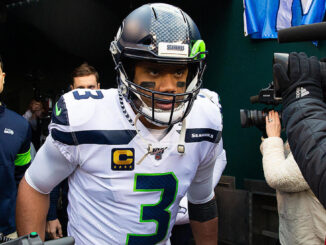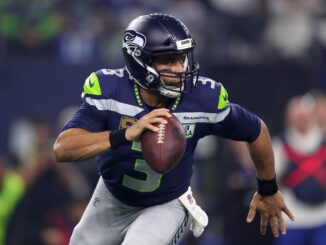
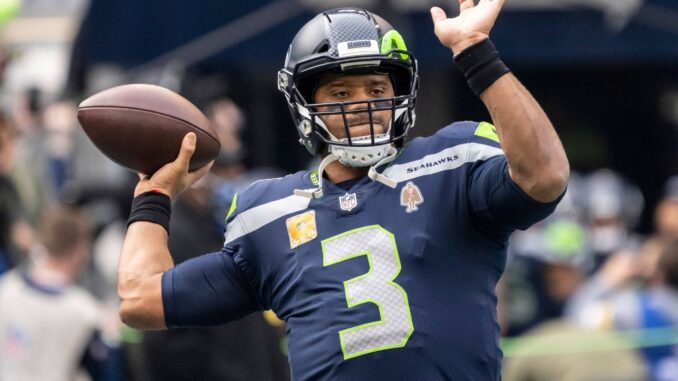
Russell Wilson officially retired from the NFL on Wednesday, and with that, one of the strangest, most successful, most debated quarterback careers of the modern era came to an end.
It feels weird to write that. Not because Wilson was still playing like a star. Those days had already slipped away. It feels weird because for so long, Wilson felt inevitable.
He was inevitable in the fourth quarter. Inevitable when a play broke down. Inevitable when he spun away from pressure, drifted right, and somehow dropped a moon ball into the hands of Tyler Lockett or Doug Baldwin. Inevitable when the Seahawks needed a win, when then-named CenturyLink Field was shaking, and when the rest of the football world was still trying to figure out how a 5-foot-11 quarterback drafted in the third round had turned into one of the most dangerous players in the league.
The Difficult Final Chapters
Wilson’s career did not end cleanly. Let’s get that out of the way first.
The Denver years were rough. The Pittsburgh year gave him a small late-career bounce, but not a rebirth. His final stop with the New York Giants was mostly a reminder that the NFL rarely gives fairy-tale endings, unless Tom Brady is involved, because apparently normal rules never applied to that guy.
But endings can be misleading.
If you only watched the final act, you missed the masterpiece.
The Seattle Era And Career Peak
Wilson’s real legacy was built in Seattle, where he became the best quarterback in Seahawks history and one of the defining players of the 2010s. He arrived in 2012 as the supposed long shot in a quarterback competition with Matt Flynn, then immediately made everyone look silly for doubting him. By the end of his rookie season, Seattle had found its franchise quarterback. By the end of his second season, the Seahawks had their first Super Bowl title.
That matters. A lot.
Wilson did not simply ride along with the Legion of Boom. Yes, those Seattle defenses were terrifying. Yes, Marshawn Lynch gave the offense its identity. Yes, Pete Carroll built one of the best rosters of that era.
But Wilson gave those teams something they had never truly had before: a quarterback who could tilt the field.
At his peak, Wilson was one of the best deep-ball passers in football. He protected the ball. He extended plays. He made defenses defend every blade of grass, even when Seattle’s offensive line looked like it had been assembled during a lunch break. He was efficient, explosive, calm, and maddeningly slippery.
For nearly a decade, the Seahawks were always relevant because Wilson was always there.
Building The Hall Of Fame Case
That’s the first piece of his Hall of Fame case.
The numbers are the second.
Wilson retires with 46,966 passing yards, 353 passing touchdowns, a career passer rating of 99.3, 10 Pro Bowl selections, a Super Bowl ring, two Super Bowl appearances, and one of the best quarterback resumes in Seahawks history. He also added more than 5,500 rushing yards, which puts him among the most productive running quarterbacks the league has ever seen.
This is not a “Hall of Very Good” resume. It’s better than that.
Now, is it perfect? No. That’s where the debate gets interesting.
Wilson never won an MVP. He was a second-team All-Pro only once. He was rarely viewed as the clear best quarterback in football, because his prime overlapped with Brady, Aaron Rodgers, Drew Brees, Patrick Mahomes, and other monster names. He also had a very loud career decline after leaving Seattle. That matters too, because Hall of Fame voters remember the ending, even when they should know better.
And then there is the play. You know the one.
The interception at the goal line in Super Bowl XLIX will always be attached to Wilson’s career, even though it probably says more about the play call than the quarterback. Fair or not, that moment changed how people talked about him. If Seattle wins that game, Wilson has two rings, back-to-back championships, and this debate gets a lot shorter.
The Debate Around His Legacy
Instead, we got a decade of arguments.
Was he elite, or was he helped by the defense?
Was he underrated, or did the “Let Russ Cook” era expose him?
Was he a franchise savior, or a quarterback whose limitations eventually caught up to him?
The answer, honestly, is yes.
He was elite. He was helped by a great defense. He was underrated. He had limitations. His style aged poorly. His peak was real. His decline was ugly. All of those things can be true.
That’s what makes Wilson such a fascinating Hall of Fame case. He is not the clean, no-argument candidate like Brady or Rodgers. He is not the stat compiler who never won big. He is not the caretaker quarterback who got carried to a ring.
He sits in the messy middle, which is usually where the best sports arguments live.
Why Russell Wilson Belongs In Canton
Start with the biggest credential: Russell Wilson was the quarterback of the first Super Bowl champion in Seahawks history and led Seattle to a second Super Bowl appearance the very next season.
Franchise-defining quarterbacks with sustained success usually end up in Canton, and Wilson checks that box comfortably. He made 10 Pro Bowls, threw for 46,966 yards and 353 touchdowns, added more than 5,500 rushing yards, and spent nearly a decade as one of the NFL’s most dangerous dual-threat quarterbacks.
The resume is not flawless. He never won MVP, was rarely considered the single best quarterback in football, and his post-Seattle decline damaged his public image. But Hall of Fame careers are measured by total impact, not perfect endings.
Wilson transformed the Seahawks, consistently won at a high level, and authored one of the most memorable quarterback peaks of his era.
That is a Hall of Fame career, and eventually Canton should recognize it as one.