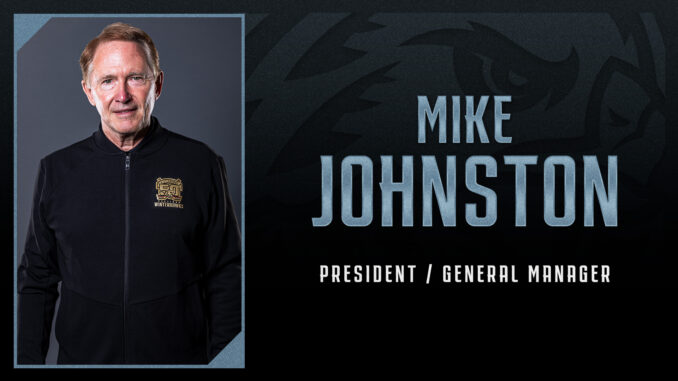
At a recent game, I had a chance to sit down and talk with Mike Johnston of the Portland Winterhawks. Mike Johnston is currently the President and General Manager of the Winterhawks.
A little backstory. In 1975, the then-Winterhawks were known as the Edmonton Oilers of the Western Canada Hockey League. At that time, there were issues between the Edmonton Oilers organization and the Western Canadian Hockey League junior franchise. This friction caused problems with attendance, building arrangements, and other matters, and the decision was eventually made to relocate the franchise.
The Winterhawks became the first U.S.-based franchise in the Western Canadian Hockey League. Shortly thereafter, the Seattle Thunderbirds were born after a move from Kamloops, British Columbia, followed by a new franchise, the Spokane Chiefs, and then the Tri-City Americans, who moved from the New Westminster Bruins to Kennewick, Washington. That was followed by a new franchise, the Everett Silvertips, in 2001, and finally the Wenatchee Wild, which had taken over the spot previously occupied by the Kootenay Ice during COVID, when the Wild could not cross the border into British Columbia as members of the BCHL.
The Wenatchee Wild actually trace back to the Kootenay Ice, a team that itself was the second incarnation of an Edmonton franchise. The Ice moved from Cranbrook, British Columbia, amid major fanfare and plans for a new rink in Winnipeg, Manitoba. However, that never materialized, and the team played exclusively at Wayne Fleming Arena at the University of Manitoba, where they won the Eastern Division before bowing out to the Seattle Thunderbirds for a berth in the Memorial Cup. Upon their move, the Wild found themselves with no draft picks and, this season, have really sunk to a new low during a rebuild.
Meanwhile, the Winterhawks were well received by the fan base and local media, and attendance at the building was fairly solid. An instant rivalry with the Seattle Thunderbirds up I-5 proved to be a hot ticket once that rivalry started in 1977.
The owners of the Winterhawks at that time, Brian “Bunny” Shaw and Ken Hodge, saw Hodge behind the bench as coach and later as General Manager. After 30 years of running the team, Hodge, following Shaw’s passing, elected to sell the team.
The new owners, collectively known as “The Three J’s,” were knowledgeable about local baseball in Arizona but not about hockey. This became apparent almost immediately when office staff were reduced, and those remaining were tasked with double or triple duties.
There was also an issue involving Mike Williamson, who had been the Winterhawks’ coach for several years, during contract negotiations. With less than three weeks to go before the start of training camp, it was learned that Williamson’s contract would not be renewed. The search was on for a new coach.
Rich Kromm, a former 1983 Memorial Cup champion player with the Winterhawks, was tapped as the new bench boss.
The team tanked immediately, with only 11 wins to its credit during the 2008-09 season. Another issue was a rash of shoulder injuries among players, and with it, the fan base dwindled. There were many nights when fewer than 1,000 people attended games.
Then other issues cropped up. There were rumors that players were not receiving proper meals while on the road, and it got to the point where one player quit the team during a road swing in 2009.
Fans themselves turned against the team after an incident in Portland in which a player named Tristan King sustained an injury on the ice. Usually, a trainer rushes out to assist the player. This did not happen. The player lay prone on the ice for what seemed like several minutes before two players helped carry him off. There was significant backlash against trainer Innes Mackie for failing to tend to the injured player.
Given such disastrous attendance and a team in free fall, many thought the Winterhawks were on their last legs, and there was widespread talk that the team would relocate. Commissioner Ron Robison squashed those rumors and immediately began searching for a new owner for the team.
The player who had quit the team during the road trip was waiting to return to Portland to retrieve his car and drive home to Las Vegas. The new owner, who would later be revealed as Bill Gallacher, stepped in.
When the team arrived by bus from a disastrous road swing, the players were told to remain on the bus, while all staff members, coaches, trainers, and others were instructed to enter Veterans Memorial Coliseum. Everybody was subsequently fired.
Kyle Gustafson would later be rehired as the video coach. The players then came inside and were introduced to the new management.
Doug Piper became the President of the club. Mike Johnston became both Coach and General Manager. Rich Campbell, nicknamed “Strength,” became the new trainer and athletic therapist. The late Rob Gagne became the equipment manager.
The team still did not fare very well that year, finishing with just 19 wins, but there was a feeling that things were finally about to turn around. They did, in a big way, the following year.
The team went from 11 wins to 19 wins to more than 40 victories and has now made the playoffs 15 straight years.
It is an almost unheard-of situation because many teams cycle players from younger prospects to 20-year-old veterans in an effort to become league champions or compete for the Memorial Cup. Often, once a team becomes a league champion or advances to the Memorial Cup, it enters a rebuilding cycle.
Most of the players on those teams are older to ice the strongest possible roster. This usually results in teams carrying a maximum of three 20-year-old players, along with nine to 12 19-year-old players. Because of that, a team will lose its 20-year-olds the following season due to age limits, and many of the 19-year-olds will turn 20, while the team can still keep only three.
This is what is known as a cycle. Teams that have used draft picks and assets to acquire veteran players often find themselves with an empty trade cupboard afterward, so they begin selling off players, regaining draft picks, and suffering through a rebuild for a few years. They then restock those draft choices through trades and try to repeat the cycle.
This is not how Mike Johnston operates a team.
Though the team finished with only 11 wins and then 19 wins, they jumped to over 40 victories the following year and, within two years, had won the Western Hockey League championship and were competing in the Memorial Cup.
Since then, the Hawks are now in the midst of their 15th straight playoff season, though this year they did not fare well, falling in the first round.
Here is our exclusive interview with Mike Johnston:
OSN: First off, congratulations on 50 years as a team. That’s a tremendous accomplishment, especially considering how many teams have changed hands, relocated, or folded over the years. In a market like Portland, which has seen its share of changes, this milestone is especially impressive.
One thing you’ve done to celebrate the anniversary is recognize the top 50 players in franchise history. How did that come about?
Mike Johnston (MJ): We started with fan suggestions, which gave us a list of about 200 names. We reviewed those names to ensure they had major accomplishments, things like league championships, Memorial Cups, Ironman records, scoring records, or a tremendous impact on the organization. From there, we narrowed it to 100 and then carefully evaluated accomplishments and long-term impact. Once we got down to 50, we began putting together the stories and achievements that earned each player a place on the list. Since I wasn’t around for every era of Winterhawks history, I relied on people who had that knowledge and helped determine where each player belonged.
(Editor’s Note: The No. 1 player was Ken Yaremchuk, a member of the 1983 Memorial Cup championship team who still holds numerous franchise records. His professional career included time with Chicago and Toronto before spending a decade overseas. His No. 15 jersey was retired at Veterans Memorial Coliseum during the unveiling of players 10 through 1 in 2026.)
OSN: Education plays a huge role within this organization. Can you explain how it works for both high school and college-aged players? It’s my understanding that not all teams are involved to this degree.
MJ: All high school-aged players must attend school until they graduate. It’s true that not every team continues supporting education beyond that point, but we believe it’s important to provide structure until players leave the organization.
High school players attend classes beginning at 8:45 a.m. and leave around noon. They then come to the rink, practice for a couple of hours, and return to their billets to complete homework. College-aged players arrive at Veterans Memorial Coliseum at 8:45 a.m. and take online classes before practice. Afterward, they return to their billets and complete assignments.
On the road, students receive assignments that must be completed and submitted immediately upon returning. Whether it’s on the bus, in hotel rooms, or at opposing arenas, academics remain a priority. Sue Johnson, who oversees our education program, coordinates much of this effort and is a major reason why our players consistently maintain strong GPAs. You’ll see that reflected during our annual awards ceremonies and in the number of players who receive WHL Scholastic recognition. We do everything we can to minimize classroom interruptions. Even during our busiest month, February, players missed only five days of class.
OSN: Media coverage has become increasingly difficult to find. The team is no longer on traditional radio, apps have replaced many outlets, and newspapers have largely moved away from covering junior hockey.
MJ: The entire media landscape has changed dramatically. Newspapers are almost nonexistent compared to what they once were, radio has become much more corporate, and we’ve had to rethink our media strategy. Social media has become a major factor, both in terms of reach and how it’s used. We’ll continue adapting and creating new opportunities as things evolve.
OSN: One of the biggest topics right now is the NCAA agreement with the CHL. How did that come about, and what impact has it had on recruiting and player movement? Previously, American players who chose the CHL couldn’t play college hockey in the United States.
MJ: There were lawsuits that ultimately led to these changes.
(Editor’s Note: The legal challenge began in 2024 when an OHL player lost NCAA eligibility after appearing in two exhibition games. The lawsuit continues. CHL players typically receive monthly stipends ranging from $200 to $600 to cover expenses, and those funds are not considered taxable income.)
Last year, several players chose the college route, and that trend continues, although I think it will eventually level out as players evaluate their options. At the same time, we’ve been able to recruit players who previously would not have considered the WHL because of NCAA restrictions.
We’re a developmental league. The majority of NHL-drafted players come through the CHL, and I believe it’s the best route for development into professional hockey. Sometimes players think the grass is greener elsewhere and choose college, and that’s certainly their right. Players deserve freedom of movement. That’s good for everyone.
Our recruiting efforts and the way we explain our program will continue to benefit us.
OSN: Walk me through the anatomy of a trade. What goes into making one, and how difficult is that process?
MJ: Under league rules, 16-year-olds can’t be traded. At 17, trades generally happen only if the player requests one. Once players are 18 and older, they’ve usually finished high school and started making decisions about their futures.
Trades begin with conversations between general managers. Personally, I don’t like making trades. We’ve spent years developing players and putting them in positions to succeed. For a trade to make sense, there has to be significant value involved, whether that’s impact players, draft picks, or other meaningful assets. We’re not in the business of mortgaging the future because that can create long-term problems.
OSN: That leads to my next question. Memorial Cup or league championship? I’ve always felt that chasing a Memorial Cup often requires sacrificing so many assets that it becomes difficult to sustain success afterward.
MJ: League championships are much more attainable and, in my opinion, more valuable. You can win a league title without giving up as much of your future.
Since I’ve been here, we’ve won one league championship, reached the Memorial Cup, and consistently posted 40- to 50-win seasons. That success has allowed players to be seen by NHL scouts and international teams. We’ve now had close to 145 players drafted, the most in WHL history, which shows the strength of the program.
I’m not willing to dismantle the future of the franchise for a chance at one tournament. Everything has to make sense. That’s one reason so many players want to come here.
Realistically, if we completely tore down the roster to chase one championship, attendance would suffer, and recovering from that could be difficult, especially in a market with so many professional sports options competing for attention.
I’m hopeful that once the Trail Blazers’ new ownership group addresses the arena situation, we may eventually see an updated facility and an ice plant. Most of our games will still be played at Veterans Memorial Coliseum, but I’d love to see special events such as the Teddy Bear Toss and New Year’s Eve games played in a larger arena. The renovations at Veterans Memorial Coliseum have already had a positive impact on attendance and the overall fan experience.
(Editor’s Note: The Winterhawks won a business award this past season in part because of increased attendance, sponsorship growth, merchandise sales, and the success of the arena renovations.)
OSN: You joined the organization later in your career. You were 52 when you came to Portland and are now 68. Do you see retirement in your future?
MJ: As long as I feel capable of doing the job, I’ll be here. I enjoy what I do. If that ever changes, then I’ll take a closer look at retirement. Right now, I don’t see that happening anytime soon. I still feel I can contribute, provide leadership and insight, and continue doing what’s necessary to build a quality, championship-caliber team.