Oregon needed a win like this.
After a shaky opening month that included a seven-point win over Boise State and a frustrating loss at Oklahoma State, the Ducks entered Saturday night’s trip to USC with plenty left to prove. An 84-0 demolition of Portland State was certainly fun, but beating an undefeated, 12th-ranked USC team at the Coliseum would tell us much more.
Oregon did exactly that, beating USC 41-27 to improve to 3-1 and open Big Ten play with a victory. The Ducks finished with 504 yards, didn’t turn the ball over, and scored the final 14 points after USC tied the game early in the fourth quarter.
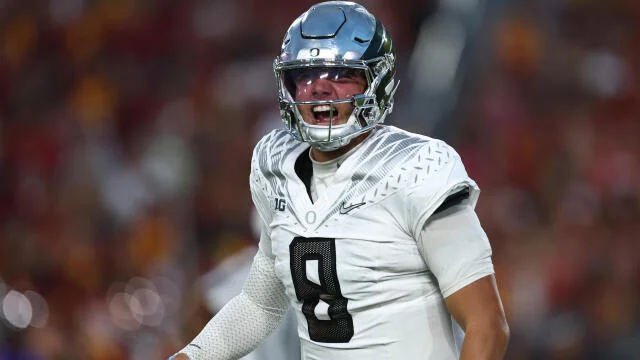
Of course, the result became secondary for a significant stretch after quarterback Dante Moore suffered a frightening injury in the second quarter. USC linebacker Desman Stephens II hit Moore in the head while attempting to slide, and Stephens was ejected for targeting. Moore was eventually taken from the field on a stretcher and transported to a Los Angeles hospital.
Dan Lanning said after the game that Moore had movement and was being evaluated. As of Sunday morning, Oregon had not announced a diagnosis or timetable for his return.
With Moore’s health clearly the most important story coming out of Los Angeles, here are three football takeaways from Oregon’s biggest win of the season.
1. Dylan Raiola showed exactly why Oregon wanted him
Nobody wanted to find out this way what Oregon had in Dylan Raiola.
Moore left with Oregon trailing 7-3, putting Raiola into one of the toughest situations imaginable for a backup quarterback. He wasn’t entering a blowout or finishing off an overmatched opponent. He was suddenly running Oregon’s offense on the road against the No. 12 team in the country after watching his teammate leave the field on a stretcher.
Raiola responded almost immediately. On his second snap, he found Evan Stewart for a three-yard touchdown that put Oregon ahead 10-7.
From there, he looked much more like an experienced Big Ten starter than a backup being thrown into a difficult situation. Raiola completed 19 of 25 passes for 289 yards, two touchdowns and no interceptions, while helping Oregon produce 270 yards and four touchdown drives in the second half.
His experience certainly mattered. Raiola started two seasons at Nebraska before transferring to Oregon, so the Ducks weren’t turning the offense over to somebody who had never handled the pressure of a major college football game.
Still, knowing someone has experience and watching him perform like that are two different things. Raiola was accurate, protected the football, and kept Oregon’s offense moving even as USC attempted to take control of the game.
Nobody knows yet how much football Raiola will need to play going forward, and that question can wait until more is known about Moore’s health. What Oregon learned Saturday, however, is that its quarterback room has legitimate depth.
2. Oregon’s offense finally showed how many different ways it can hurt a defense
USC tied the game at 27 with 12:41 remaining, and the momentum had swung heavily toward the Trojans. Given everything Oregon had already experienced, it wouldn’t have been surprising to see the Ducks struggle to respond.
Instead, Oregon immediately drove 75 yards in nine plays and regained the lead. Raiola finished the drive with a 29-yard touchdown pass to Dakorien Moore. After the defense stopped USC on downs, Oregon put together another long scoring drive to put the game away essentially.
What made the performance particularly encouraging was how many players were involved. Jamari Johnson returned after missing two games and caught seven passes for 119 yards, giving Oregon another major option in the passing game.
Dierre Hill Jr. was even more versatile. He scored twice on the ground while catching four passes for 105 yards, becoming Oregon’s first running back since De’Anthony Thomas in 2012 to surpass 100 receiving yards in a game.
Evan Stewart caught seven passes and scored a touchdown. Dakorien Moore delivered the biggest reception of the fourth quarter, while Jordon Davison finished Oregon’s final touchdown drive with a two-yard run.
That is a lot for a defense to worry about.
Oregon finished with 366 passing yards and 138 rushing yards while averaging 7.4 yards per play. Even more impressive considering the circumstances, the Ducks didn’t commit a turnover.
The offense hasn’t always looked this dangerous through four games. Saturday provided the best glimpse yet of what it could become once all of Oregon’s weapons are healthy and involved.
3. Oregon finished the game this time
Two weeks earlier at Oklahoma State, Oregon had a chance to escape with a road victory. The Ducks took a 31-30 lead early in the fourth quarter, but Oklahoma State responded by scoring the final nine points and winning 39-31.
Saturday offered Oregon another fourth-quarter test.
USC erased a 27-17 deficit and tied the game with 12:41 remaining. Oregon was on the road, playing with its backup quarterback and facing a USC team that had entered the night 4-0.
This time, Oregon responded immediately. The Ducks scored the final 14 points, while the defense made the stops it needed.
USC still moved the football effectively, finishing with 446 yards and 26 first downs. Jayden Maiava threw for 326 yards and two touchdowns, so this certainly wasn’t a dominant defensive performance from Oregon.
But the Ducks were at their best when the game reached its biggest moments. With USC trailing 34-27 and facing fourth-and-7 near midfield, Oregon forced an incomplete pass and took possession with 7:15 remaining.
The Ducks then went 49 yards in eight plays, taking more than five minutes off the clock before Davison scored to make it 41-27. Koi Perich intercepted Maiava in the end zone on USC’s final possession, giving Oregon the game’s only turnover and ending any remaining doubt.
That’s a significant difference from what happened at Oklahoma State. Oregon led in the fourth quarter there but couldn’t finish. Against USC, the Ducks saw a 10-point advantage disappear and responded by controlling the rest of the game.
Oregon entered Saturday ranked No. 20 after opening the season at No. 2, and much of the preseason excitement had disappeared during the first three weeks. One victory doesn’t erase every concern, especially with Moore’s status now far more important than anything that happened in the standings.
But from a football standpoint, Oregon left Los Angeles looking considerably different than the team that stumbled through the first half of September. The Ducks showed offensive depth, got an exceptional performance from their backup quarterback, and finished a difficult road game against a ranked opponent.
Most importantly, they’ll head into the bye week hoping for good news about Moore.