There comes a point when being close is no longer enough, and Oregon has reached that point.
The Ducks finished 13-2 last season, won two College Football Playoff games and advanced to the national semifinals. That sounds like a wildly successful year, and for most programs, it would inspire a parade, a commemorative DVD and at least three contract extensions. Oregon is not most programs anymore.
The Ducks lost twice in 2025, and both losses came against Indiana. The first was a 30-20 defeat at Autzen Stadium. The second was a 56-22 demolition in the Peach Bowl that ended Oregon’s season one victory before the national championship game. The Ducks fell behind 35-7 by halftime and spent the second half performing the football equivalent of waiting for an unpleasant dentist appointment to end.
That loss should linger. Oregon has recruited too well, spent too much and won too many games to keep celebrating playoff participation. Dan Lanning has turned the Ducks into a legitimate national power, but now comes the uncomfortable part. They need to finish the job.
The 2026 roster is talented enough to win the national championship. Anything less than another playoff appearance would be a failure, while anything short of the semifinals would be a disappointment. Those are harsh expectations, but they are also completely fair.
Dante Moore Must Go From Very Good to Unquestionably Elite
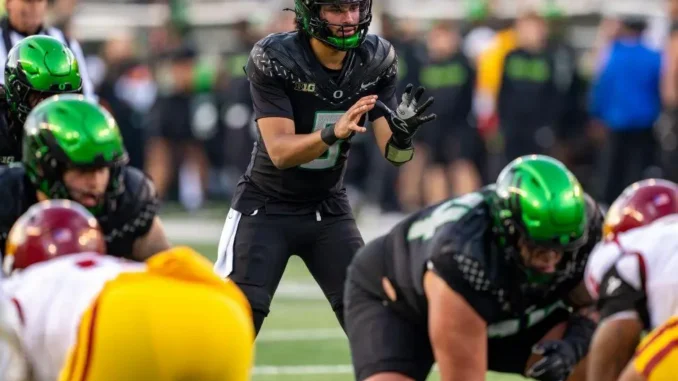
Dante Moore’s decision to return immediately made Oregon one of the country’s leading national championship contenders.
Moore completed 296 of 412 passes last season, good for 71.8 percent, while throwing for 3,565 yards, 30 touchdowns and 10 interceptions. He led Oregon to 13 victories and earned Orange Bowl Offensive MVP honors after the Ducks shut out Texas Tech in the playoff quarterfinals.
Those are excellent numbers, but they also leave room for improvement. Moore occasionally became careless when pressured, particularly against Indiana. His final season statistics look polished, but Oregon did not bring him back simply to produce another efficient regular season. He returned to win the games that decide championships.
That means making the correct decision when the pocket collapses, knowing when to take the easy completion instead of chasing the spectacular one and avoiding the early turnovers that allow an elite opponent to turn a close game into a nationally televised public embarrassment.
Moore does not need to become a different quarterback. He needs to become a more consistent version of the one Oregon already has.
The Ducks also have an absurdly qualified backup in Dylan Raiola. Before suffering a season-ending injury at Nebraska last year, Raiola completed 72.4 percent of his passes for 2,000 yards and 18 touchdowns in nine starts. He has thrown for 4,819 yards over his two college seasons.
There should not be a quarterback controversy. Moore earned the job, and Oregon should not waste August manufacturing drama for bored television analysts. Raiola’s presence still matters, though. One quarterback injury can destroy a championship season, and Oregon is better protected against that possibility than nearly anyone else.
Oregon’s Backfield Could Be Ridiculous
The Ducks do not need Moore to throw 45 times every Saturday.
Jordon Davison rushed for 667 yards and a team-leading 15 touchdowns as a freshman. Dierre Hill Jr. added 656 yards and five touchdowns while averaging an outrageous 8.75 yards per carry, the best mark in the Big Ten and second-best nationally.
Those two should become the foundation of Oregon’s offense. Davison is the power back who can finish drives, survive contact and punish defenses near the goal line. Hill provides the speed and can turn a routine running play into a 60-yard touchdown before a safety has finished making the wrong decision.
Together, they give Oregon one of the most dangerous backfields in college football. The Ducks should lean into it.
Oregon averaged 198.6 rushing yards per game last season, but there were stretches when the offense seemed too eager to prove how sophisticated it could be. There is nothing unsophisticated about repeatedly handing the ball to players the defense cannot tackle. Some games call for creativity. Others call for moving a large collection of unhappy people five yards backward.
Oregon should be capable of doing both.
The Receiving Group Has Talent, but It Needs a Star
Dakorien Moore caught 34 passes for 497 yards and three touchdowns despite missing four games with an injury. He looked like a future star because that is probably exactly what he is.
Evan Stewart is also back after missing the entire 2025 season because of injury. Jamari Johnson returns at tight end after catching 32 passes for 510 yards and three touchdowns. Oregon also added UAB transfer Iverson Hooks, who finished last season with 72 receptions for 927 yards and seven touchdowns.
The depth is obvious. What is less obvious is who becomes the player Oregon can trust on third-and-eight in Columbus.
Last season’s offense had plenty of productive receivers, but it lacked the kind of dominant target who terrifies a defense before the ball is even snapped. The Ducks need someone to claim that role.
Dakorien Moore is the best candidate. Stewart has the experience and former five-star pedigree, while Hooks has already proven he can handle a large workload. One of them needs to become more than another option in a deep rotation. Oregon needs a receiver who demands the football when the season is sitting on one play.
The Offensive Line Is the One Legitimate Reason for Concern
Almost every Oregon preview will identify the offensive line as the biggest question. That is not lazy analysis. It is the truth.
Center Iapani Laloulu and guard Dave Iuli return, and Yale transfer Michael Bennett III adds experience. Still, Oregon spent the spring sorting through a new-look group. Lanning described the line’s first major spring scrimmage as having “highs and lows” and said the Ducks had not yet solidified the group they planned to use.
That should make Oregon fans nervous, but not panicked. A’lique Terry has developed excellent offensive lines, and Oregon has accumulated plenty of highly recruited players. The problem is that recruiting rankings cannot recognize a delayed blitz in Columbus. Talent helps, but communication and experience matter more.
The early schedule gives Oregon time to figure things out. Boise State will test the line, but the Ducks should have enough advantages elsewhere. Oklahoma State and Portland State provide two more opportunities to settle the rotation before conference play starts.
By the USC game on Sept. 26, experimentation needs to end. If Oregon finds five dependable linemen, the offense can be elite. If Moore spends November running for his life, none of the recruiting rankings, transfer additions or preseason hype will matter.
This season may be decided by whether the offensive line becomes good or great.
The Defense Has No Excuse Not to Dominate
Oregon’s defense allowed 17.9 points and 273.7 total yards per game last season. Opposing quarterbacks completed only 53.3 percent of their passes, and the Ducks led the nation with 73 pass breakups.
The most frightening part is that the defensive front returns intact. Matayo Uiagalelei, Teitum Tuioti, Bear Alexander and A’Mauri Washington all decided to return. Jerry Mixon is also back after starting 13 games and recording 57 tackles, two interceptions and seven pass breakups.
Tuioti led Oregon with 16 tackles for loss and 9.5 sacks last season. Washington started all 15 games and broke up eight passes, an unusual number for an interior defensive lineman. That group should make life miserable for opposing quarterbacks.
Brandon Finney Jr. might already be the best player in Oregon’s secondary. As a true freshman, he started all 15 games, intercepted three passes, broke up eight more and allowed completions on only 40 percent of the throws directed into his coverage.
Minnesota transfer Koi Perich gives Oregon another versatile defensive back who earned all-conference honors in each of his first two college seasons and has contributed on defense, offense and special teams.
This should be the best defense of Lanning’s Oregon tenure. Not potentially. Not eventually. It should be.
The Ducks can rush the passer without constantly blitzing. They have experience in the middle, elite talent in the secondary and enough depth to survive the long Big Ten schedule. If this defense finishes outside the national top 10, something went wrong.
The New Coordinators Cannot Become an Excuse
Oregon promoted Drew Mehringer from co-offensive coordinator to offensive coordinator and Chris Hampton from co-defensive coordinator to defensive coordinator. Both have already spent multiple seasons inside Lanning’s program, and that continuity matters.
Oregon is not installing two completely different systems. The language, personnel and general philosophies should remain familiar. However, calling plays while assisting someone else is different from being responsible when a fourth-down call fails and 60,000 people immediately become amateur coordinators.
Mehringer must prove he can maintain Oregon’s offensive balance. Hampton inherits a defense loaded with veteran talent, which creates pressure of its own.
Neither needs to reinvent anything. Sometimes coaches become so excited about placing their fingerprints on a unit that they smear the entire window. Oregon’s coordinators need to avoid that temptation. Keep what works, adjust what does not and get the ball to the best players.
This is not the season for an extended learning curve.
Breaking Down the Schedule
The opener against Boise State will receive plenty of attention, but Oregon should have too much talent and depth at Autzen Stadium. A trip to Oklahoma State could become uncomfortable, especially with a 9 a.m. Pacific kickoff, but the Ducks should survive. Portland State should provide one final tune-up before conference play.
The first major test comes at USC. Oregon has the better overall roster, but road games against the Trojans tend to produce strange things. Expect points, momentum swings and at least one moment that sends Ducks fans pacing around their living rooms.
After a bye, Oregon hosts UCLA and Nebraska before traveling to Illinois. None of those games should be treated casually, but the Ducks will be favored in all three. Northwestern at Autzen Stadium follows on Halloween.
Then the season gets serious.
Oregon travels to Ohio State on Nov. 7 before hosting Michigan one week later. That is a brutal combination, even for one of the most talented teams in the country. The Ducks then visit Michigan State on a Friday night before closing the regular season against Washington at Autzen Stadium.
The Ohio State game will likely play a major role in determining whether Oregon reaches the Big Ten Championship Game without help. Columbus remains one of the most difficult places to play in college football, and the Buckeyes will enter the season with national championship expectations of their own.
Michigan at home will not be easy, but Autzen Stadium could provide the difference. Oregon should also have enough left to win at Michigan State before finishing the season with a victory over Washington.
Of course, rivalry games rarely care about predictions. Washington would happily finish 1-11 if the one victory ruined Oregon’s season. Sports are healthy and normal like that.
The Prediction
Oregon will lose a game during the regular season. The most likely loss comes at Ohio State. USC and Michigan also present real danger, but the Ducks are too talented, too experienced and too deep to stumble more than once.
The prediction here is an 11-1 regular season and an 8-1 record in Big Ten play.
That should put Oregon in the conference championship conversation and comfortably inside the College Football Playoff. Whether the Ducks win the Big Ten may depend on tiebreakers, Indiana’s attempt to defend its conference title and what happens during that November trip to Columbus. Two unofficial preseason media polls place Oregon second in the conference behind Ohio State.
In the playoff, Oregon should advance at least one round. The defensive front, quarterback experience and offensive skill talent give the Ducks a roster capable of beating anyone in the country.
But winning three or four consecutive games against elite opponents requires more than talent. It requires health, offensive line stability and avoiding the avalanche of early mistakes that ended last season against Indiana.
The final prediction is another trip to the College Football Playoff semifinals, where Oregon’s season ends one victory short of the national championship game.
That might sound disappointing for a program that wins 11 games, competes for the Big Ten title and finishes among the final four teams standing. That is also the standard Lanning has created.
Oregon is no longer chasing relevance. The Ducks are chasing the one trophy the program has never won.
The 2026 team will have every opportunity to finally bring it home.