For years, the New York Knicks were not exactly the franchise anyone wanted to copy.
They were the punchline. The cautionary tale. The team that could turn cap space, lottery picks, coaching searches, star-chasing, and Madison Square Garden electricity into one giant shrug.
Then something funny happened.
The Knicks stopped being the Knicks.
Or, maybe more accurately, they became the version of the Knicks fans always believed existed somewhere beneath the rubble. Tough. Loud. Physical. Weirdly resilient. Built for uncomfortable basketball. Led by a guard who plays like every possession is a personal grudge.
Now New York is celebrating an NBA championship, its first since 1973, while the Portland Trail Blazers are left with a question that should not be dismissed as daydreaming:
What can Rip City learn from this?
The easy answer is “get Jalen Brunson,” which is both accurate and deeply unhelpful. Great plan. While they’re at it, maybe the Blazers should also find a time machine, grab 2019 Damian Lillard, and convince Nikola Jokic that Portland has better Serbian food than Denver.
The real answer is more interesting.
The Knicks did not win because they found one magic trick. They won because they finally committed to a real identity, trusted the right kind of star, surrounded him with adults, and stopped confusing activity with progress.
That should matter to Portland.
The Trail Blazers are not the Knicks. They do not have New York’s market, spotlight, pressure, or celebrity courtside section. Spike Lee is not walking through that door in a red-and-black tracksuit, though honestly, Portland would probably give him a custom beanie and a craft IPA within 11 minutes.
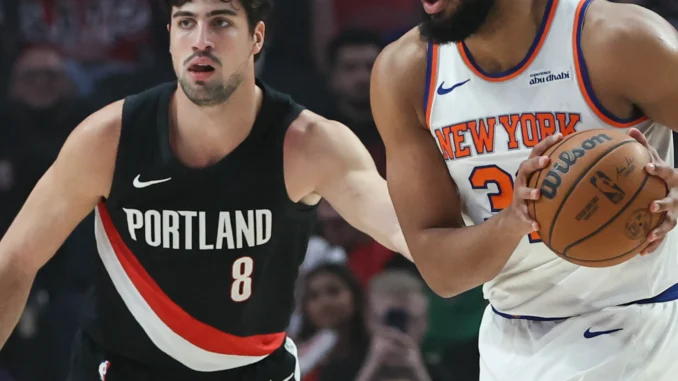
But the Blazers do have something worth studying. They just lost to the same San Antonio Spurs team that New York beat for the championship. That gives Portland a painfully clear measuring stick.
The Spurs were too much for the Blazers. The Knicks were too much for the Spurs.
That gap is where the lessons live.
Lesson 1: Pick An Identity And Stop Wandering
The Knicks did not win by being beautiful. They won by being miserable to play against.
They defended. They rebounded. They survived bad shooting nights. They played through contact. They leaned into playoff basketball instead of acting surprised when every possession turned into a street fight with better sneakers.
Portland needs that kind of clarity.
For too long, the Blazers have lived between identities. Are they rebuilding? Are they chasing the Play-In? Are they developing Scoot Henderson? Are they trying to win with veterans? Are they building around Shaedon Sharpe’s scoring upside? Is Deni Avdija the connector? Is Donovan Clingan the defensive foundation? Is Toumani Camara the tone-setter?
The answer cannot be “yes” to everything forever.
Good teams have talent. Great teams have a personality.
The Knicks knew what they were. Everyone who checked into the game knew the assignment. Brunson created advantages. Mikal Bridges, OG Anunoby, Josh Hart, Mitchell Robinson, and Karl-Anthony Towns each filled lanes around him. Some nights were pretty. Some nights looked like five guys fighting over the last folding chair at Costco.
It did not matter.
The identity traveled.
The Blazers need one of their own. Not a slogan. Not a media-day quote about being competitive. A real style that shows up on a random Tuesday in January and again when the season gets tight in April.
With Camara, Avdija, Clingan, Jrue Holiday, and the eventual return of Damian Lillard, Portland has the bones of a team that can be tough, smart, and defensive-minded. That should be the starting point.
The Blazers should not try to become the old Lillard teams again. That era was magical, but it ended. They also should not drift into a highlight-first youth project where everyone gets touches, and nobody gets held accountable.
Build the identity first. The rest gets easier.
Lesson 2: The Right Star Matters More Than The Biggest Name
Brunson is the heart of the Knicks because he gives them direction. He does not just score. He organizes. He calms. He punishes mistakes. He gives everyone else a job.
That is what Portland still needs to figure out.
The Blazers have intriguing players. Scoot has the burst and edge. Sharpe has the athletic gifts that make fans lean forward before he even leaves the floor. Avdija took a major step and looks like one of the most important players on the roster. Clingan has defensive anchor potential. Camara plays as if someone told him every loose ball contains the deed to his house.
But who bends the game?
That is the question.
A championship team needs someone who can control a possession when the building gets tight, and the other team knows exactly what is coming. Not just someone who can score 25 in November. Someone who can get to the same spot repeatedly in May and June.
Maybe Scoot becomes that player. Maybe Sharpe does. Maybe Avdija becomes the best all-around piece while Portland eventually trades for the lead engine. Maybe Lillard, when healthy, gives the Blazers enough late-game order to accelerate everyone’s development.
But the Knicks offer a reminder: build around the player who controls winning, not just the player with the loudest tools.
Brunson was not the flashiest possible superstar archetype. He was the correct one for New York.
Portland has to be honest enough to make that same distinction.
Lesson 3: Veterans Cannot Be Decorations
The Knicks were not a daycare. That matters.
Championship teams need players who have already been through ugly playoff possessions. They need guys who understand scouting reports, fouls, timeouts, momentum, and the difference between a decent shot and the shot the defense wants you to take.
This is where Portland has an interesting opportunity.
Jrue Holiday is not just a veteran name on a depth chart. He is a walking postseason education. Lillard, once healthy, is the greatest player in franchise history and still one of the smartest late-game offensive players of his era. Jerami Grant has played in plenty of meaningful games. Robert Williams III, if healthy, brings playoff-level defensive instincts.
The Blazers cannot treat veterans as placeholders until the kids are ready. They also cannot let veterans block the future. The Knicks found a balance. They had enough maturity to keep the floor from wobbling, but enough edge and hunger to keep climbing.
That is the line Portland has to walk.
Let Scoot, Sharpe, Clingan, Camara, and the rest grow. Absolutely. But do not make them learn every lesson through failure. That sounds noble until the losses pile up and bad habits start renting space.
Veterans should raise the standard every day. Not in speeches. In practice. In film. In body language after a missed rotation. In the thousand boring moments that make a team serious.
Lesson 4: Consolidation Comes Eventually
The Knicks did not hoard every asset forever.
At some point, teams that want to win have to decide which pieces fit and which pieces become currency. That is the uncomfortable part of team building. Fans get attached. Front offices get cautious. Everyone talks about upside until the roster starts to feel like a storage unit full of “maybe someday.”
Portland is nearing that stage.
The Blazers have young talent, veterans, and enough roster questions to keep offseason rumor mills employed. That does not mean they should panic-trade half the team for the first star who becomes mildly annoyed in a group chat.
But it does mean Portland has to be honest.
If Sharpe is the guy, build with that in mind. If Scoot is the guy, give him the structure to prove it. If Avdija is the most reliable two-way piece, treat him that way. If Clingan is the defensive backbone, stop pretending center is still a question. If the right star becomes available, Portland has to know who is untouchable and who is not.
The Knicks won because they eventually moved from collecting pieces to forming a team.
That is a massive difference.
The Blazers do not need to skip steps. They do need to know what step they are on.
Lesson 5: Playoff Basketball Exposes Everything
Portland’s first-round loss to San Antonio was not a failure. In many ways, getting there was progress. But the playoffs are rude. They do not care about timelines, development curves, or encouraging regular-season stretches.
They hunt weaknesses.
That is what San Antonio did to Portland. Then New York did it to San Antonio.
The Knicks showed what a team looks like when it has answers after the first punch, the second punch, and the third punch that lands directly on the nose. They trailed. They adjusted. They trusted their best player. They defended late. They found rebounds. They closed.
Portland is not there yet.
That is fine. Really. The Blazers are closer to the beginning of their climb than the end. But the Knicks’ run should light a fire under the franchise because it proves something important.
A drought does not end by accident.
It ends when the organization takes fit, toughness, decision-making, and identity seriously. It ends when the best player is also the tone-setter. It ends when young talent grows up, veterans matter, and the front office stops trying to win the transaction column and starts trying to win basketball games in June.
The Blazers do not need to copy New York player for player.
They need to copy the seriousness.
Because Rip City knows droughts, too, Portland has not lifted the trophy since 1977. Every generation since has had its own version of hope. Drexler. Sabonis. Sheed. Roy. Aldridge. Dame. Each era gave fans something to believe in, even if the final step never came.
The Knicks just reminded the league that old pain does not have to stay permanent.
For Portland, that should not feel like a fairy tale.
It should feel like homework.