
This column first appeared at SuperWest Sports, a media partner of Oregon Sports News.
With the 2025–26 campaign in the rearview mirror for the nine teams of the new Pac-12, let’s take an early look at next season.
It’s a basketball conference that effectively ceased to exist for the past two years, with the Beavs and Cougs playing in the WCC and the other 10 legacy Pac-12 teams bolting.
That sets up an exciting and unpredictable re-emergence in 2026–27.
New to the party are five former Mountain West schools, Boise State, Colorado State, Fresno State, San Diego State, and Utah State, along with Gonzaga from the WCC and Texas State from the Sun Belt.
The Zags are certain to be the preseason favorites, with the Aggies and Aztecs expected to be their most likely pursuers.
But this new consortium of teams is bound to produce plenty of surprises.
Here are my way-too-early outlooks.
Gonzaga (31–4)
The Zags immediately become the flagship brand of Pac-12 basketball, and their performance will shape the reputation of the new conference.
To play up to their usual standards, they’ll need to replace Graham Ike.
His experience in the paint will be difficult to replicate, but Braden Huff returns from injury, and he’s an elite scorer in the post.
Huff can shoot, has a good handle for his size, and is a high-IQ player. He should be able to make up for the scoring lost by Ike, but they’re very different players.
Other notable returners for the Bulldogs include Mario Saint-Supery and Davis Fogle. While Fogle gets a lot of attention, Saint-Supery could prove more important.
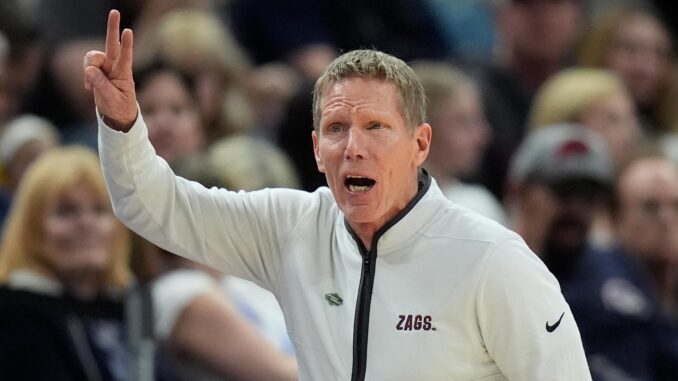
Recent Hall of Fame inductee Mark Few will need to involve multiple players, particularly early in the season, to build team chemistry.
If Saint-Supery can provide stability, it will take pressure off Fogle and allow him to shine.
This is Gonzaga’s conference to lose.
Utah State (29–7)
For some teams, the Pac-12 feels like a brand-enhancing deal, but for the Aggies, it’s an opportunity to solidify themselves as a reputable name.
Utah State made the NCAA Tournament the previous two years, but former head coach Jerrod Calhoun is out after taking the Cincinnati job, and Ben Jacobson is in.
Calhoun and Jacobson have similar styles, but there will be some differences. Calhoun prefers an in-your-face defense, while Jacobson leans more toward structure.
Jacobson, who built Northern Iowa into a high-level mid-major, likes to slow the pace, protect the ball, and be highly efficient on offense.
Utah State’s success next season, however, will likely depend on the return of Mason Falslev, who excels on both sides of the ball.
Falslev averaged 16 points per game, 5.7 rebounds, 1.9 steals, and 3.1 assists, and was selected Mountain West Player of the Year in 2025–26.
USU isn’t on Gonzaga’s level, but they feel like the second-place team heading into the season.
San Diego State (22–11)
Everyone knows what to expect from San Diego State basketball, a solid defense complemented by a spotty offense. That likely won’t change in the Pac-12.
The key for the Aztecs is scoring enough to hang with Gonzaga and Utah State. SDSU’s defense should remain strong, especially if Magoon Gwath returns.
Gwath, a 7-foot big man with solid shot-blocking skills, averaged 1.5 blocks per game a year ago. His skill set should translate.
The main concern entering the Pac-12 is finding enough offensive firepower. In particular, they’ll need production from Elzie Harrington and Zach White.
San Diego State lost a lot of scoring to the portal and graduation.
Miles Byrd recently announced he was leaving, which also stings. He was the Mountain West Defensive Player of the Year and a double-digit scorer.
White, a three-star prospect from Sherman Oaks, could help offset some of that lost production.
Colorado State (21–13)
People may be sleeping on Colorado State. This is a squad that has won at least 20 games in six of the past seven seasons, excluding the COVID year.
The 2026–27 season should be exciting for the Rams, who return their top three scorers in Brandon Rechsteiner, Kyle Jorgensen, and Carey Booth.
That trio brings experience, which should pair nicely with one of CSU’s better recruiting classes.
Colorado State added a number of quality three-star recruits from around the region, including guards Kaiden Bailey and Eli Sancomb, and forward Ethan Harris.
CSU could sneak up the standings, along with other teams in transition like Washington State, San Diego State, and Boise State.
The Rams might even knock off a few top teams.
Oregon State (17–16)
Oregon State underwent a year of transition, firing Wayne Tinkle after 12 seasons at the helm. The Beavers were solid at 17–16, but lacked an “it” factor.
OSU didn’t put together long winning streaks, had no clear star, and only a few signature wins. If not for the new conference and a desire for a reset, the athletic department might have stayed the course.
Josiah Lake II was OSU’s best player last season, leading the team with 13.1 points, 4.2 assists, and 1.4 steals per game.
He also tied for the team lead in defensive rebounds with 3.8 per contest, which is notable for a 6-foot-2 guard.
He isn’t a traditional star, but he was the engine for OSU as a First-Team All-WCC selection.
Other key contributors included Isaiah Sy and Dez White, who earned All-WCC Honorable Mention honors after averaging 9.7 points per game.
Looking to generate more excitement, OSU hired Michigan assistant Justin Joyner in the offseason. It’s his first head coaching job, and he’s expected to bring a faster-paced, high-volume three-point offense.
He’ll need strong guard play to make it work, so Lake’s return would be pivotal.
If Lake returns alongside Sy and White, giving the Beavers three experienced seniors, they could push into the upper tier of the Pac-12.
Boise State (20–12)
Some analysts believe Boise State can make a run in the new Pac-12, but that feels unlikely, at least in the short term.
In fact, the Broncos could slip toward the bottom of the conference.
They lost most of their guards to the transfer portal, including Drew Fielder, RJ Keene II, and Dylan Andrews.
That’s concerning, especially since BSU was already average defensively, ranking 330th in blocks per game and 167th in points allowed nationally.
The Broncos still went 20–12, but declined an invitation to the NIT.
They have a lot of holes to fill this offseason. Aginaldo Neto and Julian Bowie return, but expecting major jumps might be a stretch.
If Boise State can find a solid big man, a reliable point guard, and some fearless scorers, they could stabilize.
It would be a fun season to do it, especially with upgrades coming to their student section, “Blue Chaos.”
Washington State (12–20)
Washington State had a rough year, suffering surprising losses to Portland, Pepperdine, and San Diego.
Head coach David Riley seemed out of sync during his second season on the Palouse.
He’s probably fortunate the school is dealing with financial issues, or his seat might be much hotter.
The Cougars ended the season on a four-game losing streak, including a loss to Portland in the WCC Tournament.
After strong showings against Gonzaga and Saint Mary’s earlier in the year, WSU looked promising, until they blew a 17-point lead in Corvallis.
Three issues defined their season, a porous defense, a tendency to blow big leads, and struggles on the road.
Wazzu ranked 279th in points allowed per game and unraveled late in games.
A bounce-back season depends heavily on whether Ace Glass returns.
The Cougars have already lost key pieces like Rihards Vavers and ND Okafor. If Glass leaves too, this roster is starting from scratch.
Still, oddly, they’re not in a terrible position.
If Riley struggles again in non-conference play, it could cost him his job.
On the flip side, a complete reset might actually help.
Texas State (19–13)
Texas State might be getting overlooked due to its limited basketball history.
The Bobcats won’t be a top team right away, but they could land in the middle of the standings with the right breaks.
They return DJ Hall, who does a little bit of everything.
Hall, the Sun Belt Freshman of the Year, averaged 15.6 points, 7.7 rebounds, and 1.4 steals per game.
They also have an experienced head coach in Terrence Johnson, who has already won back-to-back Sun Belt titles.
The challenge will be adjusting to a tougher schedule.
They’ll take some lumps, but Hall and Johnson should keep them competitive.
Fresno State (13–19)
Fresno State is improving, but not quite there yet.
Vance Walberg did a solid job in his second year, but taking over a 12–21 team means this is still a rebuild.
And things are about to get tougher.
Fresno State has already lost key players to the portal, including DeShawn Gory and Zaon Collins, with more potentially on the way out.
They also graduated leading scorer Jake Heidbreder, who averaged 17 points per game and played a team-high 37 minutes.
Without him, and with significant roster turnover, this could be another difficult season.
The Bulldogs project as a bottom-tier team in the conference.



Be the first to comment