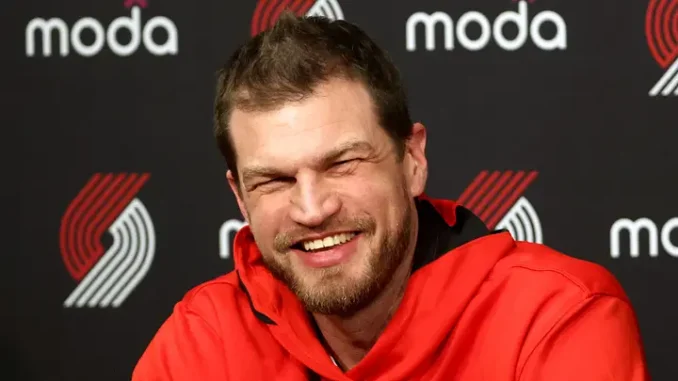
Tiago Splitter is going to the Chicago Bulls, and the Portland Trail Blazers are left with a question they probably did not want to face this quickly.
Did they let the right coach leave?
That does not mean Splitter was perfect. He was not. His first season as an NBA head coach came with clear limitations, especially in the playoffs. Portland’s offense still had long stretches where it stalled. The Blazers ranked near the bottom third of the league in offensive rating, and their half-court execution never fully caught up with their defensive effort.
Still, when judging Splitter’s time in Portland, the full picture matters.
The Blazers finished 42-40. Splitter himself went 42-39 after taking over following Chauncey Billups’ departure after the first game of the season. Portland made the playoffs for the first time in five years. The Blazers won a Play-In game, earned the seventh seed, and even stole a road playoff game from a 62-win San Antonio Spurs team before losing the series in five games.
That is not a small accomplishment.
It is especially not small, given the circumstances. Splitter was hired as an assistant. He did not walk into the season as the planned head coach. He did not get a full offseason to install his system, build his staff the way he wanted, or define the tone from day one. He inherited the job under difficult conditions and still helped Portland produce a winning record.
For a first-time NBA head coach, that deserves real credit.
The numbers paint an interesting picture. Portland was not a dominant team. The Blazers had a net rating of -0.3. Their expected record was 40-42, suggesting they slightly outperformed what their point differential would have predicted. They ranked 20th in offensive rating and 14th in defensive rating. In other words, this was not some hidden powerhouse. This was a flawed team that found a way to win more often than it lost.
That is where Splitter’s case gets stronger.
The Blazers were not winning because they overwhelmed teams with elite shot creation. They were not winning because they had a finished superstar carrying them every night. They were winning because they were organized enough, tough enough, and connected enough to survive a long season that could have gone sideways quickly.
That reflects well on the coach.
The biggest improvement under Splitter was not that Portland suddenly became a contender. It was then that the Blazers began to look like a serious team again. That has been missing too often in recent seasons. They competed. They defended well enough to stay in games. They played with pace. They showed real buy-in from important young players.
The player-development piece matters, too. Scoot Henderson, Shaedon Sharpe, Toumani Camara, Donovan Clingan, and Deni Avdija all needed structure. They did not need empty minutes or vague promises about the future. They needed a coach who could hold the group together while still pushing them toward something bigger.
Splitter seemed to do that.
There is also something to be said for how players responded to him. Deni Avdija publicly praised him during the playoff run, saying Splitter believed in the players and got the best out of them. That type of support is not everything, but it is not nothing. Young teams need accountability, but they also need trust. Splitter appeared to earn both.
That is why his move to Chicago feels like more than a coaching transaction.
The Bulls looked at Splitter and saw a coach who could grow with a young roster. They saw his international experience, his player-development background, his season in Portland, and his ability to lead a team through instability. Chicago just finished 31-51, so this is not a win-now hire. It is a development hire. It is a culture hire. It is a bet on a coach who has shown he can connect with players and keep a team competitive.
That is exactly the kind of coach Portland needed, too.
The counterargument is fair. Splitter’s playoff series against San Antonio exposed some concerns. The Spurs were better, deeper, and led by one of the league’s most difficult matchups in Victor Wembanyama. Still, Portland’s adjustments were not always sharp. The offense too often became predictable. Rotations and late-game decisions invited questions.
Those concerns matter.
But they should not erase everything else.
Almost every first-time head coach learns painful lessons in the playoffs. That is part of the job. The question is not whether Splitter had all the answers in April. He did not. The better question is whether he showed enough during the regular season, the Play-In, and the first round to justify a real commitment from Portland.
I think he did.
At minimum, he deserved clarity.
Instead, the Blazers now look like a franchise that allowed a credible internal candidate to leave while still sorting through its own process. Maybe Portland has another coach in mind. Maybe that coach will be better. Maybe the front office will end up looking patient and smart.
But right now, it feels risky.
The Blazers are at a delicate point. They are no longer a bottom-feeder with unlimited patience. They are also not ready to jump straight into contention. They are somewhere in the middle, which is often the hardest place to be. That is when coaching becomes even more important.
Portland needs someone who can develop Scoot without handing him anything. It needs someone who can push Sharpe from an exciting talent to a consistent winning player. It needs someone who can keep Camara’s defensive identity central to the team’s personality. It needs someone who can use Avdija as more than a connector and figure out the long-term frontcourt plan with Clingan.
Splitter had already started doing that work.
The Blazers were not elite under him, but they were better than expected. They were competitive. They were steadier. They played through noise, injuries, and uncertainty. That is not the full definition of a great coach, but it is a strong start.
Now Portland has to start over.
That is the part that should bother Blazers fans. The issue is not simply that Splitter left. Coaches leave. Teams make choices. The issue is that Portland finally had a season with forward movement, and one of the people most responsible for that movement is now taking over another rebuilding team.
Chicago made its bet.
Now the Blazers have to make theirs.
If Portland’s next hire brings a clearer vision, stronger offensive structure, and the same level of player buy-in, then this will fade into a minor what-if. But if the next coach struggles to connect with this roster, Splitter’s departure will look worse with time.
For now, the truth is simple.
Tiago Splitter did a good job as head coach of the Portland Trail Blazers. Not a perfect job. Not a flawless job. But a good one. He took over a difficult situation, won games, helped end a playoff drought, and gave the franchise a little momentum.
The Bulls saw enough to act.
The Blazers better hope they were right not to.