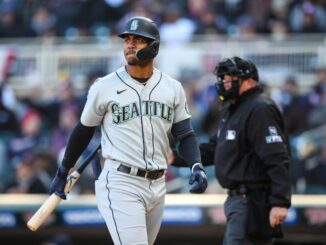
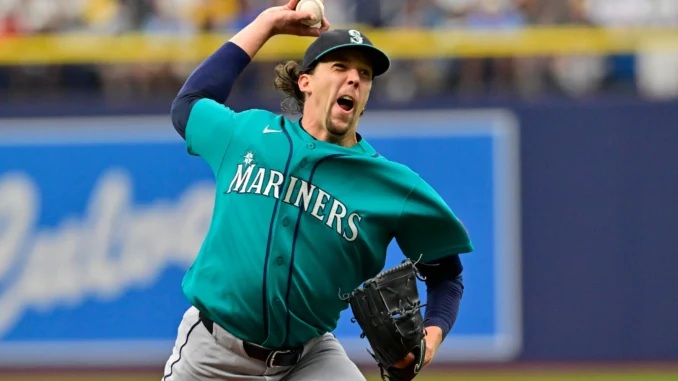
The Seattle Mariners have spent the first half of the 2026 season doing something that feels both confusing and extremely familiar. They have pitched well enough to contend, struggled to score consistently and somehow remained directly in the middle of the playoff race.
Seattle enters the All-Star break at 48-49, only 1.5 games behind the Texas Rangers in the American League West. The Mariners also currently occupy the final AL Wild Card position, although they are tied with Minnesota and only a half-game ahead of Boston. They have scored 392 runs, allowed 376 and own a plus-16 run differential, which produces an expected record of 50-47. In other words, the Mariners have played like a winning team in the aggregate, but the actual standings have not rewarded them.
That helps explain why this team is so difficult to evaluate. The Mariners are not playing well enough to inspire much confidence, but they are far too close to first place to dismiss. Their strengths are legitimate, their weaknesses are obvious and their second half could go in almost any direction.
Here is the good, the bad and the ugly from Seattle’s first 97 games.
The Good: The Pitching Has Given Seattle a Chance
The Mariners’ pitching staff remains the primary reason this season can still become something meaningful. Seattle owns a 3.61 team ERA, sixth-best in Major League Baseball, while its 1.18 WHIP ranks fourth. Opponents are batting only .240 against Mariners pitching, and the staff has recorded 825 strikeouts against just 242 walks in 857 1/3 innings.
Those numbers become even more impressive when considering that the rotation has not followed its expected script. Luis Castillo has gone 3-8 with a 4.93 ERA, while Bryan Woo has a 4.23 ERA after establishing himself as one of baseball’s better young starters last season. George Kirby has been solid but not dominant, posting a 3.76 ERA and a 1.32 WHIP through 18 starts.
Fortunately, Logan Gilbert and Emerson Hancock have provided stability. Gilbert has a 3.32 ERA, a 0.99 WHIP and 119 strikeouts in 114 innings. Hancock, meanwhile, has been one of the season’s most encouraging developments, going 6-4 with a 3.17 ERA, a 1.01 WHIP and a .209 opponent batting average across 18 starts.
Bryce Miller has also been outstanding when available. He owns a 2.18 ERA, a 0.83 WHIP and 65 strikeouts against nine walks in 57 2/3 innings. His limited availability has prevented him from becoming a larger part of the first-half story, but his performance provides Seattle with another potential difference-maker for the stretch run.
This is not quite the perfectly healthy, overwhelmingly dominant rotation Seattle envisioned entering the year. It remains, however, one of the better collections of arms in baseball. When the Mariners hand the ball to Gilbert, Hancock, Miller, Kirby or Woo, they have a reasonable chance to win on nearly any night.
The Good: Randy Arozarena Has Carried the Offense
Randy Arozarena is Seattle’s lone representative in the All-Star Game, and he has earned the honor. He leads the Mariners with a .286 batting average, a .380 on-base percentage and an .838 OPS while contributing 11 home runs, 21 doubles, 45 RBIs, 59 runs and 19 stolen bases.
Arozarena has provided something the rest of Seattle’s lineup has struggled to deliver: consistent production. He can reach base, create runs with his legs and drive the ball without depending entirely on home runs. When so many other hitters have gone through extended slumps, Arozarena has prevented the offense from becoming completely unwatchable.
Dominic Canzone also deserves recognition. Through 83 games, he has hit .264 with a .335 on-base percentage and a team-leading .529 slugging percentage. His 15 home runs lead Seattle, and his .864 OPS is the best on the club among players with at least 200 at-bats.
Canzone may not carry the same name recognition as Arozarena or Julio Rodríguez, but his power has become essential. Without his production, Seattle’s offensive rankings would somehow look even worse, which is a sentence that probably just caused several Mariners fans to stare silently into the distance.
The Good, With an Asterisk: Julio Rodríguez Remains Productive
Rodríguez has not been terrible. In fact, his .259 batting average, .323 on-base percentage and .424 slugging percentage would make him one of the better hitters on many teams. He has added 14 home runs, 40 RBIs, 46 runs and 12 stolen bases in 87 games.
The issue is not that Rodríguez has been bad. The issue is that Seattle needs him to be great.
Rodríguez’s .747 OPS ranks well behind Arozarena and Canzone, and his 29 walks reflect an approach that still occasionally becomes too aggressive. He has the athletic ability to change games in every possible way, but the Mariners have not received the extended superstar-level stretch that can carry an otherwise ordinary lineup.
The second half does not require Rodríguez to become a completely different player. It does require more consistency, particularly in the middle of the order. Seattle’s offense simply does not have enough depth to survive when its franchise player is merely good.
The Bad: The Overall Offensive Numbers Are Brutal
The Mariners rank 27th in MLB with a .230 team batting average and 26th with 392 runs scored. Their .310 on-base percentage, .380 slugging percentage and .690 OPS also place them near the bottom of the league. Seattle has hit 115 home runs, which ranks closer to the middle of the pack, but the occasional power has not compensated for the lack of traffic on the bases.
The strikeouts remain a problem as well. Seattle has struck out 841 times, ninth-most in baseball, while collecting only 736 hits. The Mariners can hit the ball out of the park, but they do not produce enough singles, doubles or sustained rallies between those home runs.
That creates a lineup with almost no margin for error. When the home runs come, Seattle can score six or eight runs and look dangerous. When they do not, the offense often becomes a collection of strikeouts, walks and stranded runners.
The final road trip before the break offered a particularly painful example. Seattle scored only 12 total runs during a five-game losing streak and went 27 consecutive at-bats without a hit with runners in scoring position before finally breaking through in Sunday’s 8-2 victory over Tampa Bay.
The Mariners do not need to become one of baseball’s five best offenses. With this pitching staff, league-average production would probably be enough. Instead, the lineup has spent much of the season trying to determine just how little offense a contender can survive.
The Bad: Too Many Important Hitters Are Underperforming
Cal Raleigh’s season has been the most alarming. The Mariners catcher is batting .169 with a .271 on-base percentage, a .310 slugging percentage and nine home runs. He has struck out 91 times in 242 at-bats, meaning more than 37 percent of his official at-bats have ended without the ball entering play.
J.P. Crawford has also struggled to hit for average, batting .218 with a .359 slugging percentage. His 45 walks have helped him maintain a respectable .334 on-base percentage, and he has contributed 10 home runs, but Seattle needs more than occasional power and patience from a player receiving regular opportunities near the top of the lineup.
Josh Naylor has been another mixed bag. His .252 batting average and 18 stolen bases are useful, but a .354 slugging percentage and eight home runs are light for a first baseman expected to help anchor the middle of the order. Cole Young has shown promise with 11 home runs and 43 RBIs, yet his .313 on-base percentage still reflects the inconsistency of a young hitter learning at the major-league level.
Every lineup has two or three players performing below expectations. Seattle has too many. Arozarena, Canzone and Rodríguez cannot generate a functional offense by themselves, especially when Rodríguez has not reached his highest level.
The Ugly: Seattle Has Wasted Its Run Prevention
The clearest summary of Seattle’s season can be found in two numbers: 392 runs scored and 376 runs allowed. The Mariners have outscored their opponents by 16 runs, yet they remain one game below .500. MLB’s expanded standings estimate that a team with Seattle’s scoring profile should be 50-47 rather than 48-49.
That difference does not mean the Mariners have been cursed by the baseball gods. It means they have distributed their production poorly. They have scored plenty of runs in occasional blowouts, then failed to provide enough offense in competitive games where one timely hit could have changed the outcome.
Their splits make the problem even harder to ignore. Seattle is 27-20 at T-Mobile Park but just 21-29 on the road. The Mariners are also 19-27 against teams with winning records, an important warning for a club hoping to survive a postseason chase filled with quality opponents.
Winning the AL West will require more than beating weaker teams at home. Seattle must become more competitive on the road and against the clubs it would eventually face in October.
The Ugly: Andrés Muñoz Has Not Been Automatic
Muñoz remains capable of overpowering any hitter in baseball, but his first-half results have not matched his reputation. He has a 4.19 ERA and a 1.28 WHIP, with 16 saves in 21 opportunities. He has struck out 51 hitters in 34 1/3 innings, but he has also walked 15 and allowed 16 earned runs.
The bullpen around him has produced several positive performances. Eduard Bazardo owns a 2.40 ERA, Gabe Speier has a 2.22 ERA and Matt Brash has allowed only one earned run in 16 2/3 innings. The late innings, however, feel much different when the closer converts barely three-quarters of his save opportunities.
Muñoz has the talent to dominate during the second half, and Seattle will need him to do exactly that. With an offense this inconsistent, the Mariners cannot afford to give away many games after finally building a lead.
What Should Seattle Do at the Trade Deadline?
The Mariners are in an unusual position. They are below .500 and clearly flawed, but they are also 1.5 games out of first place and currently hold the final Wild Card spot. Selling would make little sense unless the club collapses immediately after the break.
That does not mean Seattle should empty its farm system for a short-term rental. The AL West remains open largely because every team has significant weaknesses, and the Mariners already possess enough pitching to stay competitive. Their priority should be adding a dependable hitter who can reach base, reduce the lineup’s strikeout exposure and provide legitimate middle-order production.
They do not need another all-or-nothing power bat. They need someone who can keep innings alive and prevent the lineup from becoming completely dependent on Arozarena, Canzone and Rodríguez.
Second-Half Outlook
The Mariners have 65 games remaining. A 38-27 finish would give them an 86-76 record, while a 39-26 run would get them to 87 wins. Neither total guarantees a postseason berth, but both should keep Seattle firmly involved in the AL West and Wild Card races.
The formula is not complicated. Gilbert, Hancock, Miller and the rest of the rotation must continue preventing runs. Muñoz needs to regain his late-inning dominance, and the Mariners must find some combination of internal improvement and outside help to drag the offense closer to the middle of the league.
Seattle’s first half was disappointing, but it was not disastrous. The Mariners remain close enough to first place that one strong month could change the entire tone of the season.
The question is whether this roster can finally turn quality pitching into actual victories. If the offense improves even modestly, Seattle can win the division. If the same hitters continue producing the same results, the Mariners may waste another excellent pitching staff and spend October wondering how a team with a positive run differential managed to go nowhere.