
Remember two weeks ago when Oregon State was riding a five-game winning streak, Braden Atkinson was throwing touchdowns like they were going out of style, and the Beavers looked like they might actually make some noise in the Pac-12? That was fun, wasn’t it?
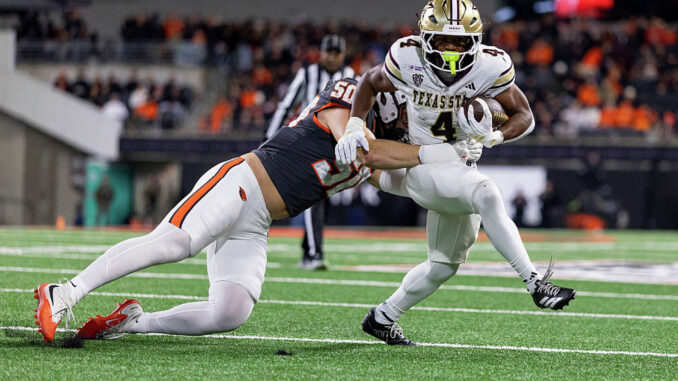
Because whatever showed up at Reser Stadium on Saturday night looked nothing like that team. Texas State walked into Corvallis and handed Oregon State a 42-21 loss that somehow felt worse than the final score.
The Bobcats ran for 386 yards, finished with 600 yards of total offense, and spent most of the evening treating the Beavers’ defense like an optional obstacle. Oregon State, meanwhile, managed 347 total yards, couldn’t establish much of a running game, and watched its previously explosive offense spend three quarters looking completely lost.
This wasn’t a case of a good team catching a few bad breaks. This was a team getting pushed around on its home field, and after last week’s disappointing loss to Fresno State, that’s becoming a pretty concerning trend.
The first warning sign came on Texas State’s opening possession. The Bobcats took the kickoff and marched 75 yards in 15 plays, chewing up nearly seven minutes before Davian Jackson scored from two yards out.
It wasn’t particularly flashy, which somehow made it worse. Texas State simply lined up, moved the football, and kept moving the football.
That’s the sort of opening drive that tells you an awful lot about how the rest of the evening might go. Unfortunately for Oregon State, the answer wasn’t encouraging.
The Bobcats added another touchdown later in the first quarter, with Torrance Burgess Jr. finishing a 47-yard drive with a short scoring run. Suddenly, Oregon State was trailing 14-0, and the home crowd was watching a team that looked completely unprepared for the physical challenge in front of it.
AJ Newberry finally gave the Beavers something to celebrate with a nine-yard touchdown run late in the quarter, cutting the deficit to 14-7. For a moment, it looked like Oregon State might settle down, but that moment didn’t last particularly long.
Texas State added another touchdown in the second quarter, taking a 21-7 lead into halftime. Oregon State’s offense, which had spent much of October making 300-yard passing performances look routine, couldn’t find any rhythm.
The Beavers were getting beaten at the line of scrimmage, struggling to create rushing lanes, and failing to sustain drives. And the defense wasn’t helping matters, as Texas State continued to run the football with alarming success.
The Bobcats weren’t doing anything especially mysterious. They were winning blocks, finding open space, and making the Beavers tackle, which apparently was asking quite a bit.
Burgess finished with 196 rushing yards on 28 carries, while Davian Jackson added 107 yards and three touchdowns on just 10 attempts. Quarterback Brad Jackson contributed another 87 rushing yards while completing 16 of 20 passes for 214 yards.
Those three players alone combined for 390 individual rushing yards before accounting for Brad Jackson’s passing production. Texas State’s official team rushing total was 386 after team adjustments, but the larger point remains pretty obvious.
Oregon State couldn’t stop anybody, and the numbers back that up. The Bobcats averaged more than seven yards per offensive play and converted 10 of 15 third-down opportunities.
They controlled possession for nearly 36 minutes and consistently found ways to keep the Beavers’ defense on the field. When an opponent converts two-thirds of its third downs, that’s not simply a bad night. That’s a fundamental problem.
And here’s what makes it particularly frustrating. Oregon State had already seen warning signs against Washington State and Fresno State.
The defense allowed 459 yards against the Cougars, then surrendered 38 points to the Bulldogs. Those performances should have provided plenty of motivation to clean things up, yet the Beavers somehow looked worse.
Head coach JaMarcus Shephard has done some impressive things during his first season in Corvallis. Turning an 0-2 start into five consecutive victories was no small accomplishment, and the offensive production during that stretch was genuinely exciting.
But Saturday was the kind of performance that puts a coaching staff under the microscope. Texas State wasn’t simply making a handful of explosive plays. The Bobcats were consistently winning at the point of attack, controlling the tempo, and forcing Oregon State to play from behind.
At some point, you have to make adjustments that actually change what’s happening. Those adjustments never arrived, and the third quarter was especially painful.
Oregon State entered halftime trailing by 14, which certainly wasn’t ideal but wasn’t impossible to overcome. This was still an offense that had scored 48 points against Washington State just a few weeks earlier, so a touchdown coming out of halftime could have changed the entire atmosphere.
Instead, the Beavers went scoreless in the third quarter while Texas State added another touchdown. The deficit grew to 28-7, and things were about to get even uglier.
The Bobcats scored twice more in the fourth quarter to make it 42-7. That’s a 35-point deficit at home against a Texas State team that entered the evening with a 4-4 record, which is difficult to explain away.
The Beavers eventually scored two late touchdowns, with Cornell Hatcher Jr. and Kourdey Glass finding the end zone. Those scores made the final margin look a little more respectable, but they didn’t change what happened during the first three quarters.
Texas State had already decided the game. Oregon State was simply making the scoreboard less embarrassing, and by that point, the passing game had become another major concern.
Atkinson entered Saturday having thrown for at least 300 yards in all eight games this season. He had broken Sean Mannion’s school record for consecutive 300-yard performances and established himself as one of the nation’s most productive quarterbacks.
Against Texas State, he completed 20 of 36 passes for 192 yards. That’s not necessarily a disastrous performance in isolation, but compared to what we’ve seen from Atkinson this season, it was a significant drop.
More importantly, the offense never looked comfortable. The Beavers finished with just 80 rushing yards, Newberry led the team with 41, and Oregon State struggled to create the offensive balance that had made it so dangerous during the winning streak.
When opponents don’t have to respect your running game, everything becomes more difficult. Defensive backs can concentrate on receivers, pass rushers can attack more aggressively, and quarterbacks start finding themselves in situations where every completion feels like a small victory.
That’s a far cry from the offense that was piling up 500 and 600 yards earlier this season. And while Jesse Legree provided one of the few encouraging performances with eight catches for 99 yards, there’s only so much one player can do.
Legree is still an outstanding young receiver, and his production remains one of the best stories of Oregon State’s season. But he can’t block for the running backs, protect Atkinson, or tackle Burgess when Texas State’s offensive line opens another enormous hole.
The Beavers need more help from everyone around him, and that brings us to what bothers me most about this loss. It isn’t simply the score. It’s the direction Oregon State appears to be heading.
Two weeks ago, the Beavers were 5-2, undefeated in conference play, and playing with the kind of confidence that makes college football so entertaining. Now they’re 5-4, sitting at 3-2 in the Pac-12, and coming off consecutive losses in which they’ve been outscored 80-43.
That’s not exactly the momentum you want heading into the final stretch of the season. And the schedule isn’t about to offer much sympathy, with Oregon State traveling to face Boise State next Saturday, November 14.
The Broncos have been one of the conference’s stronger teams, and a road game in Boise isn’t where you want to discover whether your defensive problems have magically disappeared. The Beavers will need to find some answers before then, starting with a defensive front that has to win more individual battles.
Oregon State can’t continue allowing opponents to establish the running game whenever they feel like it. The offense also needs to rediscover some balance, because Atkinson and Legree are talented, but asking them to carry the entire operation every Saturday isn’t a sustainable strategy.
And finally, Shephard and his staff need to figure out why this team has looked so different over the past two weeks. It’s one thing to lose a competitive game because the opponent makes a few more plays. It’s another thing to get thoroughly outplayed at home by a team that entered the evening with an even record.
The five-game winning streak showed what Oregon State is capable of accomplishing when everything clicks. Saturday showed what happens when almost nothing does, and I’m not ready to write off this season just yet.
There’s still time to recover, and the Beavers have enough offensive talent to make things interesting. But the margin for error is disappearing, and Oregon State doesn’t need another offensive record or another impressive statistical milestone.
It needs to remember how to win football games. Because right now, the Beavers look a lot more like the team that started 0-2 than the one that won five straight, and that’s a pretty troubling development.


Be the first to comment