
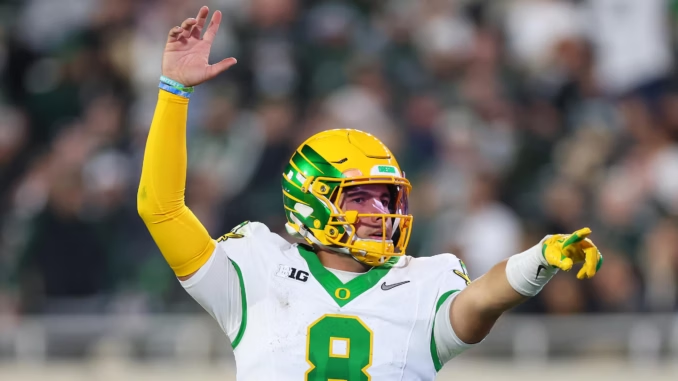
For a while Friday night, Oregon looked like a team that had forgotten it was supposed to be fighting for a College Football Playoff spot. The Ducks had seven points, their offense was going nowhere, and Michigan State was hanging around despite having no business making this a competitive game.
Then Oregon’s kicker scored a touchdown. Yes, the kicker, because apparently, when your offense isn’t doing much, the logical solution is to let the guy who kicks field goals run one into the end zone.
That was the turning point in Oregon’s 45-7 victory over Michigan State, a game that started with some familiar frustrations before turning into another impressive November performance. The No. 13 Ducks improved to 8-3 overall and 6-2 in Big Ten play, winning their fourth consecutive game and keeping their playoff hopes alive.
Oregon finished with 422 total yards, held Michigan State to 200, and outscored the Spartans 28-7 after halftime. It wasn’t a flawless performance, but it was exactly the kind of result the Ducks needed heading into their regular-season finale against Washington.
And while the final score suggests Oregon dominated from beginning to end, there were a few things worth discussing. Here are three takeaways from Friday’s convincing victory.
1. Oregon’s Running Back Depth Might Be Its Most Valuable Asset
At some point, Oregon is going to run out of running backs, right? Apparently not, although the Ducks certainly seem determined to test that theory.
Oregon entered Friday dealing with injuries at the position, and things got worse when Dierre Hill Jr. limped off the field during the opening possession. Hill didn’t return, leaving the coaching staff searching for another solution.
Fortunately, Brandon Smith was ready. The freshman carried 14 times for 121 yards and two touchdowns, delivering the kind of performance that makes you wonder how many other talented players Oregon has sitting on its bench.
Smith scored Oregon’s first touchdown on a five-yard run, then added another from one yard out in the third quarter. His ability to find running lanes and turn modest opportunities into meaningful gains helped Oregon establish control after a frustrating first half.
But Smith wasn’t the only freshman making an impression. Simeon Price scored two touchdowns on just six carries, including one on his first rushing attempt in an Oregon uniform. Da’Jaun Riggs added 42 yards on nine attempts, giving the Ducks another dependable option.
Oregon finished with 188 rushing yards and four touchdowns on the ground. That’s a pretty impressive response considering the injuries and uncertainty surrounding the backfield.
And here’s why it matters. Oregon has spent much of this season relying on Dylan Raiola to generate explosive plays through the air. When the passing game works, the Ducks can look nearly unstoppable. When it doesn’t, things have occasionally gotten ugly.
Friday provided another reminder of how valuable a productive running game can be. Raiola struggled with pressure during the first half, and Oregon’s offense couldn’t find much rhythm.
The Ducks managed zero yards in the second quarter before finally getting things moving late in the half. That’s not a typo, and it’s certainly not something Oregon wants to repeat against Washington.
But once Oregon established its running game after halftime, everything became easier. The offensive line created better opportunities, Raiola had more time, and Michigan State couldn’t concentrate entirely on stopping the passing attack.
The biggest question now is Hill’s health. Dan Lanning indicated afterward that he didn’t expect Hill’s injury to be a long-term issue, which is encouraging. But with Washington coming to Eugene next weekend, Oregon needs as many healthy options as possible.
Smith and Price proved they can contribute when called upon, and that’s a big deal for a team hoping to extend its season into December. And if Oregon somehow finds another freshman running back capable of scoring twice next week, perhaps somebody should investigate what they’re putting in the water down in Eugene.
2. Oregon’s Defense Is Playing Its Best Football At Exactly The Right Time
Michigan State’s offense wasn’t particularly intimidating entering Friday, so let’s not pretend Oregon just shut down the 2007 New England Patriots. Still, holding a Big Ten opponent to 200 total yards and seven points on the road deserves recognition.
The Spartans managed just 80 rushing yards and 120 passing yards. They recorded 13 first downs, struggled to sustain drives, and rarely threatened Oregon’s defense.
Michigan State’s only touchdown came in the third quarter on a one-yard run by Jaziun Patterson. That drive received considerable help from three Oregon penalties, making the scoring opportunity as much about the Ducks hurting themselves as the Spartans finding an offensive rhythm.
Outside of that possession, Michigan State accomplished very little. Gavin Nix led Oregon with eight tackles, while A’Mauri Washington added seven. Matayo Uiagalelei also came up with an interception in the second half, giving the Ducks another opportunity to extend their lead.
And that’s becoming a familiar story. Oregon has now held consecutive opponents to seven points. Michigan managed just one touchdown last weekend, and Michigan State couldn’t do much better.
The Ducks have allowed only 14 points over their last two games, which is particularly encouraging considering the injuries they’ve dealt with defensively. There’s something else I like about this group, too.
Oregon isn’t relying on one defensive superstar to carry everyone else. Different players are contributing, and the coaching staff has managed to maintain a consistent level of performance despite losing important pieces.
That doesn’t mean everything is perfect. Oregon committed penalties that helped Michigan State put together its lone touchdown drive. Those mistakes are frustrating because they’re avoidable, and they could become considerably more expensive against stronger opponents.
Lanning acknowledged afterward that the penalties weren’t good enough, and he’s right. The Ducks were penalized for 75 yards Friday, and that kind of sloppiness can turn a comfortable victory into an unnecessarily stressful afternoon.
Against Michigan State, Oregon could afford those mistakes. Against a playoff-caliber opponent, probably not, especially if the offense starts slowly again.
Still, the defense deserves credit for how well it’s playing. Four consecutive victories don’t happen without contributions on both sides of the football.
Oregon’s offense receives most of the attention because of Raiola and its explosive receivers, but the defense has quietly become one of the biggest reasons this team is back in the postseason conversation. And with Washington coming to Autzen Stadium next Saturday, Oregon will need another strong performance.
3. Oregon’s Playoff Hopes Are Alive, But The Ducks Still Need Help
Here’s something that seemed pretty unlikely a month ago. Oregon is entering the final week of the regular season with a legitimate chance to make the College Football Playoff.
The Ducks have won four consecutive games, including victories over Ohio State and Michigan, and they’re playing considerably better football than they were during their October struggles. But here’s the problem: Three losses are still three losses.
Oregon entered Friday ranked No. 13 in the College Football Playoff standings, meaning the Ducks were outside the projected 12-team field. Beating a 3-7 Michigan State team isn’t going to suddenly convince the committee that Oregon belongs among the nation’s elite.
A 38-point victory certainly helps the overall impression, but the quality of the opponent matters. And that’s why Oregon’s remaining schedule is so important.
The Ducks host Washington on November 28, giving them one final opportunity to improve their record and strengthen their postseason argument. At 9-3, Oregon would have an interesting case.
The Ducks would own a road victory over Ohio State, a convincing win over Michigan, and a five-game winning streak to finish the regular season. Those are meaningful accomplishments, especially considering how poorly things looked following the losses to UCLA and Illinois.
But Oregon would also have three defeats, including some performances that exposed significant problems with its offense. The committee will have to weigh both sides.
And even if Oregon beats Washington, the Ducks will probably need help from teams ahead of them in the rankings. That’s the frustrating part of being on the playoff bubble. You can take care of everything within your control and still find yourself watching other games, hoping somebody loses.
Fortunately, Oregon has given itself a reason to care about those results. A month ago, this team looked lost. The offense couldn’t consistently move the ball, Raiola was struggling, and the Ducks seemed headed toward a disappointing finish.
Now Oregon has won four straight, its defense is limiting opponents to single digits, and its young running backs are stepping up when injuries threaten to derail the offense. That’s a pretty remarkable turnaround, although I still have one concern.
Oregon has developed a habit of starting slowly, and Friday was another example. The Ducks led just 7-0 for much of the first half before a muffed Michigan State punt helped set up a field goal.
Then came the play that changed everything. Facing a fourth down late in the second quarter, Oregon lined up for what appeared to be a routine field goal. Instead, Gage Hurych took off running and scored from 15 yards out.
A kicker scoring a rushing touchdown is unusual enough. Doing it in a game with playoff implications makes it even better.
The fake field goal gave Oregon a 17-0 halftime lead and completely changed the momentum. The Ducks followed with 28 second-half points, turning what had been a frustrating evening into a comfortable victory.
But what happens when Oregon faces a better opponent and can’t rely on a trick play to wake everyone up? That’s something Lanning and his staff need to address.
The Ducks can’t afford another sluggish start against Washington, particularly with their postseason hopes hanging in the balance. And if Oregon does make the playoff, those slow starts could become even more dangerous.
The encouraging part is that Oregon continues finding ways to win. Sometimes it’s Raiola throwing deep touchdown passes. Sometimes it’s the defense shutting down an opponent. And sometimes it’s a freshman running back stepping into a bigger role because somebody else got hurt.
Friday, it was a little bit of everything. The Ducks have one regular-season game remaining, and the stakes couldn’t be much higher.
Beat Washington, finish 9-3, and give the selection committee something to think about. Lose, and the playoff conversation probably ends right there.
After everything this team has been through, Oregon has managed to make the final week of the regular season meaningful. That’s more than most people expected a month ago.
And if the Ducks need another unexpected touchdown next Saturday, I’m sure Hurych would be happy to help. He apparently has more than one way to put points on the board.


Be the first to comment