
Well, that was a pretty lousy way to spend Halloween.
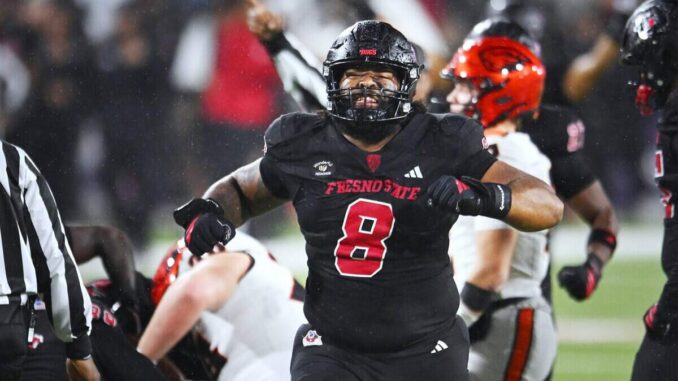
After five straight wins and an offense that seemed capable of scoring whenever it felt like it, Oregon State finally ran into a team that wasn’t particularly interested in participating in the Braden Atkinson highlight show. Fresno State handed the Beavers a 38-22 loss Saturday night, and the frustrating part wasn’t necessarily that Oregon State lost. It was how the Beavers managed to lose.
Oregon State finished with 450 yards of offense. Fresno State had 392. The Beavers ran 87 plays compared to the Bulldogs’ 56 and picked up 25 first downs to Fresno State’s 15. If you looked at those numbers without knowing the final score, you’d probably assume Oregon State had another comfortable victory.
Instead, the Beavers lost by 16 points. That’s quite a trick.
The biggest difference was pretty simple. Fresno State made its opportunities count, and Oregon State spent much of the evening finding creative ways to waste its own.
The warning signs appeared almost immediately. Oregon State intercepted Fresno State quarterback Jayden Mandal on the Bulldogs’ opening possession, setting up the offense with excellent field position. That’s exactly how you want to start a road game, especially when you’ve had two weeks to prepare.
The Beavers moved inside the Fresno State 5-yard line and came away with absolutely nothing. A failed fourth-down attempt ended the drive, and the Bulldogs escaped without allowing a point.
I don’t necessarily have a problem with the decision to go for it. Oregon State has been aggressive offensively, and that confidence has helped fuel its winning streak. But there’s a difference between trusting your offense and assuming every possession will eventually work out.
Saturday was a reminder that sometimes taking the points isn’t such a terrible idea.
Caleb Ojeda eventually put Oregon State ahead with a 54-yard field goal, but Fresno State responded with a 75-yard touchdown drive. Mandal finished it with a 15-yard scoring run, and suddenly the Beavers were playing from behind.
That hadn’t happened in quite a while.
The second quarter wasn’t much better. Oregon State put together two lengthy scoring drives, one covering 65 yards and another going 64. Both ended with Ojeda field goals.
Meanwhile, Fresno State needed just 45 seconds to answer the first one. Bryson Donelson broke loose for a 63-yard touchdown run, turning what had been a one-point game into a 14-6 deficit.
That’s the sort of play that makes defensive coordinators reconsider their career choices.
The Bulldogs added another touchdown before halftime when Mandal connected with Josiah Freeman from 26 yards out. Oregon State had another opportunity to respond, but a fumble ended its final meaningful possession of the half.
Fresno State led 21-9 at the break, and the Beavers had nobody to blame but themselves.
What bothered me most wasn’t that Oregon State couldn’t move the football. The Beavers moved it plenty. They just couldn’t finish anything.
And when you’re settling for field goals while the other team is scoring touchdowns, the math gets ugly pretty quickly.
The third quarter made sure of that.
Fresno State opened the second half by adding another field goal. Then, after forcing an Oregon State punt, the Bulldogs recovered a Beavers fumble on the next Oregon State possession and took over at the 19-yard line.
Mandal eventually scored from three yards out, and the deficit ballooned to 31-9.
At that point, the comeback was going to require something pretty special. Unfortunately, Oregon State had already used up most of its special moments during the previous five games.
Cornell Hatcher Jr. provided a little hope with a five-yard touchdown run, cutting the deficit to 31-16. But Fresno State immediately answered with another touchdown, this time on a 31-yard pass from Mandal to Freeman.
Just like that, the Bulldogs were back ahead by 22.
Oregon State finally scored another touchdown with 1:45 remaining when Atkinson connected with Eric Olsen from nine yards out. By then, the outcome had been decided.
There were some encouraging individual performances, although I’m guessing nobody in the Beavers’ locker room was particularly interested in celebrating personal achievements afterward.
Atkinson completed 33 of 59 passes for 373 yards and a touchdown. That marked his eighth consecutive 300-yard passing game, breaking Sean Mannion’s school record of seven straight.
That’s impressive, regardless of the final score.
But those numbers also demonstrate why statistics don’t always tell the entire story. Atkinson attempted 59 passes, completed fewer than 56 percent of them, and was sacked five times. Fresno State had allowed him to throw the football, but it made him work considerably harder than he had during the winning streak.
For the first time in weeks, Oregon State’s offense looked uncomfortable.
The running game didn’t provide much relief. The Beavers finished with just 77 rushing yards on 28 attempts, an average of 2.8 yards per carry. Hatcher led the team with 53 yards on nine attempts, while AJ Newberry managed 34 yards on seven carries.
When you’re throwing nearly 60 times and struggling to establish anything on the ground, opposing defenses can start making your life miserable.
Fresno State certainly did.
There was one especially encouraging performance from DeCorion Temple, who caught six passes for a career-high 97 yards. That was the most receiving yardage by an Oregon State tight end since Connor Hamlett recorded 119 against Arizona State in 2013.
Olsen added seven catches for 71 yards and a touchdown, giving Atkinson a couple of reliable options when Fresno State concentrated on limiting the bigger threats.
And speaking of bigger threats, Jesse Legree finally looked somewhat human.
The freshman receiver finished with seven catches for 70 yards, ending his remarkable streak of seven consecutive 100-yard receiving performances. He also failed to score a touchdown for the first time this season.
I’m not particularly concerned about Legree. He’s been incredible, and expecting a freshman to produce 150 yards and multiple touchdowns every Saturday is probably a little unreasonable.
What concerns me is what happens when opposing defenses manage to contain him.
Oregon State needs more offensive balance. Saturday showed why.
The defensive performance wasn’t much better.
Fresno State rushed for 190 yards and averaged seven yards per offensive play. Mandal completed 11 of 17 passes for 202 yards and two touchdowns while adding two rushing scores. Donelson finished with 108 rushing yards, including that enormous 63-yard touchdown.
The Bulldogs didn’t need 80 offensive plays to put up 38 points. They needed just 56.
That’s a problem.
Oregon State’s defense had shown improvement during the winning streak, but there were warning signs against Washington State two weeks earlier. The Beavers allowed 459 yards and 30 points in that game, although the offense scored enough to make those mistakes relatively harmless.
Saturday, the offense couldn’t cover for the defense.
That’s what makes this loss particularly frustrating.
Head coach JaMarcus Shephard deserves plenty of credit for turning Oregon State’s season around after an 0-2 start. Five consecutive victories don’t happen by accident, and the Beavers have demonstrated considerable improvement since September.
But this game exposed some weaknesses that were easier to overlook when Oregon State was scoring 48, 56, or 66 points.
The offensive line struggled with Fresno State’s pressure. The running game never established itself. The defense surrendered too many explosive plays. And the offense repeatedly failed to convert promising possessions into touchdowns.
You can survive one or two of those problems.
All four? Good luck.
The coaching staff also deserves some scrutiny for the team’s inability to adjust. Fresno State consistently pressured Atkinson, yet Oregon State never found a reliable way to make the Bulldogs pay for it. The Beavers kept moving the football between the 20-yard lines, but that doesn’t mean much when the scoreboard isn’t moving with it.
And the defensive approach clearly wasn’t working against Mandal and the Fresno State rushing attack.
I’m not suggesting Shephard needs to reinvent everything. That would be ridiculous after five straight wins. But this was the kind of game where you wanted to see Oregon State make adjustments that changed the direction of the afternoon.
Those adjustments never really materialized.
The good news is the Beavers are still 5-3 overall and 3-1 in Pac-12 play. Their season is far from over, and there’s plenty of football left to play.
Oregon State returns home next Saturday to face Texas State, which should provide an opportunity to regroup.
But I wouldn’t dismiss this loss as simply one bad night.
For five weeks, Oregon State looked like a team that could overcome almost anything with its offense. Saturday proved that isn’t necessarily true.
The Beavers are still dangerous. Atkinson is still one of the conference’s most productive quarterbacks, Legree remains a nightmare for opposing secondaries, and this team has enough offensive talent to beat plenty of opponents.
But there’s a difference between being capable of scoring 50 points and being capable of winning when you can’t.
Fresno State exposed that difference Saturday night.
Now we’ll find out whether Oregon State learned anything from it.


Be the first to comment