
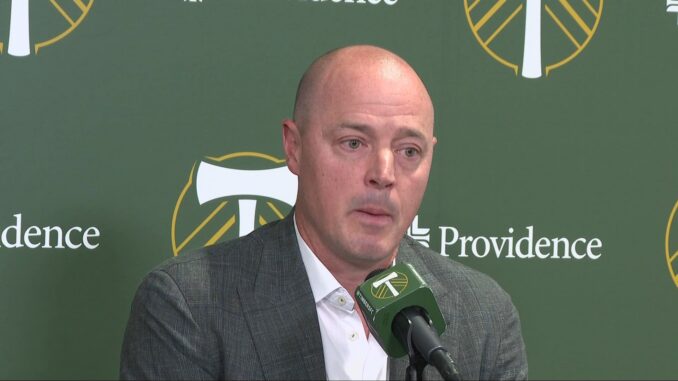
Merritt Paulson has certainly had his share of complicated moments during his time in Portland sports. But this week, the Portland Timbers owner said something about the Trail Blazers that deserved attention and, more importantly, some credit.
As uncertainty continues to surround the Blazers, the Moda Center renovation and the relationship between new owner Tom Dundon and local government, Paulson offered a remarkably simple message: “The Blazers can’t move.” He followed that by calling the franchise “massively critical to the culture and the economic vitality” of Portland.
The more interesting part, though, came when Paulson talked about what it actually means to own a professional sports team.
“When you buy a team, you’re not just investing in a league, you’re not just investing in a franchise, you’re investing in the city,” Paulson said. “You’re investing in a community, and that’s essential.”
That was the part worth hearing.
Professional sports teams are businesses, of course. Owners spend billions to buy them, cities negotiate arena deals, and politicians debate how much public money should be involved. But teams like the Trail Blazers also carry decades of history that can’t simply be separated from the place they represent.
The Blazers have played in Portland since 1970. Generations of fans have grown up with them, from the 1977 championship team to the Clyde Drexler era, Brandon Roy, LaMarcus Aldridge and Damian Lillard. For many people in Oregon, the franchise has been part of their family history for decades.
Paulson’s comments stood out because he understands the other side of this relationship better than most. Providence Park is owned by the City of Portland, and the Timbers have spent years working within a public-private arrangement involving stadium improvements and investment. Paulson said roughly $145 million in private money has gone into Providence Park over the years.
That doesn’t make the Timbers’ situation identical to the Blazers’, but it does give Paulson some credibility when he talks about the relationship between a team, an owner and a city.
He also didn’t use the moment simply to praise Portland. Paulson called the current situation a “wake-up call” for the city, county and state and said the region needs to become a better place for businesses to operate.
That was an important distinction.
His message wasn’t that Portland is perfect, or that the city should hand the Blazers whatever they want. It was that the franchise is worth fighting for while Portland also takes a serious look at the issues that make major investment more difficult.
That’s a far more useful conversation than treating this as an all-or-nothing fight between local government and a billionaire owner.
Paulson also deserves credit for saying any of this publicly. He could have stayed out of the Blazers debate entirely. He could have compared the public money being discussed for Moda Center with the Timbers’ investment at Providence Park and turned the whole thing into a complaint about fairness.
Instead, he talked about responsibility.
That’s especially notable considering Paulson’s own complicated history with Portland fans. His tenure hasn’t been free of controversy, and one interview doesn’t erase any of that. But someone can have a messy record and still make a good point.
This was a good point.
Tom Dundon didn’t just buy an NBA team. He bought the Portland Trail Blazers, a franchise with more than half a century of history in one city and an identity deeply tied to Oregon.
That doesn’t mean Portland should give Dundon a blank check, and it doesn’t mean every demand from the Blazers should be accepted. Public officials should negotiate hard, especially when taxpayer money is involved.
But Paulson’s broader point is one Dundon should keep in mind throughout those negotiations. Owning a sports franchise carries responsibilities that go beyond maximizing its financial value.
Sometimes another owner has to be the one to say it.