
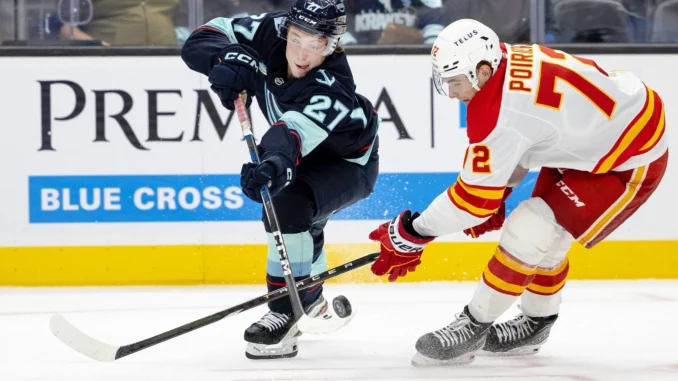
With the Seattle Kraken not playing until Thursday, it’s an opportune time to reflect upon the welcome surprise that has been Berkly Catton’s start to the season, with the blossoming young talent flashing the skill necessary to be the team’s long-awaited star up front.
Catton’s rapid – but not entirely unexpected – ascent up the Kraken forward hierarchy has altered the franchise’s trajectory for this season and beyond. Let’s dive in.
Catton’s Production Leading Kraken
In my preseason predictions column, the 20-year-old forward was my pick to enjoy a breakthrough effort in his sophomore campaign, and he’s already staked his claim as the franchise’s jet-setter despite only having 82 career NHL games to his name.
The eighth-overall pick in 2024 posted a combined 49 goals and 151 points over his final 77 regular-season and playoff games in junior, showing off the raw skill which made him a coveted prospect in the first place. Catton then tallied 17 points in 66 games during his rookie season last year while learning the ropes, but he’s since shattered any preseason expectations.
Through the Kraken’s first 16 games this season, Catton is currently tied for third on the team in goals (five) and assists (nine), is tied for second in plus-minus rating (plus-5), and paces all skaters in points (14).
Related: 5 Takeaways From The Seattle Kraken’s Surprising October Start
Catton has delivered that level of production despite ranking ninth among Kraken forwards in average ice time (ATOI) at five-on-five, fifth in powerplay ATOI, and ninth in all situations. Take a look at Catton’s per-60-minute production at five-on-five among qualified NHL forwards leaguewide (minimum 100 minutes played).
| Statistic | Catton | NHL Rank |
| Goals | 1.57 | 25th |
| Primary Assists | 1.89 | 4th |
| Total Assists | 2.2 | 11th |
| Points | 3.77 | 4th |
While his finishing is running a tad hot (his 26.3% shooting percentage is 16th among qualified forwards at five-on-five), Catton finds himself in rarified air nearly a quarter of the way into the season. The only forwards ahead of him in per-60-minute production at five-on-five? Nathan MacKinnon, Seth Jarvis, and Connor McDavid. How’s that for good company?
Catton’s Elite Skating a Key Factor in Offensive Breakout
Most, if not all, of the NHL’s best players have one or more elite skills or abilities which set them apart from the pack. This could be an unstoppable shot, pinpoint passing and vision, or waterbug-like skating, but there needs to be something to make them unique. Catton falls into the latter category, where his agility and blistering skating speed has allowed him to be one of the league’s fastest and most dangerous puck-carriers in Year Two.
According to the NHL’s EDGE tracking data, Catton sits in a tier littered with some of the league’s most-decorated names. EDGE tracks and denotes skating speed bursts as “the number of times a skater achieved a sustained speed above a given threshold” and places each player in a certain percentile. By max skating speed, bursts between 18-20 miles per hour (MPH), 20-22 MPH, and 22+ MPH, Catton is no lower than the 96th percentile among all NHL forwards, which is increasingly necessary because of his modest frame (5-foot-11 and 179 pounds).
Catton has leveraged his most important trait into being among the league leaders in controlled offensive zone entries (i.e. with possession of the puck) and zone entries leading to scoring chances, showing he knows what to do with the puck once he gets into dangerous areas.
Not to pile onto former Kraken forward Shane Wright, but skating acts almost as a get-out-of-jail-free card and is a skill at which he was only slightly above-average. He is and was by no means slow or plodding, but Catton occupies the highest rung of the proverbial ladder and can zoom into the offensive zone and explode out of trouble when needed.
Related: Seattle Kraken’s November 2026 Schedule Could Shake Up Pacific Division
It’s a young man’s league now more than ever, and speed helps keep the opposition on its toes. Of course, speed is just one variable. Hart Trophy candidates such as Connor McDavid pair elite speed and skating with outrageous hand-eye coordination and unimpeachable body control, but Catton has the foundation needed to finally give the Kraken the game-breaking talent the organization has been desperately searching for since day one.
Catton Already Making Case for Bigger Role
If Catton’s offensive production wasn’t enough to grant him more playing time, his two-way prowess should push head coach Lane Lambert into the decision.
Catton ranks first among regular Kraken forwards (minimum 50 minutes played) in the share of shots, scoring chances, high-danger chances, and expected goals the Kraken account for when he’s on the ice. Sure, easier opposition and favorable offensive zone start deployment make things easier for him, but why not see if the success will translate up the lineup?
The Kraken don’t exactly have much to lose and stand to gain the unleashing of a singular offensive talent unlike they’ve ever had as an organization. Alright, maybe the hyperbole is a bit much, but there’s no one with more promise currently under team control. As Catton goes, so do the Kraken and right now, they’re only going up.
Data courtesy of Hockey Stats, MoneyPuck, Natural Stat Trick, and the NHL.




Be the first to comment