
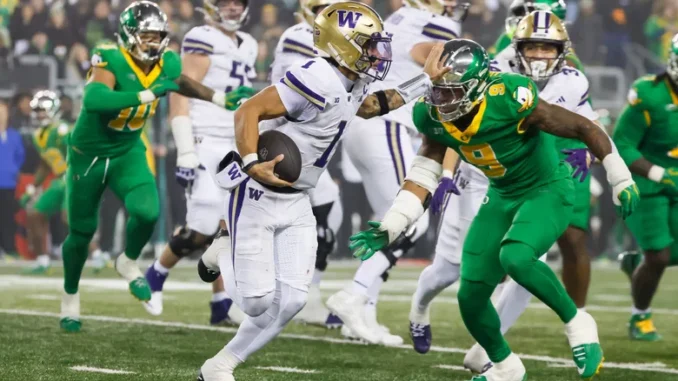
Of all the ways Oregon’s regular season could have ended, this one might hurt the most. Losing to Washington is bad enough, but doing it at Autzen Stadium with a potential Big Ten Championship Game appearance and College Football Playoff berth on the line makes it considerably worse.
The No. 12 Ducks fell 33-27 in double overtime to the No. 24 Huskies on Saturday night, finishing the regular season at 8-4 overall and 6-3 in Big Ten play. Oregon’s four-game winning streak is over, its conference championship hopes are officially gone, and its playoff chances are practically nonexistent.
What makes this loss particularly frustrating is that Oregon had multiple opportunities to win. The Ducks erased a 14-point fourth-quarter deficit, had a chance to take the lead with just over a minute remaining, and received another opportunity when Washington missed a field goal in overtime.
Yet here we are, talking about bowl destinations instead of championship scenarios. Here are my three biggest takeaways from a miserable Saturday night in Eugene.
1. Oregon’s Offensive Inconsistency Finally Caught Up With It
Remember last week against Michigan State when Oregon’s offense struggled throughout much of the first half before eventually turning the game into a blowout? I wondered what would happen if the Ducks started similarly against a better opponent.
Well, there’s our answer. Unfortunately, Washington was more than happy to provide it.
Oregon scored just six points in the first half Saturday, settling for a pair of Gage Hurych field goals. The Ducks entered halftime trailing 13-6 and didn’t score their first touchdown until the third quarter.
The offensive numbers weren’t particularly encouraging, either. Oregon finished with 320 total yards, including just 96 on the ground, and converted four of its 14 third-down opportunities.
That last statistic bothers me more than anything. It’s difficult to establish offensive momentum when you’re constantly sending your punter onto the field, especially against a quarterback as dangerous as Demond Williams Jr.
Dylan Raiola and the Oregon offense deserve credit for battling back in the fourth quarter. Brandon Smith’s 20-yard touchdown run helped spark the comeback, and the trick play involving tight ends Jamari Johnson and Kendre Harrison produced the tying touchdown with 1:09 remaining.
It was a terrific play call, but it also highlighted something that’s bothered me throughout the season. Why does Oregon seem to need something unconventional to get its offense moving when things aren’t going well?
Last week, it was a fake field goal against Michigan State. This week, it was a tight end throwing a touchdown pass to another tight end.
I appreciate the creativity, and I’m certainly not complaining about either touchdown. But with the talent Oregon has assembled, its offense shouldn’t have this much trouble consistently moving the football.
The Ducks gained nothing on their first overtime possession and couldn’t reach the end zone in the second. When the game came down to Oregon’s offense needing to deliver, it simply couldn’t.
That’s going to be one of the biggest questions facing Dan Lanning and his coaching staff this offseason. How does an offense with this much talent spend so much time looking ordinary?
2. Don’t Put This Loss Entirely On Gage Hurych
I’m sure plenty of Oregon fans went to bed Saturday night thinking about that missed extra point. Some probably didn’t sleep much at all.
Hurych had a chance to give Oregon its first lead of the game after Harrison’s late touchdown, but his extra-point attempt struck the upright. Washington couldn’t score on its final possession of regulation, sending the game into overtime.
Then, in the first overtime, Washington’s Drew Azzopardi blocked Hurych’s 42-yard field goal attempt. The Huskies missed their own field goal, giving Oregon another chance before Washington eventually prevailed.
Those are two enormous special teams plays that went against Oregon. There’s no getting around their significance, and the missed extra point will understandably haunt Ducks fans for a while.
But blaming Hurych for this loss ignores everything that happened during the previous 59 minutes. Oregon’s defense surrendered too many opportunities, and its offense spent much of the evening struggling to sustain drives.
Williams completed 28 of 39 passes for 270 yards and three touchdowns without throwing an interception. He added another touchdown on the ground, while receiver Chris Lawson finished with 147 receiving yards and a score.
Oregon actually sacked Williams six times, which makes his overall performance even more impressive. Despite the pressure, he consistently found ways to keep Washington’s offense moving.
The Huskies converted nine of 18 third downs and possessed the football for more than 35 minutes. Oregon’s defense simply couldn’t get off the field often enough, and several costly penalties made its job even harder.
Williams’ 22-yard scramble to open the second overtime was particularly frustrating. Oregon knew exactly how dangerous he was outside the pocket, yet he still managed to put Washington in excellent scoring position before connecting with Decker DeGraaf for the winning touchdown.
Oregon’s defense had been outstanding in recent weeks, allowing just seven points apiece against Michigan and Michigan State. Saturday was a reminder that those performances didn’t necessarily mean all of the unit’s problems had been solved.
Hurych will receive plenty of criticism, and that’s unfortunately part of being a college football kicker. But Oregon had more than enough opportunities to ensure the game never came down to his right foot.
This was a team loss, and there should be plenty of accountability to go around.
3. An 8-4 Season Is A Disappointment, And It’s OK To Say That
I don’t want to hear about how plenty of college football programs would love to finish a season with eight victories. Of course they would, but we’re not talking about plenty of college football programs.
We’re talking about Oregon, a program that has invested heavily in recruiting, facilities, coaching and assembling a roster capable of competing for national championships. The expectations are different now, and they should be.
Entering Saturday, the Ducks still had an opportunity to salvage a season that had gone sideways in October. Four consecutive victories had brought Oregon back into the playoff conversation, and a win over Washington would have given the Ducks a chance to compete for the Big Ten championship.
USC’s convincing 45-10 victory over UCLA earlier Saturday had made the conference championship picture even more interesting for Oregon. Instead, Indiana and UCLA will play for the title while the Ducks watch from home.
That’s a difficult outcome to accept considering how close Oregon came to extending its championship pursuit. But when you look at the season as a whole, the Ducks have nobody to blame but themselves.
The offensive inconsistency, penalties, slow starts and inability to capitalize on opportunities weren’t problems that suddenly appeared against Washington. They’ve been recurring issues throughout the season.
Oregon’s four-game winning streak was encouraging, and Lanning deserves credit for keeping the team together when things could have completely unraveled. There were moments over the past month when the Ducks looked like a team nobody would want to face in the postseason.
But championship-caliber teams have to deliver when the stakes are highest. Oregon had that opportunity Saturday night, at home, against its biggest rival, and couldn’t get it done.
That’s what separates a promising team from a championship team. Having talented players and an impressive recruiting class only gets you so far.
The Ducks will now await their bowl assignment, and there will still be an opportunity to finish the season with nine victories. I’ll certainly be watching, although it won’t carry nearly the same excitement as a playoff game or conference championship.
I’m not suggesting Oregon needs to make sweeping changes or that Lanning suddenly forgot how to coach football. But this offseason needs to involve some uncomfortable conversations about why a roster with this much talent lost four regular-season games.
Oregon fans have every right to expect more. And I suspect nobody in that football facility is particularly satisfied with eight wins, either.
The worst part of Saturday’s loss isn’t necessarily that Oregon won’t be competing for a national championship. It’s that the Ducks fought their way back into contention, gave themselves a legitimate opportunity, and then watched their biggest rival take it all away.
It’s going to be a long offseason in Eugene. And something tells me that missed extra point is going to appear in a few nightmares between now and September.

Be the first to comment