
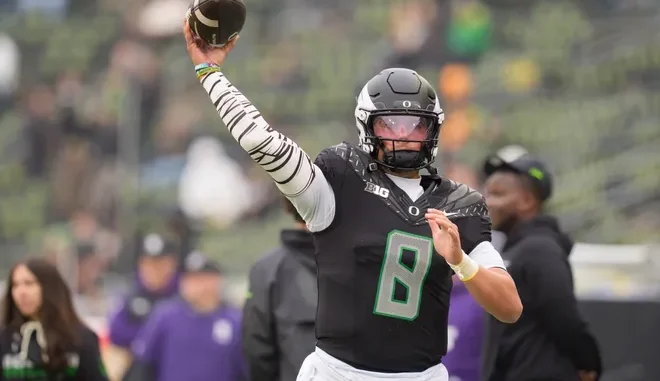
For the first time in several weeks, watching Oregon’s offense didn’t feel like an exercise in patience. There were actual touchdowns, big passing plays, and even a few moments when the Ducks looked like the team everyone expected to see when the season began.
Of course, this being the 2026 Oregon Ducks, nothing could come easily. Northwestern jumped out to a 20-6 lead, Oregon lost two of its top running backs to injuries, and the defense spent much of the first half chasing quarterback Aidan Chiles around Autzen Stadium. Somehow, the Ducks turned that mess into a 34-26 victory over the 20th-ranked Wildcats on Halloween afternoon.
The win doesn’t erase Oregon’s three losses or magically put the Ducks back into the national championship conversation. But after the offensive disasters against UCLA and Illinois, it was encouraging to see this team respond when things started going sideways.
Here are three takeaways from Oregon’s fifth victory of the season.
1. Dylan Raiola Finally Looked Like the Quarterback Oregon Needs
Remember when Oregon fans were debating whether Dylan Raiola should even be starting? That conversation feels a little different after Saturday.
Raiola completed 22 of 31 passes for 336 yards and three touchdowns without throwing an interception. Those numbers would be impressive under normal circumstances, but considering how poorly Oregon’s offense has performed recently, they might as well have come from a different team.
The most encouraging part wasn’t necessarily the statistics. Raiola looked comfortable, made decisive throws, and demonstrated the kind of confidence that was missing during his disastrous performance against UCLA.
And he certainly picked the right moment to deliver his biggest play.
After Oregon finally grabbed a 27-23 lead early in the fourth quarter, Northwestern answered with a field goal to make it 27-26. The Wildcats had spent most of the afternoon controlling possession, and another long Oregon drive would have been perfectly acceptable.
Raiola apparently had other ideas.
On the very next offensive play, he connected with Dakorien Moore for a 75-yard touchdown. Eleven seconds after Northwestern pulled within one point, Oregon had an eight-point advantage. That’s the kind of explosive response Ducks fans have been waiting to see.
Moore finished with seven receptions for 128 yards and two touchdowns, including a 10-yard score just before halftime. Raiola also found tight end Jamari Johnson for a 17-yard touchdown in the third quarter, helping Oregon claw back from a 23-13 deficit.
The Ducks averaged 10.8 yards per passing attempt. That’s a significant improvement for an offense that had struggled to create much of anything downfield over the previous three games.
Now comes the difficult part.
With Dante Moore ruled out for the season, Raiola is no longer simply keeping the quarterback position warm until the starter returns. He’s the player Oregon needs to build its offense around for the remainder of the year.
One impressive performance doesn’t guarantee he’ll suddenly become an elite quarterback. Northwestern’s defense also had its share of breakdowns, and the Ducks still managed just 17 first downs.
But Saturday was the first time in a while that Oregon’s offense looked capable of putting genuine pressure on an opponent. Raiola deserves considerable credit for that, and the coaching staff should be looking for ways to build on what worked.
The days of wondering whether he can handle the job might not be completely over, but he certainly gave everyone a reason to feel better.
2. Brandon Smith Might Have Saved Oregon’s Afternoon
If you had Brandon Smith leading Oregon in rushing yards on your Halloween bingo card, congratulations. You probably also predicted the Ducks would need their fourth-string running back to score the game’s most important rushing touchdown.
Smith wasn’t supposed to be the featured attraction Saturday. Oregon entered the game expecting Jordon Davison and Dierre Hill Jr. to handle much of the rushing workload, but both were dealing with injuries by halftime.
That left the Ducks searching for answers at a position where they could hardly afford another setback.
Enter Smith, a freshman who apparently didn’t receive the memo about being buried on the depth chart.
Smith carried the ball eight times for 82 yards, averaging more than 10 yards per attempt. He also caught four passes for 32 yards, giving Oregon a productive option out of the backfield when its offense desperately needed one.
But his biggest contribution came early in the fourth quarter.
Trailing 23-20, Oregon faced fourth-and-goal from Northwestern’s two-yard line. Dan Lanning could have kicked a field goal to tie the game, especially considering how difficult touchdowns had been to find recently.
Instead, he went for it.
Smith took the handoff, powered into the end zone, and gave Oregon its first lead of the afternoon. It was exactly the kind of aggressive decision that has defined Lanning’s tenure, although those decisions haven’t always worked out quite so nicely.
The touchdown also highlighted something that hasn’t received enough attention. Oregon’s offensive line started the same five players for the first time this season, and the unit looked considerably more comfortable as the game progressed.
That matters, particularly with the quarterback situation still developing. An offense dealing with injuries at multiple positions needs some consistency somewhere, and the offensive line would be a pretty good place to start.
Smith stepped into a larger role because of the injuries to Davison and Hill. The extent of those injuries remains something to monitor, especially with Ohio State coming up next.
Smith’s performance doesn’t mean Oregon suddenly has a new starting running back. Eight carries are hardly enough to make that determination, and the Ducks will want their established backs healthy as soon as possible.
Still, Saturday demonstrated why depth matters. Oregon needed somebody to step up, and a freshman who wasn’t expected to play a major role delivered one of the afternoon’s biggest moments.
That’s a pretty good way to introduce yourself to Ducks fans.
3. Oregon’s Defense Made the Adjustments, but the Slow Starts Are Getting Old
Let’s talk about the first half for a moment, because it wasn’t particularly encouraging.
Northwestern quarterback Aidan Chiles looked like he could do just about whatever he wanted against Oregon’s defense. He was extending plays, finding open receivers, and repeatedly converting third downs.
The Wildcats converted six of their first eight third-down opportunities. They scored on their first four possessions and built a 20-6 lead late in the second quarter.
At that point, Oregon looked headed toward another miserable afternoon.
Chiles finished with 281 passing yards and 93 rushing yards, while receiver Griffin Wilde caught five passes for 146 yards. His 64-yard touchdown reception in the first quarter gave Northwestern a 10-0 lead and exposed some serious problems in Oregon’s secondary.
Former Oregon coach Chip Kelly, now Northwestern’s offensive coordinator, clearly had a game plan that was working. His offense kept the Ducks guessing, particularly when Chiles escaped the pocket and created opportunities with his legs.
Fortunately for Oregon, football games have two halves.
The Ducks allowed just six points after halftime and held Northwestern to one third-down conversion over the final two quarters. Oregon also recorded three sacks and forced the Wildcats to settle for field goals when touchdowns would have made the comeback considerably more difficult.
Those adjustments deserve credit.
Northwestern finished with 456 total yards and held the football for nearly 36 minutes, according to the official statistics. Oregon actually lost the total-yardage battle, something that might surprise anyone who watched the Ducks score 21 second-half points.
But the defense improved when it mattered.
The Wildcats managed two second-half field goals, and their final meaningful opportunity ended without points. Oregon eventually secured the victory after forcing Northwestern to punt and converting a crucial third down to run out the clock.
There’s something encouraging about a defense that can recognize what’s going wrong and make the necessary adjustments. That’s particularly important when facing an experienced offensive mind like Kelly.
The concern is that Oregon keeps putting itself in situations where those adjustments become necessary.
The Ducks have developed an unfortunate habit of starting slowly, falling behind, and spending the rest of the afternoon trying to recover. Sometimes that approach produces an exciting comeback, as it did against Nebraska and Northwestern.
Other times, it produces losses like the ones against UCLA and Illinois.
And now Oregon travels to face No. 2 Ohio State next Saturday.
That’s a considerably different assignment.
The Buckeyes aren’t likely to be particularly forgiving if Oregon spends the first half missing assignments or struggling to establish its offense. Falling behind by two touchdowns against Northwestern is one thing. Doing it against one of the nation’s best teams could turn into a very long afternoon.
Still, Saturday offered something Oregon fans haven’t enjoyed much lately: legitimate reasons for optimism.
Raiola played his best game as a Duck, Smith delivered when injuries threatened to derail the offense, and the defense responded after a rough opening half. Oregon also scored four touchdowns after managing just one in its previous game.
That’s progress, even if it wasn’t always pretty.
The Ducks are now 5-3, and the season hasn’t unfolded anything like most people expected. But there are still opportunities to make something meaningful out of November.
Saturday showed that Oregon has enough talent to compete with a ranked opponent, overcome adversity, and make big plays when necessary.
Next week will tell us whether the Ducks can do those things against a team that might not give them a second chance.


Be the first to comment