
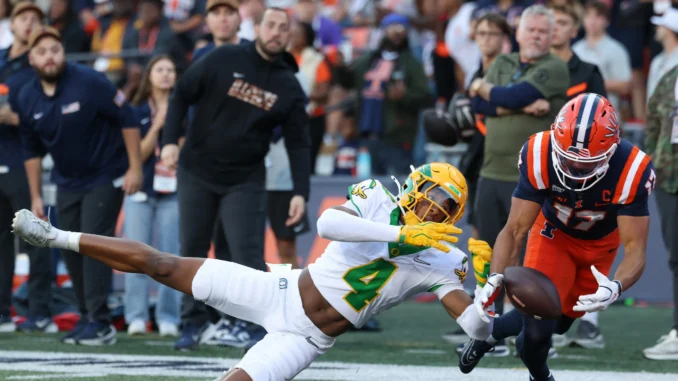
At some point, you have to stop calling these games frustrating and start admitting there’s something seriously wrong with Oregon’s offense. Saturday’s 21-10 loss to Illinois wasn’t a case of the Ducks running into an unstoppable opponent. It was another afternoon of missed opportunities, questionable execution, and an offense that apparently forgot scoring touchdowns is a fairly important part of football.
Oregon actually outgained Illinois 426-314. The Ducks had more first downs, threw for more yards, and moved the football well enough to make the final score seem almost impossible. Yet somehow, Illinois scored the game’s final 21 points and handed Oregon its third loss of the season.
The Ducks are now 4-3 overall and 2-2 in Big Ten play. After entering the season with legitimate championship expectations, they’re suddenly fighting to keep things from getting considerably worse.
Here are three takeaways from a game that should have Oregon fans asking some uncomfortable questions.
1. Oregon’s Offense Has Become Remarkably Good at Accomplishing Nothing
Four hundred twenty-six yards. Ten points. How does that even happen?
Oregon opened the game with an impressive 11-play, 75-yard touchdown drive, capped by Jordon Davison’s two-yard run. It was exactly the kind of start the Ducks needed after struggling offensively against UCLA and Nebraska. Dylan Raiola looked comfortable, the running game was producing, and Illinois appeared to be in for a long afternoon.
Then Oregon spent the rest of the game doing just about everything except scoring.
The Ducks managed one more field goal before halftime and never scored again. They converted just four of 15 third-down opportunities, punted five times, and watched three field-goal attempts sail unsuccessfully through the afternoon.
And those weren’t exactly chip shots. Gage Hurych missed from 52, 53, and 47 yards, so blaming the entire loss on the kicker would be ridiculous. Even if he had made all three, Oregon would have added only nine points to its final total, assuming everything else played out the same way.
The bigger problem is that Oregon keeps moving the football without finishing drives. One particularly aggravating example came late in the second quarter, when the Ducks marched 89 yards before settling for a 20-yard field goal. That’s a lot of work for three points, especially when touchdowns have become so difficult to find.
The official box score shows Oregon finished with 21 first downs compared with Illinois’ 15. The Ducks also averaged 5.8 yards per play, which isn’t terrible by any stretch.
But football games aren’t decided by how many yards you accumulate between the 20-yard lines. Oregon has plenty of players capable of producing impressive individual statistics, and Saturday offered another reminder that those numbers don’t necessarily translate into victories.
Dan Lanning and his offensive staff need to figure out why this keeps happening. Injuries are certainly part of the equation, but the Ducks have too much talent to make scoring 20 points feel like an impossible assignment.
2. One 75-Yard Run Completely Changed the Game
For most of the first half, Oregon’s defense looked perfectly capable of handling Illinois. The Fighting Illini had managed just 43 yards before their final scoring possession of the half, and the Ducks seemed to have everything under control.
Oregon led 10-0 with 2:29 remaining before halftime. Fourteen seconds later, the lead was suddenly 10-7.
Illinois running back Aidan Laughery broke free for a 75-yard touchdown run, and Oregon’s comfortable afternoon disappeared almost instantly. The play wasn’t just a defensive breakdown. It gave an Illinois offense that had accomplished practically nothing a reason to believe it could win.
That’s the kind of play that changes how a team approaches the second half. Illinois suddenly had momentum, while Oregon was left wondering how a game it had controlled had become competitive.
The Fighting Illini followed with a nine-play, 70-yard touchdown drive to open the third quarter. Freshman quarterback Michael Clayton II found Christian Abney for a nine-yard score, giving Illinois a 14-10 lead it would never surrender.
Clayton eventually finished with just 84 passing yards, but he threw two touchdowns and avoided the mistakes that could have handed Oregon the game. His second touchdown came on a terrific 23-yard reception by Collin Dixon late in the fourth quarter, essentially ending whatever comeback hopes the Ducks had left.
To be fair, Oregon’s defense wasn’t terrible. Teitum Tuioti finished with eight tackles and 2.5 sacks, and the Ducks kept Illinois within striking distance for most of the afternoon. But allowing 225 rushing yards, including Laughery’s game-changing touchdown, made life considerably easier for an Illinois team starting a freshman quarterback.
That’s what makes this loss particularly annoying. Illinois didn’t need a spectacular offensive performance to win. It needed a handful of successful plays and enough defensive stops to let Oregon continue sabotaging itself.
The Ducks have now lost three games this season, and there’s a troubling similarity between them. When something goes wrong, Oregon struggles to regain control. A bad possession becomes a bad quarter, and before long, the Ducks are trying to rescue a game they should have been managing comfortably.
That has to change.
3. Dante Moore Can’t Return Soon Enough, but He Won’t Fix Everything
It’s becoming painfully obvious how much Oregon misses Dante Moore.
The Ducks have now played three consecutive games without their starting quarterback, who remains sidelined following the concussion he suffered against USC. During that stretch, Oregon has scored 15 points against UCLA, 17 against Nebraska, and 10 against Illinois.
That’s 42 points in three games. For a program that has spent the last several seasons routinely putting up 30 or 40 points, the offensive decline is pretty remarkable.
Raiola deserves some credit for Saturday’s performance. He completed 27 of 41 passes for 246 yards without throwing an interception, which was a significant improvement from his disastrous outing against UCLA. He also helped Oregon move the ball consistently enough that the Ducks should have scored considerably more than 10 points.
But that’s part of the problem.
Raiola didn’t throw a touchdown pass, and Oregon’s passing game rarely produced the kind of explosive plays needed to put pressure on Illinois. Dakorien Moore caught nine passes for 70 yards, while Jamari Johnson added seven receptions for 69 yards. Solid contributions, certainly, but nothing that forced Illinois to dramatically adjust its approach.
Meanwhile, Oregon’s running backs actually had productive afternoons. Davison finished with 92 yards on 14 carries, and Dierre Hill Jr. added 83 yards on 13 attempts. Those are encouraging numbers, especially considering how badly the rushing attack struggled against UCLA.
So why couldn’t Oregon score?
That’s the question Lanning needs to answer before Northwestern comes to Autzen Stadium on Halloween. The Ducks have enough offensive talent to move the football, even without Moore. What they haven’t demonstrated is an ability to consistently turn those possessions into touchdowns.
Moore’s eventual return should help, assuming he’s fully healthy and cleared to play. But expecting one player to solve every offensive problem would be a mistake. Oregon’s issues extend beyond the quarterback position, and Saturday’s performance offered plenty of evidence.
The schedule isn’t getting any friendlier, either. After Northwestern, Oregon travels to Ohio State before hosting Michigan and eventually Washington. The Ducks have already lost three games, meaning their margin for error is considerably smaller than anyone anticipated entering the season.
Saturday also ended Oregon’s streak of 10 consecutive Big Ten road victories, a remarkable run that began when the program joined the conference in 2024. It’s another reminder of how quickly things have changed for a team that seemed capable of competing with anyone just a few weeks ago.
The frustrating thing is that Oregon doesn’t look completely overmatched. The Ducks have talent, they can move the football, and their defense has played well enough to keep them competitive.
But there’s a difference between being competitive and being good enough to win consistently.
Right now, Oregon is spending far too much time proving that difference.


Be the first to comment