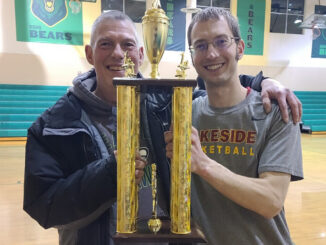

When I started as a youth basketball coach, I had no idea where this journey would take me. I had big dreams, though. My end goal was to become the head coach of an NBA team, which, in hindsight, was probably unrealistic for a former high school bench warmer who’d been away from the game for a decade.
But because of that college professor everyone has, the one who convinces you to chase meaning over money, I decided to pursue coaching anyway, defying all economic logic. Eight years later, I’m still coaching in the lower tiers of the basketball world, but I’ve grown as a human. And honestly, that matters more.
Coaching has also opened doors I never expected. To be transparent, I coach at Lakeside Middle School, an elite private school in the greater Seattle area. That connection pulled me into sports I had no background in at all. What began organically in basketball led me to coach youth volleyball, assist a blind high school track and field athlete, and even spend an afternoon coaching wheelchair basketball. I didn’t have the skills to help much there, but I showed up.
What I thought was a journey to become the greatest basketball coach ever was really a journey toward finding myself.
And it happened in the exact opposite way I imagined.
Rosie Perez said it best in White Men Can’t Jump: “Sometimes when you win, you really lose. And sometimes when you lose, you really win.” She followed it up with, “Winning or losing is all one organic mechanism, from which one extracts what one needs.”
My first year as a head coach at the seventh-grade varsity level, any varsity level, I was blessed with a loaded roster. I coached the No. 1-ranked sophomore in the state of Washington, an elite football player, and a third kid who could score at will. Their talent, combined with my ignorance, led us to a CYO championship. I thought I was Phil Jackson.
Then the next season, I was stunned to learn the program head wanted me to coach sixth-grade varsity.
Why was I getting “demoted” after winning a title?
I’ll never know the exact reasoning, but looking back, I was probably too focused on winning and not focused enough on development.
In hindsight, I also understand how fortunate that title run really was. The team we beat in the championship had blown us out by 27 points earlier in the season. What they didn’t know was that our star player and another starter were suspended for that first meeting. When you don’t game-plan for a kid like “Q,” it’s over. He dropped 40 points in a 32-minute game and made me look competent in the process.
Over the next two varsity seasons, my teams went a combined 0-14. My junior varsity squads fared better, but the losses piled up.
The strange part? I earned more respect from players during the winless seasons than I ever did from the championship team.
Before our title game, I remember a player saying, “We’re going to lose this game because no one takes this team seriously.”
I’m glad he was wrong, but it says a lot about the culture we had.
This season told a different story. After getting blown out by 20 points in our final game, a player came up to me and said, “We weren’t very good, but at least it was fun.”
As a youth basketball coach, fun is the ultimate goal. Somewhere along the way, when I realized how talented that first team was, I lost sight of that.
This sport gave a cocky, overlooked public-school kid access to some of the most elite institutions in the world. More importantly, it shaped me into a more patient, faithful, and loving human.
This journey inflated my ego, humbled me, and eventually brought me back to center. Chasing dreams isn’t about what you achieve. It’s about how you grow and who you help along the way.
I got a new coaching gig today, and it forced me to reflect on the past eight years. I’ll be leading a fourth-grade co-ed volleyball team and a fifth-grade boys squad at a school located in one of the most expensive neighborhoods in Seattle.
The athletic director who once watched me win a championship at Lakeside reached out for this opportunity and said I was “good with the kids.” She never mentioned the title.
Today, I drove my Hyundai Sonata with 214,000 miles on it, slung my pink North Face backpack I found at Goodwill over my shoulder, and walked into a billion-dollar neighborhood.
This kid from Shoreline is still dreaming.