
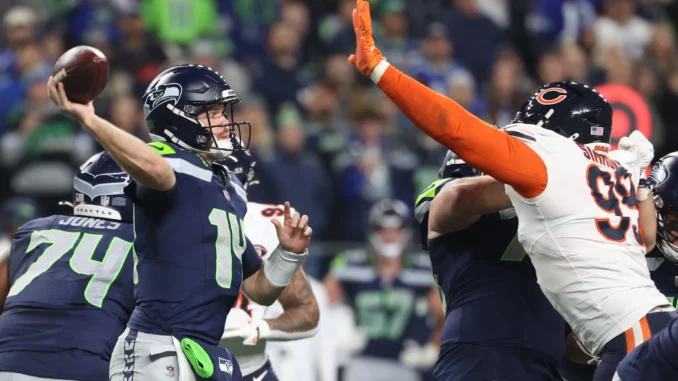
The Seattle Seahawks are the defending champions. This current team is not a Super Bowl team. And that’s not some knee-jerk response to their loss to Chicago on Monday night. These are concerns that have been becoming more obvious with each passing week. And they were on full display this week.
Seattle now has two clear choices – address the problem and get the season back on track before things get bad. Or they can keep pretending nothing needs major adjustments, and we’ll see if they even get a playoff spot.
The first problem they need to address is QB Sam Darnold. As a passer, Darnold is averaging just 211 yards per game (21st), and has thrown 10 touchdowns (18), against 9 interceptions (tied for 2nd most). He has been sacked 17 times (9th most) and is averaging just 6.6 air yards per pass attempt (25th), his career-low.
Darnold was a strength for the offense last season. The uncomfortable truth is that he has been a liability in 2026.
When you’re watching a game, you brace yourself for disaster when he drops back to pass. You tried to pretend it wasn’t happening, but you’re surprised when a really good play happens. It wasn’t always that way, and there’s still hope the team will turn things around. But they can’t fix anything until they admit there’s a problem.
Darnold took time to settle into a new offense with new teammates last year, but this season those excuses are gone. He hasn’t gotten a ton of help, but he needs to do more with what he has. Jaxon Smith-Njigba has been on an insane run with no sign of slowing down or being contained by a defense, but outside of him, Seattle has zero consistent weapons. And Darnold doesn’t seem interested in giving other players a chance to prove him wrong, which isn’t a recipe for success.
Veteran QBs have to be willing and able to elevate the play of the guys around them. No one is going to question Darnold being on a mind meld with JSN, but how is it that he has a very basic connection with everyone else? No one is saying his other options are world beaters, but they are very capable players.
If you’re a leader and one of the highest-paid guys on the team, you have to find a way to get the most out of your role players. And Darnold is coming up well short in that department, among others.
Seattle has a Sam Darnold problem.
Seattle’s offensive line is not doing anyone any favors, and they are no friends to their QB. Darnold is averaging just 2 seconds of pocket time, based on the time between the ball being snapped and the QB starting to throw or being pressured. That is down from 2.4 last season. Less than half a second might not seem like much, but with how fast defenders can get to Darnold in a single step, that could be the difference between a completed pass and a play being dead before it can develop.
For comparison, Jordan Love is playing behind a historically bad offensive line in Green Bay, and he is getting 2.1 seconds of pocket time per dropback.
Running the ball doesn’t get much better. Green Bay averages 2.8 yards per attempt, and they are the worst in the league by any grading system you can find. Seattle isn’t that bad, but they still average only 3.9 yards per carry, which is 23rd out of 32 teams.
This offensive line can’t give their QB time to throw, and they can’t open lanes for the running backs. It’s not a problem of Seattle not giving the running game a chance; they have the seventh-most running attempts so far this season, but it’s just not working.
New guard Quenton Nelson will help the left side, and things will improve when LT Charles Cross returns to the starting lineup, but that won’t fix the other three players on the line, all of whom are struggling. And the guys who are struggling are begging for better coaching from coaches who either can’t or won’t provide it. Hopefully Nelson won’t mind being a player-coach.
Seattle has an offensive line problem.
Darnold needs to play better, and the offensive line needs to play better. But the biggest problem is that the offensive coordinator seems to have no idea how to install plays based on the defense they’re facing that week, or how to make in-game adjustments to support his players.
If the other team has a disruptive interior lineman? Give the guy closest to him an extra blocker, or shift protection that way. Call plays that use more guys on the line and misdirection to confuse the defense. Put guys in motion and rotate assignments to make the defenders guess who is staying in to block vs. who is running a route. Seattle doesn’t seem to do much of these things.
If the other team has a great edge rusher? Call plays with an extra tight end or lineman on that side of the line. Make them beat chips and double teams, frustrate them and wear them out. Run right at them, not away from them. You have these gargantuan humans on the roster just taking up space; let them get on the field and push people, let them do what they get paid to do. Backup linemen can still contribute. An extra blocker or leaving a tight end in to help might leave a third receiver off the field, but why is that a problem? Darnold isn’t throwing to them anyway.
First-year offensive coordinator and play caller Brian Fleury appears to be out of his depth as someone who can create, install, and run a functional offense against elite defenders, and, most importantly, adjust to what the defense is doing in a game.
Fleury seems to have a good idea of how and when to call plays, but adjusting them based on what the defense is doing across the field seems to be what is stopping him from being successful. He isn’t creating check-downs to counter blitzes; his deep plays take too long to develop, and his running plays leave a lot to the imagination. The Shanahan system isn’t for the uninspired; it’s supposed to use creative running plays to open the pass and spread the ball around to wear down a defense by making them cover the entire field for three hours, never knowing who is getting the ball next.
More problematic than failing to adjust is that Fleury has no experience doing this at any level. He probably needs to ask one of his assistants to help, but that won’t work based on who he has under him.
Pass game coordinator Jake Peetz has been in charge of an offense once, for one season, at LSU in 2021. Run game coordinator Justin Outten has helped run an offense once, for Denver in 2022 under Nathanial Hackett. He saw firsthand how not to run a scheme, but hasn’t seen how one should work. Running backs coach Thomas Hammock helped run an offense for the University of Minnesota in 2010. Receivers coach Frisman Jackson has never run an offense. Offensive line coach John Benton has not run an offense since he was co-offensive coordinator at Colorado State from 2000-03. Offensive assistant Jimmie Dougherty
has served as OC for San Diego University (2008), San Jose State (2013-14), and the University of Washington (2025).
That’s the team working with Fluery; no one has any idea how to run a successful system at the pro level. They have an entire offensive staff trying to emulate what other guys have done. It’s impressive they have made it this far given their lack of experience, but now, midway through the season, that inexperience is becoming impossible to ignore.
How is there not an assistant head coach or senior analyst with multiple years running pro offenses who can help this guy? Many people have run or worked in the Shanahan system in the last thirty years, and Seattle couldn’t find one to help? Not even a former QB who wants to get into coaching who can help them navigate what this system does well?
In a perfect world, Darnold could help fix this, but instead he’s a big part of the problem.
Seattle has a coaching problem. It’s not Mike Macdonald, but this is his staff, so he is part of the issue.
Ryan Grubb was a terrible OC, and Macdonald replaced him with Klint Kubiak, who turned out to be an incredible OC. Now he has Fleury, who seems to be a decent play-caller, but not a good pick as OC. Macdonald might need to hire someone who can install the offense weekly and then let Fleury call the plays, but the current system is set up for disaster.
Seattle’s defense is carrying the team so far, and I can’t imagine they can keep doing that in an absolutely loaded NFC. For a team trying to defend their title, they might instead just be fighting for a playoff spot if this continues much longer.
Seattle may have problems at QB and offensive line, but a competent OC would fix that by figuring out how to hide their weaknesses and promote their strengths.
Seattle’s biggest problem is their offensive coordinator, or the simple fact that they don’t have one.



Be the first to comment