A few weeks ago, a handsome, articulate, young writer on this site (yours truly) wrote a piece examining the two big Japanese position players coming stateside this offseason and how Yomiuri Giants captain Kazuma Okamoto, over Yakult Swallows slugger Munetaka Murakami, was a better fit for Seattle and their timeline for contention. And while Okamoto signing elsewhere stings (especially to the team that beat you for the American League pennant), it doesn’t leave the Mariners without options. Between some very real trade targets, a weirdly interesting free-agent tier, and a wave of infield prospects that finally hit the big leagues in 2026, the M’s have multiple ways to solve third base without forcing anything.
Let’s walk through the names that actually make sense now that we know what they just did in 2025 — not what we thought they might do.
Trade targets
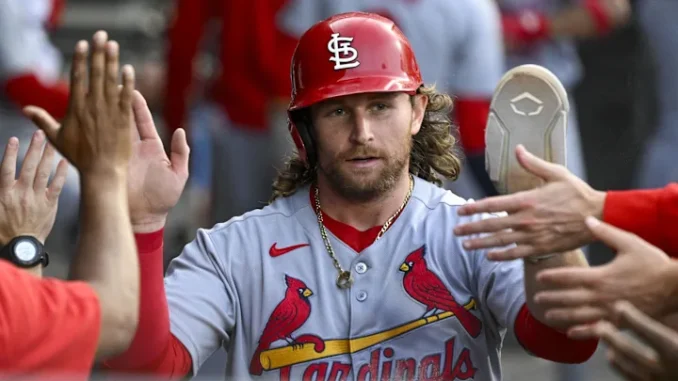
Brendan Donovan (Cardinals)
Donovan might be the single cleanest fit on the board for how the Mariners want to play offense.
In 2025, he hit .287/.353/.422 with 10 homers in 118 games for St. Louis, good for a 118 wRC+ and a .337 wOBA. Statcast backed it up: .285 xBA, .443 xSLG, and a .346 xwOBA with a 40.1% sweet-spot rate — classic high-contact, line-drive stuff rather than flukey bloops.
Contract-wise, he lost his first arb case and is projected to make $5.75M in 2025, with team control through 2027 and free agency in 2028. That’s exactly the kind of surplus-value bat you trade prospects for. He’s not a pure third baseman, but he can play it capably while moving around the diamond as prospects Ben Williamson, Cole Young, and Colt Emerson arrive.
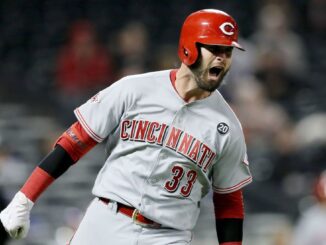
Christian Encarnacion-Strand (Reds)
This is the buy-low power bat.
Encarnacion-Strand’s 2025 in Cincinnati went sideways: he hit just .208 with six homers and a .610 OPS before being optioned back to Triple-A, where chase issues continued. The power is still there, but the approach was bad enough that the Reds didn’t even bring him back in September when rosters expanded.
He’s still pre-arb in 2026 on an estimated $820K deal and isn’t arb-eligible until 2027, with free agency slated for 2030. That’s six more years of control. If you believe your hitting group can rehab the swing decisions, this is the kind of distressed asset you target instead of paying sticker price for a finished product.
Alec Bohm (Phillies)
If Seattle wants a solid everyday third baseman with contact skills and some pop, Bohm fits perfectly.
In 2025, he hit .287 with 133 hits, 11 home runs, and 59 RBI in 120 games for the Phillies. The surface line doesn’t scream star, but that’s a high-contact right-handed bat with enough thump to matter and no glaring platoon split issues.
Only one problem—he’s a pure rental, getting paid around $10.25 million for this year before hitting free agency next winter. But with Philadelphia at least listening for deals on him earlier this winter, this is a realistic “pay real prospect capital, get a real big leaguer” scenario, who might extend long-term a la Josh Naylor.
Nolan Arenado (Cardinals)
Arenado is no longer the MVP candidate he once was, but he’s still a name to watch due to his fit and contract.
He’s in the middle of the eight-year, $260M extension signed initially with Colorado, running through 2028; he’s owed $31M over the next two years with adjusted obligations on the Rockies’ side. Production has leveled off into “above-average regular” territory rather than perennial top-five at the position. Still, the glove and instincts remain strong enough that contenders have shown renewed trade interest, especially around the last trade deadline.
For Seattle, this only works if St. Louis eats money or takes on salary back, but in terms of stabilizing defense and giving you a credible middle-of-the-order presence for two more years, it’s at least a real conversation.
Free-agent options
Yoán Moncada (Angels)
Moncada spent 2025 with the Halos on a one-year, $5M deal and quietly had a useful year when he was on the field: in 289 plate appearances, he slashed .234/.336/.448 with 12 homers and an 11.1% walk rate. The advanced metrics like xwOBA (.323) and barrel rate (14.3%) suggest the bat is still real when he’s healthy.
He’s back on the market after that one-year deal and is drawing multi-team interest as a bounce-back third baseman who likely lands in the short-term, mid-tier money range.
Eugenio Suárez (Diamondbacks/Mariners)
Suárez just put up one of the loudest power seasons in baseball: 49 homers, 3.6 WAR (Wins Above Replacement), and 588 at-bats in 2025, finishing his long extension with a bang for Arizona and then Seattle. He was at 142 wRC+ around the All-Star break with a .250/.320/.569 slash in 391 PA before the second half cooled a bit, but the overall power impact is undeniable.
He made $15M in 2025 and, as of this writing, is still a free agent for 2026. There are already multiple reports linking him both to a potential Mariners reunion and to other clubs that need a right-handed thumper at third.
Willi Castro (Twins/Cubs)
Castro isn’t a classic third baseman, but he’s a useful glue guy if Seattle goes “sum of parts.”
He hit .226/.313/.366 with 11 homers, 33 RBI, 58 runs, and 10 steals over 120 games split between Minnesota and Chicago in 2025, good for a 93 wRC+ — slightly below average (which is 100) but buoyed by versatility. He’s now a free agent after six-plus years of service, with market-value estimates in the three-year, roughly $9–10M AAV range.
As a secondary move after a bigger bat, he makes more sense than as “the” third-base solution.
Alex Bregman (Red Sox)
Bregman is the true big fish.
In 2025 with Boston, he hit .273/.360/.462 with 18 homers, a 128 OPS+, and 3.5 fWAR in 114 games — still a star-level bat when healthy, with elite plate discipline and October experience. He opted out of his three-year, $120M deal after that lone season and is now back in free agency, reportedly fielding offers in the five-year, ~$160M range with an AAV (Average Annual Value) in the low-30s.
For Seattle, this is the only option that fundamentally changes the offensive ceiling at third by himself—but given how the Mariners have seemed to revert to their Scrooge-like ways, doesn’t make this partnership likely.
Internal candidates
Ben Williamson (Mariners)
Williamson made his debut last season and quietly gave Seattle something they haven’t had in a while: a real, homegrown third baseman.
He hit .253/.294/.310 over 295 plate appearances, with 70 hits, one homer, and five steals, good for 1.3 WAR thanks in part to competent defense and baseline contact skills. That’s not flashy, but as a rookie, it’s a perfectly respectable floor, and there’s room for the bat to tick up as he settles in.
Cole Young (Mariners)
Young split 2025 between Tacoma and Seattle, showing both the upside and the adjustment curve.
In the majors, he hit .211/.302/.305 with four homers and a 10.9% walk rate across 223 at-bats — an OBP-driven profile with more patience than damage so far. Underneath that, his minor league line remained excellent: .277/.392/.853 OPS in 206 Triple-A at-bats. The ingredients (zone control, all-fields contact) still scream everyday regular; the question is just whether that ends up at second or third.
Colt Emerson (Rainiers)
Emerson spent 2025 in the high minors, and the industry view on him only got louder.
He worked primarily at shortstop and third base, reached Triple-A after starting the year in High A, and is now the Mariners’ top prospect with a 55 FV: projected plus hit tool, average game power, and the versatility to stay on the dirt, with some questions of whether that’s at SS or 3B long term. Club officials have already hinted he’ll get a real shot to break through in 2026.
So what’s the actual lane?
Given the state of the M’s and their length of one of the most dreaded words in sports: window, the cleanest paths look like:
- High-floor trade: Bring in Bohm or Donovan as stabilized, potential multi-year solutions.
- Ceiling swing: CES reclamation project or Bregman mega-deal, depending on how wild ownership feels (so highly doubtful).
- Layered approach: In the short-term, pair Moncada/Suárez with Williamson/Young in 2026, while clearing the runway for Emerson in 2026–27. Given the stunning two (!) transactions the M’s have made this winter, including re-signing a player already in their building, this seems most likely. Conservative is the name of the game in the Pacific Northwest.
Okamoto would’ve been one move that solved everything. The 2025 numbers say Seattle can still get there — they might have to build it out of two or three smart decisions instead of one.