
Preseason basketball isn’t about wins and losses.
That’s especially true for a Portland Trail Blazers team with a new head coach, a dramatically different backcourt, and more rotation options than available minutes.
Micah Nori has plenty to figure out before opening night. Who starts? How do Damian Lillard and Ja Morant coexist? Which combinations work? How deep can Portland realistically go when everyone is healthy?
We won’t get the full picture during the preseason, especially with Shaedon Sharpe sidelined. But with Portland opening its exhibition schedule Wednesday against the Golden State Warriors, we should at least start getting some clues about Nori’s plans.
Damian Lillard: Look Comfortable Again
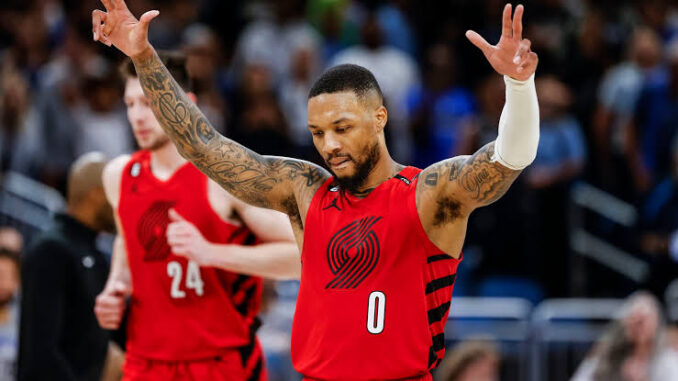
Nobody needs Lillard playing 35 minutes, launching 15 threes or looking like the Dame of five years ago. After missing last season, the priority should be much simpler: Look comfortable playing NBA basketball.
Among other questions: How does Lillard move? Does he look confident changing directions and creating separation? Is he comfortable running pick-and-roll, navigating screens and letting shots fly without hesitation?
How Nori deploys him will also be worth watching. We don’t need to see Portland’s entire Lillard playbook in October, but seeing him naturally settle into the offense would be more encouraging than any preseason scoring total.
Ja Morant: Look Confident Without the Ball
We know what Morant can do as an offense’s engine. What we don’t know is how he looks as a cog in the machine.
Morant will have stretches when somebody else is running the show. That’s when we’ll want to see him cut, relocate, screen, and use advantages created by someone else, rather than watching him wait for his next turn with the ball.
Of course, Morant should still have plenty of opportunities to attack with the ball in his hands. Lillard won’t operate as a full-time ball-handler, just like Avdija won’t be a full-time downhill attacker. But what Morant does off-ball, and if he can keep defenses honest with his shot, could determine how easily this unusual collection of guards fits together.
Jrue Holiday: A Little Bit of Everything
Is it fair to put “a little bit of everything” on a 36-year-old guard? Perhaps not. But reframed: Holiday doesn’t have much to prove.
Let’s see how many different ways Nori plans to use him.
Putting Holiday on the ball gives him a chance to showcase his creation. Playing him off it could boost his catch-and-shoot volume, where he shot 43.2 percent from three and 43.0 percent inside the arc last season.
Jrue can also stabilize some of Portland’s younger lineups or be the necessary defensive reinforcement among the starters. That ability to defend multiple positions gives Nori freedom to experiment offensively without completely sacrificing the other end.
While the roster is unconventional, Holiday could help make the unusual combinations work.
Deni Avdija: Hybrid Deni
Avdija fully earned his Turbo nickname last year as Portland’s offensive engine. He won’t need to be that every night this year. And finding “hybrid” Deni might be the key to his success.
How Deni adjusts when Lillard and Morant create offense will be a major storyline. Equally important will be whether he can flip a switch to attach mode, or if his newer, more complementary role slows down his momentum.
Maybe Deni cuts more, attacks immediately upon catching the ball, or pushes in transition while leaving half-court creation to Portland’s guards. It will also be interesting to see how often Nori still puts the ball in Avdija’s hands, since taking away too much of what made him successful wouldn’t make much sense.
Finding balance could be one of Portland’s biggest early-season challenges as a team, but that theme applies doubly to Avdija.
The Blazers don’t need less Deni. They may need a different version of him.
Scoot Henderson: Be Impossible To Ignore
Scoot might have more at stake than anyone. He’s entering Year 4 on a roster suddenly loaded with veteran guards, leaving no shortage of competition for minutes and touches.
Of course, Jrue Holiday also called him the MVP of training camp, returning fan expectations to previous heights.
During preseason, we want to see Scoot play under control. We need to see him defend, create good shots, and push the pace.
Maybe more than anything, he needs to show that Portland is better when he’s on the floor.
Scoot doesn’t need to be a starter in the preseason, or even the 2026-27 regular season. And there may not even be room for him to close every night. But we want him to play well enough that Nori has no choice but to give him significant minutes. That means making an impact even when he isn’t controlling every possession.
If he can complement Portland’s veterans and build upon his own successes, the path to a major role, both this season and beyond, becomes much clearer.
Toumani Camara: Confident Shooting, and More of It
We already know what Camara brings defensively. Now he needs to keep making defenses pay for ignoring him.
Portland needs spacing around Morant, Avdija, and its centers. If Camara confidently takes and makes open threes, there’s almost no lineup where his skill set doesn’t fit.
The important part is the confidence. If defenders sag off him, those shots need to go up without hesitation. That’s how the offense will stretch defenses, and how his individual ceiling can keep rising.
Jeremy Sochan: Show How He Fits
Sochan brings defense, size, rebounding, and another forward who can handle the ball. The question is how all of that fits on a roster with plenty of non-shooters.
As a no-risk signing and former No. 9 overall pick from the 2022 draft, Sochan is worth a look even if he’s unlikely to make the final roster. Preseason gives him a chance to make his case by defending multiple positions, grabbing rebounds, running in transition, screening, and making plays off the catch.
He’ll need those strengths to offset a career 28.6 percent mark from three. The most interesting test could come alongside Donovan Clingan or Robert Williams III, where we’ll see if there’s enough spacing to make Sochan’s size, defense, and versatility worth the tradeoff.
Donovan Clingan: More Offensive Experimentation
Clingan has proved, without a doubt, he can protect the rim and dominate the glass. He led the league in both total rebounds and offensive rebounds last season. His 11.6 rebound-per-game average was third. He was fourth in total blocks behind only Chet Holmgren, Jay Huff, and Victor Wembanyama.
Clingan is a defensive force and rebounding machine after just two seasons in the league.
Preseason is when Portland can experiment with everything else.
From the onset of the year, Clingan should always take the open three. He shouldn’t be afraid to make the ambitious pass. Operating from the elbow could give Portland the Draymond-type playmaker they never fully tapped into with Jusuf Nurkić. And when the opportunity presents itself—especially after a made three—put the ball on the floor to force opposing centers out of their defensive comfort zones.
Robert Williams III: Healthy Minutes
Nothing fancy here. Williams can be an extremely useful backup to Clingan when he’s available, but that last part (availability) has always been the issue.
We don’t need 25 minutes or five blocks; instead, give Portland a healthy stretch to look mobile, explosive, and comfortable while reminding everyone how disruptive he can be defensively.
That’s what Time Lord will hang his hat on this season. And that should be obvious from Day 1.
Vít Krejčí: Shooting That Demands Minutes
The Trail Blazers finished last season 28th in three-point percentage despite being third in three-point attempts. Anyone who can reliably stretch the floor should get minutes.
That’s where Krejčí enters the chat.
If you’re Krejčí, shoot when you’re open and make enough that Nori starts wondering whether Portland can afford not to play you.
On a roster with plenty of creators but many spacing questions, shooting alone could earn him a role.
Sidy Cissoko: Winning Plays
The Trail Blazers don’t need Cissoko to become a featured offensive player suddenly. We want to see the boring stuff.
Defend, run, make quick decisions, and move the basketball. Continue taking charges, go after loose balls, and challenge everything from the rim out to the arc.
With Portland’s rotation this crowded, those are the things that could convince Nori to trust Cissoko for meaningful rotation time, even after Sharpe returns and takes over minutes on the wing.
Yang Hansen: Proof He’s Ready Now
Yang may or may not be part of the regular-season rotation. But that’s why exhibition games matter. They’re a chance to see what’s there before we get started.
Things to watch for: Can Yang defend without fouling? Can he rebound against NBA athletes? Can he execute the offense without slowing things down? Is he consistently in the right place defensively?
We’re not looking for Yang to dominate; we want to see whether Nori can put him into a game situation without worrying about him.
That trust factor—the whole “not worrying” thing—will be far more important than any highlight-reel pass or dunk over the next four games.
Micah Potter: A Reason to Keep Playing Him
Potter may or may not have a regular role this year, but at 6’9”, his shooting gives Portland something different from its other frontcourt options. (And if you ask those who doubt Yang’s potential, Potter may actually be the more reliable rotation option.)
In preseason, watch to see if Potter can pace the floor, make some threes, and pull bigs away from the basket.
He doesn’t have to win a rotation job during preseason. But with good, quality minutes, he can make it hard for Nori to dismiss it as a “lightnight” to RWIII’s “thunder.”
Branden Carlson: Make the Frontcourt Decision Difficult
As a 7-footer with shooting range, Carlson has a shot at sticking on the roster. Sort of like Micah Potter, but with true NBA height for a 5.
Portland already has several centers competing for opportunities behind Clingan. But if Carlson can protect the rim, rebound, and consistently stretch the floor, he’ll add some intrigue to final roster cuts.
Chris Youngblood: Let the Shooting Translate
Youngblood is on a two-way contract, so the immediate expectations should be modest.
Still, shooting is always an easy way to get noticed. If he can knock down open threes, compete defensively, and show his game translates against NBA rotation players—not just developmental competition—this preseason could be a good step toward an NBA contract, even if it’s ultimately not with Portland.
Jayson Kent: Make an Impression
Kent’s preseason opportunity is less about making the rotation and more about showing Portland and the NBA that he’s better than his two-way contract indicates.
Bring energy, defend, and make hustle plays, and an otherwise empty box score won’t look so bad.
Don’t do those things, and he risks falling out of favor not just with the Blazers but with scouts across the league.


Be the first to comment