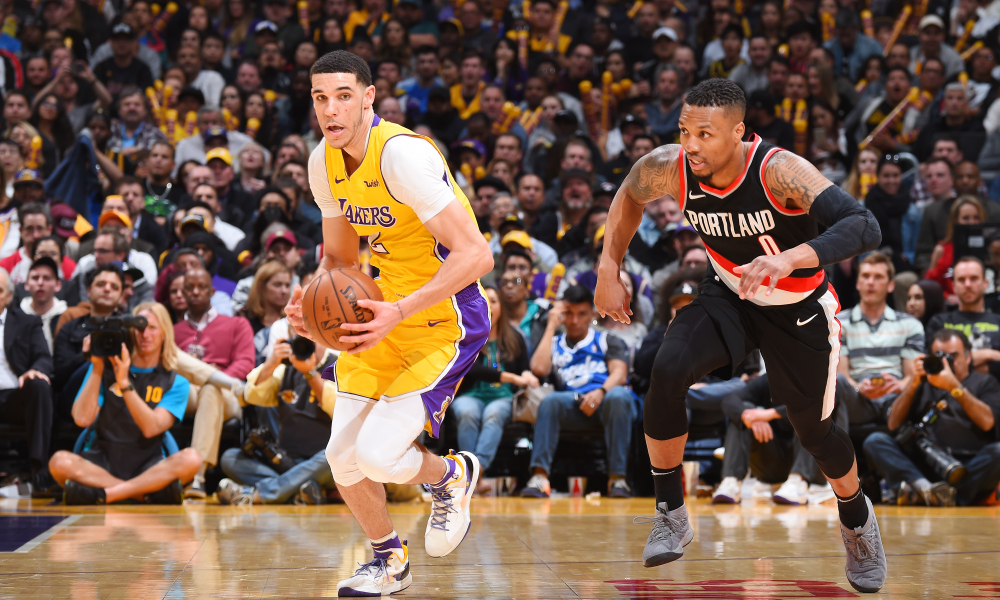
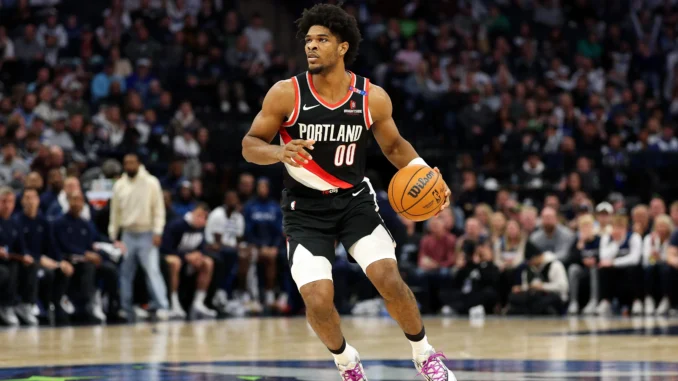
Back in 2023, Joe Cronin and the rest of the Portland Trail Blazers front office were faced with a tough choice: run it back with franchise legend Damian Lillard, who always came up just short, or rip the band-aid off and grab Scoot Henderson, the guard of the future. In a controversial move, they did the latter, and there’s no doubt there’s been some mixed results. The former G League Ignite alum once battled “The Alien” Victor Wembanyama, which seemed to be a preview of two perennial All-Stars destined to clash for the foreseeable future. But since then, while Wembayana has become a bona fide superstar who has given the San Antonio Spurs their first 50-win season in years, Henderson has been plagued not only by injuries but also by ineffective play, particularly from the perimeter. He projected as a hyperathletic guard who lacked the shooting touch to be a true impact from the one, a la Dennis Smith or Killian Hayes. A bust to some, frankly. While he has a better feel for the game than those two players, playmaking when you can’t score from every level makes an offense one-dimensional.
Once he returned from his hamstring tear in early February, we saw some rust as he adjusted back to the physicality and pace of the modern NBA. But the cliche “the game started to slow down” for the third-year Georgia native. But ever since the beginning of March, Henderson has quietly put together the most promising offensive stretch of his young career. The raw scoring is up, but the real story is how he’s getting these points: cleaner shot selection, refined mechanics, and a better blend of rim pressure and perimeter scoring. His true shooting percentage of 55.3 this season (an advanced shooting stat that takes into account two-point field goals, three-point baskets, as well as free throws) is now up to league average for a guard, driven by three things:
- Improved three-point accuracy: More catch-and-shoot looks, fewer off-balance pull-ups. After shooting a dreadful 24 percent from three in February, as of this writing, he’s currently shooting 45 percent in March.
- Better finishing at the rim: Using his body to create angles to the basket rather than just relying on burst. His 60.5 rim field goal percentage, albeit on a smaller sample size, is significantly higher than the average for his position (44.4%).
- More trips to the line: Attacking with a plan instead of throwing up contested jumpers (averaging a career high 3.5 free throw attempts per game).
The standout performance in this stretch was on March 8th against the Indiana Pacers, where he put up 28 points, 3 rebounds, and 6 assists, on 10 for 15 shooting and 3 of 7 from deep in only 26 minutes of play, which felt like a proof-of-concept game. He combined volume and efficiency, hit threes off the dribble and the catch, and looked fully in control of the offense.
An Evolving Offensive Profile
What’s changed isn’t just that more shots are going in; it’s the shape of his shot diet. Upon his return, you saw the same ol’ Scoot: when he couldn’t blow by a defender, his game became contested middies and defended drives. Once the calendar flipped to March, Henderson’s game shifted to a more modern NBA guard template. This means a higher three-point rate, with more of his attempts coming above the break, as well as better-orchestrated drives into the lane, and fewer long twos late in the shot clock. In other words, he’s trimming the low-value aspects of his offensive repertoire and leaning into shots that bend defenses. His usage hasn’t dropped–he’s still a primary creator with the second unit–but the efficiency per possession has ticked up, exactly what you want from a lead guard in a developing offense.
The game against the Pacers is a perfect snapshot of his new bag. He mixed pull-up pick-and-roll jumpers with catch-and-shoot looks when the ball swung back to him, and strong drives that put pressure on the rim and eventually led to kickouts. That’s not just “hot shooting”, that’s an offensive template that can be scalable for a whole season, provided health.
How it Changes the Blazers Spacing
But this improvement from three doesn’t just help Henderson in a pivotal year for him; it also impacts the whole team’s geometry. Now bigs have to come up higher to help in pick-and-rolls, opening slips, and short rolls for Donovan Clingan and others. Weak side defenders can’t stunt as aggressively because kicking out to Scoot, especially above the break, is now a real punishment. Off-ball actions on the weak side have more room to operate, since the nail defender can’t fully commit to clogging the lane to cut off Hendo’s driving ability.
Teams are going under screens less often, and when they do, Scoot is more willing to let it fly. That forces a subtle but important adjustment: once defenses start fighting over the top, the Blazers’ shooters get cleaner looks on swing-swing actions, and the bigs get less congestion in the paint.
Even his improved catch‑and‑shoot numbers matter. When he gives up the ball, relocates, and is ready to fire on the catch, he stops being a “ball‑dominant non‑shooter” and becomes a real spacer in secondary actions. That’s huge for late‑clock possessions and for lineups where he shares the floor with other creators.
Impact on the post-season hunt
The Blazers are living on the fringes of the postseason picture, where small improvements from key players can swing a week—or a season. Scoot’s March shooting surge doesn’t suddenly turn them into contenders, but it does move a few important needles.
- Offensive rating in his minutes: When he’s efficient, Portland’s half‑court offense looks functional instead of stuck in mud, especially when Jrue Holiday and Deni Avdija are off the floor.
- Clutch possessions: A guard who can create a decent three or get to the line late in games is invaluable for a team that plays a lot of close ones.
- Scouting reports: If opponents have to treat him as a real perimeter threat, it softens the game plan against everyone else.
In a tight Western Conference, the difference between a bottom‑five offense and a merely below‑average one can be the difference between playing out the string and hanging around the play‑in race into April. Scoot’s March suggests that, at least for stretches, Portland can reach that “respectable” tier when his jumper is falling, and his decision‑making holds.
More importantly, it reframes the long‑term question. Instead of asking, “Can he ever shoot well enough to run an offense?” the conversation shifts toward, “How often can he sustain this level, and what do you need to put around him to maximize it?” That’s a much healthier place for a rebuilding franchise to be.