
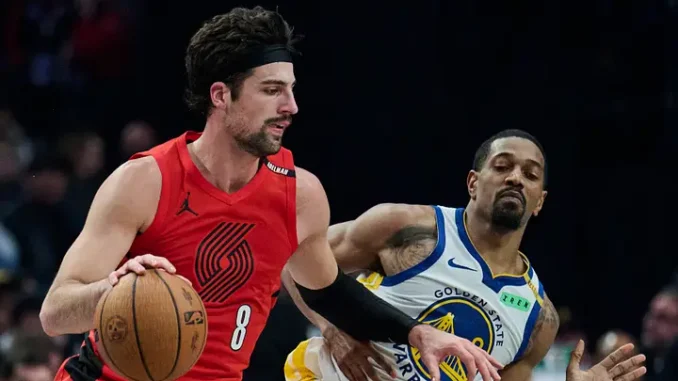
Remember when the most interesting conversations surrounding the Portland Trail Blazers involved lottery odds, potential trades, and whether the organization was actually making progress with its rebuild? Those conversations seem considerably less interesting these days.
The Blazers are 13-6, have won three consecutive games, and are headed to the NBA Cup quarterfinals. They finished a challenging week with victories over Philadelphia, San Antonio, and Golden State after suffering a heartbreaking one-point loss to New York last Saturday.
We’re approaching the quarter mark of the NBA season, and Portland is giving us legitimate reasons to reconsider what this team might accomplish. Here are five things we’re learning about the Blazers.
1. Deni Avdija Might Be Portland’s Best Player
I realize what I’m suggesting here, especially considering Damian Lillard is back in Portland and Ja Morant is also on the roster. But if we’re evaluating what players are actually contributing to winning basketball games right now, Avdija deserves to be at the center of that conversation.
He scored 31 points against Philadelphia on Monday, followed that up with 33 points, 12 rebounds, and seven assists against San Antonio on Wednesday, and finished the week with 26 points against Golden State on Friday. That’s 90 points across three consecutive victories, and his scoring only tells part of the story.
What makes Avdija so valuable is his ability to influence practically every possession. He can bring the ball up the court, create opportunities for teammates, attack smaller defenders, and knock down outside shots.
Against San Antonio, Lillard scored 29 points and Victor Wembanyama put up an absurd 44. Yet Avdija was arguably the most important player on the floor for the winning team, contributing in ways that extended well beyond his scoring.
I’m not suggesting Portland should suddenly run everything through Avdija and ask Lillard and Morant to stand in the corner. What I am suggesting is that the Blazers may have acquired a legitimate franchise cornerstone without fully realizing what they were getting at the time.
The more I watch this team, the more I wonder whether Avdija should be considered the centerpiece of Portland’s next competitive era rather than simply one of its complementary pieces.
2. Donovan Clingan Is Becoming More Than Just A Defensive Specialist
There was never much question about Clingan’s ability to protect the rim when Portland drafted him. The bigger question was whether he could develop enough offensively to become a consistently effective NBA center.
This past week offered some encouraging answers. Clingan finished with 22 points and 13 rebounds against New York before recording 15 points, 18 rebounds, five assists, and two blocks against Philadelphia.
Five assists from Clingan might have been my favorite statistic from that Philadelphia game. We’ve become accustomed to seeing him collect rebounds and make opposing players reconsider driving to the basket, but his ability to get teammates involved adds another dimension to Portland’s offense.
He closed out the week with another double-double against Golden State, recording 10 points and 12 rebounds. He’s becoming the kind of center who doesn’t necessarily need plays drawn up for him to make a significant impact.
Portland has plenty of players who want the basketball in their hands. Having a center who can set screens, create second-chance opportunities, protect the paint, and facilitate possessions without demanding a dozen shots every night is incredibly valuable.
Clingan doesn’t need to become the next Wembanyama. He just needs to continue becoming a better version of Donovan Clingan, and that’s looking like a pretty darn good basketball player.
3. Micah Nori Has A Complicated Backcourt Situation On His Hands
Scoot Henderson scored 18 points and dished out seven assists against Golden State on Friday, taking advantage of an opportunity with Lillard and Morant unavailable. It was another reminder that Henderson has plenty to offer when given meaningful opportunities.
And that’s where things get complicated.
Morant is getting closer to returning from his hamstring injury, while Lillard missed Friday’s game with a calf issue. Assuming both eventually return to full health, head coach Micah Nori will have to figure out how to distribute minutes and responsibilities among those two, Henderson, and Jrue Holiday.
That’s a nice collection of talent, but unfortunately, the NBA hasn’t introduced a second basketball to accommodate teams with crowded backcourts.
Henderson is at an important stage of his development. He needs consistent opportunities to make decisions, run an offense, learn from mistakes, and establish confidence. Giving him occasional extended minutes whenever somebody gets injured isn’t necessarily the best long-term development plan.
At the same time, Portland is winning games. Nori can’t prioritize Henderson’s development at the expense of a team that’s establishing itself as a competitive Western Conference opponent.
I’m fascinated to see how this situation plays out over the next month. Henderson’s ability to contribute without dominating possession could ultimately determine how significant his role becomes when everyone is healthy.
The Blazers don’t need to make any drastic decisions right now, but it’s becoming increasingly clear that keeping everybody involved will require more than simply dividing up the minutes.
4. This Team Is Resilient, But Its Consistency Still Needs Work
Last Saturday’s loss to New York was simultaneously one of Portland’s most frustrating and encouraging performances of the season. The Blazers fell behind by 26 points against the defending NBA champions, fought all the way back, and took a two-point lead before Mikal Bridges buried a three-pointer at the buzzer.
Then came Friday’s game against Golden State, which provided something resembling the opposite experience. Portland built a ridiculous 36-point advantage before allowing the Warriors to get within 10 points in the fourth quarter.
Apparently, the Blazers are committed to making sure nobody watching their games feels entirely comfortable.
To Portland’s credit, the response against Golden State was impressive. The Blazers scored 14 consecutive points after the Warriors closed within 10, effectively ending any possibility of an embarrassing collapse.
That ability to respond when things start going sideways is something good basketball teams possess. The Blazers demonstrated it against New York, even in defeat, and again against Golden State.
But I’d also like to see Portland eliminate some of these enormous swings. Digging yourself a 26-point hole against a championship-caliber opponent or nearly allowing a 36-point lead to disappear isn’t something you want to make a habit of doing.
The encouraging part is that Portland appears increasingly capable of handling adversity. The next step is learning how to avoid creating quite so much of it.
5. The NBA Cup Is A Bigger Deal For Portland Than You Might Think
I’ll admit that I haven’t always been particularly invested in the NBA Cup. Between the unusual basketball courts, complicated tiebreakers, and discussions about point differential, sometimes it feels like I’m watching basketball while simultaneously trying to complete a math assignment.
But for this particular Portland team, I think the tournament matters.
The Blazers won West Group C with a 3-1 record, finishing ahead of a group that included San Antonio and the Los Angeles Lakers. They’ll host Memphis at the Moda Center on December 5 with a trip to the semifinals on the line.
For a franchise that hasn’t appeared in the playoffs since 2021, there’s real value in playing meaningful elimination basketball. It gives younger players a chance to experience pressure, gives Nori an opportunity to evaluate his roster in a different environment, and gives Portland fans something substantial to get excited about.
The NBA Cup won’t determine whether this season is ultimately successful. I’d gladly trade a tournament trophy for a deep playoff run, and I suspect most Blazers fans would do the same.
But learning how to win games when the stakes increase is an important part of becoming a competitive NBA team. Portland hasn’t had enough opportunities to develop that experience in recent years.
Nineteen games into the season, I’m not ready to declare the rebuild officially complete or start predicting a Western Conference Finals appearance. There are still legitimate questions about health, rotations, consistency, and how this team will respond when opponents start treating Portland as a serious threat.
What I am ready to do is raise my expectations. For the first time in several years, the most interesting question surrounding the Portland Trail Blazers isn’t what they’re building for the future.
It’s how far they can go right now.


Be the first to comment