
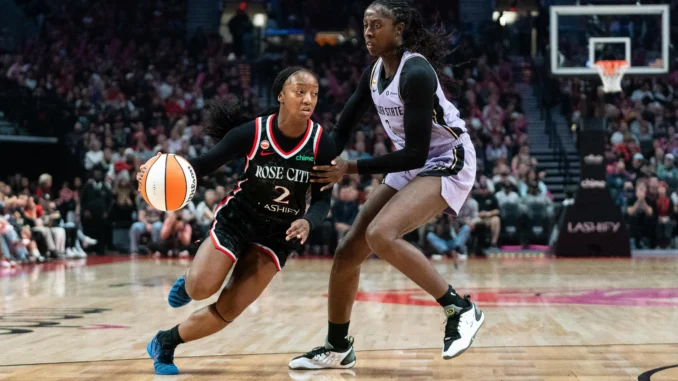
The Portland Fire didn’t make the playoffs in their first season back in the WNBA.
Honestly, that feels like about the only disappointing thing you can say about Year 1.
Portland finished its inaugural season Tuesday night with a 90-82 overtime win over the Golden State Valkyries, wrapping up the year at 17-27. The Fire even spotted Golden State a 17-0 lead before coming all the way back against one of the best teams in the league. It was a fitting way to finish a season in which Portland proved far more competitive than you might expect from an expansion franchise.
Seventeen wins aren’t going to hang a banner at Moda Center. But expansion teams aren’t supposed to arrive fully formed, either. The Fire had to build an entire roster, establish a coaching staff, create chemistry between players who had barely played together, and figure out exactly what kind of team they wanted to become.
Somewhere along the way, they became pretty entertaining.
Carla Leite might be the biggest find of the season. She finished the year averaging 16 points and 6.3 assists per game, numbers that suddenly make the 22-year-old look less like an interesting young player and more like someone Portland can build around. Bridget Carleton averaged 14.3 points and gave the Fire a veteran presence, while Sarah Ashlee Barker averaged 10.7 points and showed plenty of reasons to be excited about her future.
The final game almost felt like a little preview of what could come next. Carleton scored 26 points, while Leite delivered the biggest baskets in overtime as Portland knocked off a Golden State team that entered the night with 31 wins and a chance to finish with the No. 1 playoff seed.
But if we’re judging whether the Portland Fire’s first season was successful, wins and losses probably aren’t even the best place to start.
Look at the seats.
Portland averaged more than 14,500 fans per game, fourth-best in the entire WNBA. The only teams drawing more were Golden State, New York and Indiana. This wasn’t a novelty that disappeared once people checked “WNBA game” off their Portland summer bucket list. Fans kept coming back.
We probably should have known that from opening night.
A sellout crowd of 19,335 packed Moda Center for the Fire’s first regular-season game in May. It was the largest crowd ever for an expansion team’s WNBA debut and the second-largest home-opening crowd in league history. Portland lost that game 98-83 to Chicago, but you wouldn’t have guessed it from the atmosphere.
I am a season ticket holder, and the thing that stuck with me wasn’t anything in the box score. It was the noise. The building felt alive. At times, it was louder than plenty of Blazers games I’ve attended over the years.
That enthusiasm didn’t disappear when the games started counting.
That’s probably the biggest victory from this season. The Fire didn’t spend four months begging Portland to notice them. Portland noticed immediately.
There was always reason to believe this could work. The Thorns have spent years proving that Portland will strongly support women’s professional sports. Women’s basketball has deep roots throughout Oregon, and the original Fire still had fans who remembered the team’s brief run from 2000 through 2002. The new franchise wasn’t introducing women’s basketball to Portland. It was bringing something back that probably never should have disappeared in the first place.
The organization also treated the Fire like something meant to last. RAJ Sports opened the $150 million Kaiser Permanente Performance Center this summer, a shared facility built for the Fire and Thorns. That’s a pretty significant statement about where ownership sees women’s professional sports going in Portland.
Now comes the fun part.
The Fire don’t have to spend next season establishing whether Portland cares about the team. That question has been answered. They can focus on making the basketball better.
There are holes to fill. A 17-27 record is still a losing record, and the gap between Portland and the WNBA’s playoff teams remains significant. Nobody should look at this season and declare the rebuild finished.
But that’s not what Year 1 needed to accomplish.
The Fire needed to give Portland a team worth caring about. They needed to establish an identity. They needed to find players who could become part of the future. They needed Moda Center to feel like the “Fire Pit” instead of an arena borrowing a nickname for marketing purposes.
They checked every one of those boxes.
Twenty-four years after the original Portland Fire disappeared, professional women’s basketball finally returned to the city.
This time, it feels like it’s here to stay.
Be the first to comment