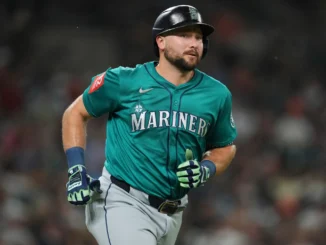
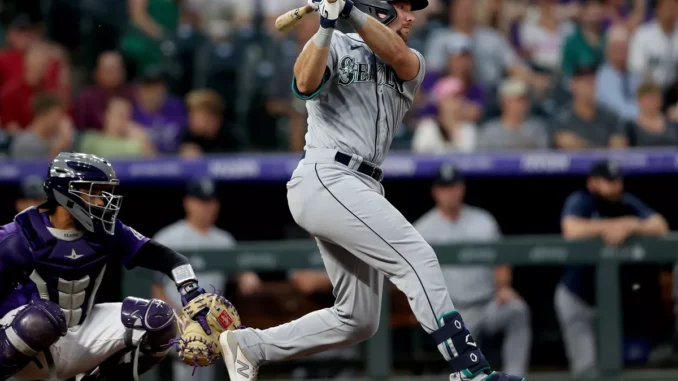
Let’s be frank: The Seattle Mariners have been, as the kids say, mid (currently sitting 1.5 games back of the surging Texas Rangers for the American League West title at 48-49), with Cal Raleigh, Seattle Mariners superstar backstop and 2025 MVP runner-up, leading the way. Most notably, he went 0-for-38 earlier this season–a 10-game hitless streak that was the longest in the sport since 2011 (when current Chicago Cubs manager Craig Counsell was suffering through 0-for-45). If you don’t like that, you don’t like Seattle Mariners baseball.
In an offseason where the front office didn’t make many moves, bringing the gang all back, save for swapping Jorge Polanco and Eugenio Suarez and adding line drive hitter and utility man extraordinaire Brendan Donovan, Raleigh’s lack of offensive contributions speaks volumes about this team: the same old thing isn’t working. Instead of seeking true upgrades that could offer legitimate run support to one of the best rotations in baseball (sitting sixth in team ERA as of the All-Star break) like Kazuma Okamoto, a free agent I was high on, who’s 10th in the American League with 22 home runs, Jerry Dipoto and the rest of Mariners brass saw the result of going–and losing–last year’s ALCS and decided to double down, with expected results.
Let’s get back to Cal. I think we knew he’d regress from last season’s heroics of 60 bombs (which led the AL) and 125 RBIs, but not like this. From both conventional and advanced stats perspectives, it’s been a rough start for Team USA’s catcher. He’s slashing .169/.271/.310 for a dreadful OPS of .581. While he’s hit 9 bombs and driven in 29 runs, he’s also projected to strike out over 150 times and draw only 58 walks.
If you’re talking nerdy, all of his expected stats are down–including his batting average, on-base average, and slugging. The catcher’s hard-hit rate has cratered while his strikeout rate has ballooned. If you look at his Savant page, there’s a lot of blue for a player of his caliber.
We’ve seen Raleigh play at the upper echelon of the sport, and I’m a believer that if you’ve shown that you can do it once, you can do it again. But offensive consistency from a catcher is always volatile, given the demands of the position. Basically, his offensive profile has turned into “pray he hits it,” which, as a switch-hitter, is unusual since the platoon advantage isn’t helping his strikeout percentage or walk totals.
But it’s not all doom and gloom. Offensively, his bat speed is still there (74.9 MPH), placing him in the 79th percentile among qualified hitters. Additionally, his barrel percentage remains above average, suggesting this likely isn’t a physical decline but rather a mechanical or timing issue. Considering he also walks at an elite rate, he’s seeing the ball pretty well, just not doing the damage we expect from the former Seminole. He’s still batting in the heart of the lineup, so he will still get his opportunities to be a run producer (even if he doesn’t deserve them right now).
But it’s not all on him. Speaking of the lineup, numbers one through nine have struggled to hit for power. After ranking third in all of baseball with 238 dingers last campaign, they’ve fallen to 14th this year while their team slugging percentage is 28th in the league. Obviously, considering the extreme park factor that T-Mobile provides, this stat was always going to be tough to replicate. But even trying to hit gap-to-gap hasn’t been going well– they ranked 29th in doubles this season, after being in the same spot in 2025 and 27th in 2024. This is a homer-reliant team, which, in this writer’s opinion, doesn’t align with the approach they should be taking, given the environmental factors and park dimensions this club plays in.
Injuries to regular contributors, including Randy Arozarena, Julio Rodriguez (placed on the 7-day IL with a concussion on July 2nd but expected to be back shortly after the All-Star Break), and the Big Dumper himself, who missed 33 games due to an oblique strain, have kept this team from achieving the heights they dreamed of before the season started. Donovan, while he was playing well before his groin injury (.839 OPS), hasn’t played in over two months and profiles more as a leadoff hitter rather than the slugging power threat the team needs right now. Players like first baseman Josh Naylor, infielder J.P. Crawford, and catcher/designated hitter Mitch Garver have regressed significantly this season and haven’t been able to pick up the slack.
Let’s face it: running it back with a flawed roster and expecting a different result is peak Mariners behavior. You can’t blame the Puget Sound for a noticeable lack of offensive production when ownership and the front office went bargain-bin hunting for impact free agents, a move that rarely works (unless you’re the Tampa Bay Rays, Cleveland Guardians or Milwaukee Brewers). Raleigh’s decline is a gut punch, but it also speaks to a larger, systematic failure in a lineup completely devoid of protection or length. And while Dumper has the tools to turn it around, he shouldn’t have to carry the Mariners on his back. If Seattle’s brass doesn’t inject some actual firepower into this position-player core at the trade deadline in a few weeks, fans will view the 2025 run to the American League Championship Series not as a launchpad but as an outlier.