For nearly three decades, the Seattle Seahawks have been one of the NFL’s model franchises. That isn’t something fans take for granted. Around the league, organizations rise and fall amid ownership changes, front-office shakeups, and coaching turnover. Seattle largely avoided that cycle thanks to Paul Allen, whose 1997 purchase of the team changed the franchise’s trajectory.
Allen didn’t simply keep the Seahawks in Seattle. He invested heavily in every aspect of the organization, trusted football people to make football decisions, and created an environment where winning became the expectation rather than the exception. During his ownership, the Seahawks reached four Super Bowls, won two Lombardi Trophies, and established themselves as one of the NFL’s premier organizations. Even after he died in 2018, his sister, Jody Allen, continued to carry out his vision as chair of the franchise. The organization remained stable, continued competing for championships, and ultimately captured another Super Bowl before the team officially went up for sale.
That chapter officially begins now.
The Khosla family has agreed to purchase the Seahawks for a reported $9.612 billion, making it the most expensive sale of an NFL franchise in league history. The deal still requires approval from NFL owners, but there is little expectation it won’t move forward. Seahawks fans aren’t concerned with what was paid. They’re wondering who is taking over one of the league’s flagship organizations, and whether the culture that made Seattle successful will remain intact.
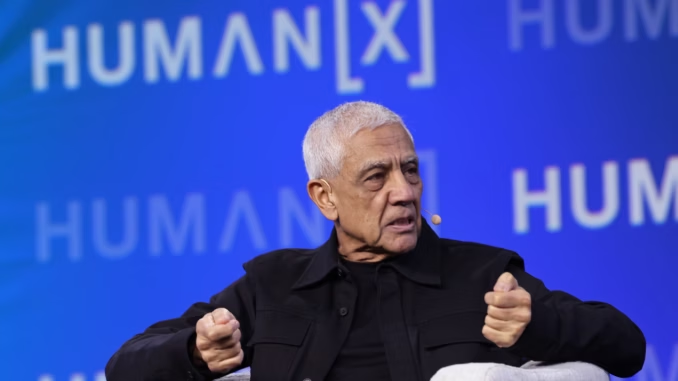
Unlike Allen, who became one of the world’s most recognizable technology leaders through Microsoft, Vinod Khosla built his fortune differently. He co-founded Sun Microsystems, one of Silicon Valley’s pioneering computer companies, before launching Khosla Ventures. This venture capital firm has backed companies such as Stripe, DoorDash, and Instacart, as well as numerous artificial intelligence, healthcare, and robotics startups. Forbes currently estimates his net worth at nearly $14 billion.
In many ways, it’s an interesting transition. The Seahawks are moving from one legendary technology entrepreneur to another. While their paths to success were different, both built fortunes by identifying opportunities before others did. That’s an encouraging trait for any business leader.
Whether it translates to owning an NFL franchise remains to be seen.
Fortunately, Khosla isn’t inheriting a rebuilding project—quite the opposite.
Seattle remains one of the healthiest organizations in professional sports. Mike Macdonald has quickly established himself as one of the league’s brightest young coaches. General manager John Schneider continues to earn widespread respect throughout the NFL. The roster is loaded with young talent, the front office has consistently drafted well, and Lumen Field remains one of the toughest places for opposing teams to play.
That changes the challenge for new ownership.
This isn’t about rescuing a struggling franchise.
It’s about preserving excellence.
The biggest question isn’t whether the Khosla family can afford to own an NFL team. Nobody spends nearly $10 billion without extraordinary financial resources. The real question is whether they’ll operate the way Paul Allen did.
Allen understood that winning organizations require constant investment. Whether it meant improving facilities, expanding resources for coaches and players, or providing football operations with everything needed to compete for championships, he rarely let finances become the obstacle. Just as importantly, he trusted the people he hired. He wasn’t trying to call plays on Sunday or make draft picks from the owner’s suite.
That may be the most important lesson Khosla can take from his predecessor.
His background in technology could actually become an advantage. The NFL grows more reliant every year on analytics, sports science, artificial intelligence, and player performance data. Having an owner who understands innovation isn’t a bad thing. But success in professional sports still comes from empowering experienced football minds to make football decisions.
Seattle fans also know better than most why ownership matters.
The departure of the SuperSonics still leaves scars throughout the city, making any ownership change feel more significant than it might elsewhere. Fortunately, there has been no indication this sale threatens the Seahawks’ future in Seattle. The team’s lease at Lumen Field runs through 2032 with extension options, and Khosla has already spoken about building upon the winning legacy Paul Allen created rather than changing it.
Still, comparisons to Paul Allen are inevitable.
That’s an impossible standard for anyone to match overnight. Allen didn’t simply own the Seahawks. He transformed them into one of the NFL’s flagship franchises. He delivered stability, invested in every level of the organization, and built a championship culture that produced four Super Bowl appearances and two Lombardi Trophies.
The Khosla family doesn’t need to become the next Paul Allen.
They need to protect what he built while allowing the organization to continue evolving.
The good news is that they’re taking over from a position of strength. Fans believe in Mike Macdonald. They believe in John Schneider. They believe the roster is capable of competing for championships. Ownership doesn’t need to reinvent the wheel.
It simply needs to keep it turning.
Years from now, nobody will remember the record-setting purchase price. They’ll remember whether the Seahawks continued playing meaningful football in January, competing for Super Bowls, and adding to a championship legacy that Paul Allen spent nearly three decades building.
Buying the team was the easy part.
Maintaining one of the NFL’s premier franchises will be where this ownership group is ultimately judged.