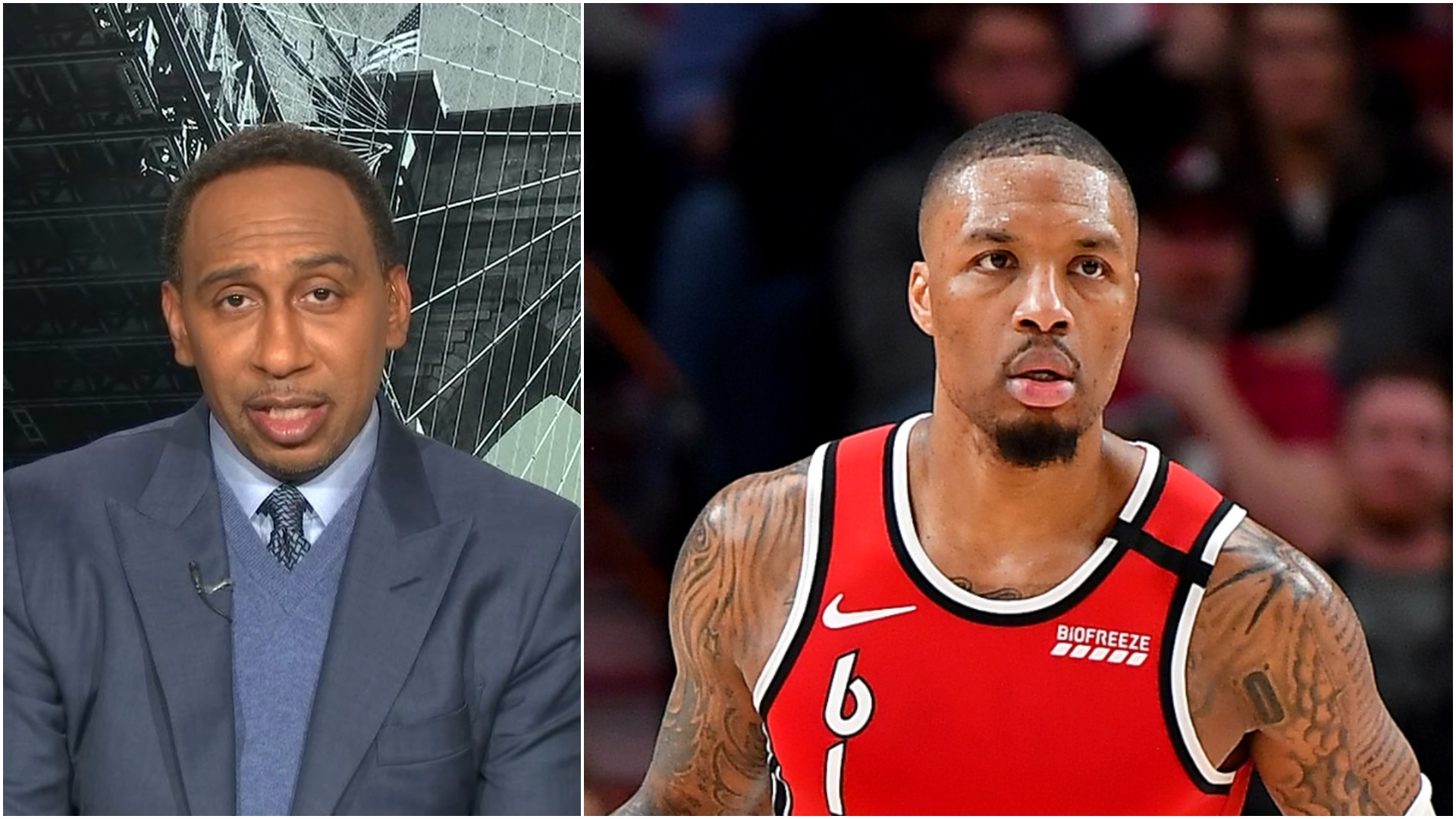
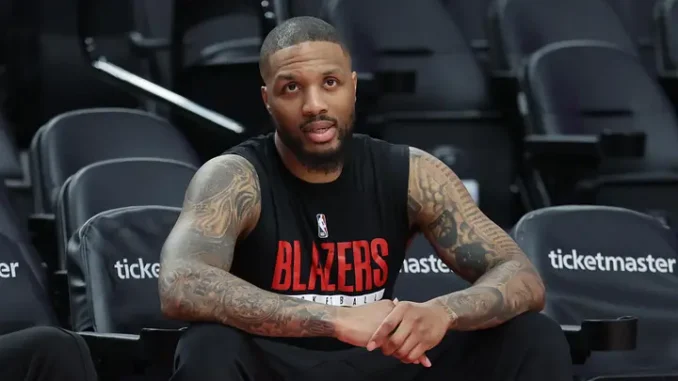
Damian Lillard has spoken.
After the topic was raised, as to whether Dame would call himself the second-best shooter in NBA history behind Stephen Curry, Lillard responded with a simple answer:
“Yes I would.”
The title of greatest shooter in NBA history belongs to Curry. He holds the all-time record for made three-pointers, with 4,248 triples, and his influence on the sport is inseparable from the modern game itself.
But Lillard’s case for second place is strengthened, not weakened, by Curry’s existence.
The two megastars are the only players in NBA history who have forced defenses to treat 30-foot jumpers as offensive weapons. And they’re the only players to treat half-court logos as places where games could be won or lost.
Just ask the Oklahoma City Thunder.
Ray Allen, Reggie Miller, and Klay Thompson were all historically great shooters. None, though, consistently inspired the kind of defensive panic that Curry and Lillard have created.
The debate often becomes a comparison of percentages and career totals. Those numbers have value, but they don’t fully capture the difference between making shots and creating them.
Simply put: Not all three-pointers are created equal.
A catch-and-shoot corner three isn’t the same shot as a pull-up from 31 feet. It’s just not.
A jumper created by a teammate isn’t the same shot as one created after dribbling into a double-team late in the shot clock.
Lillard has spent most of his career focusing on the latter. He has made 2,804 career three-pointers while shooting 37.1 percent from deep. And more importantly, he accumulated those numbers while functioning as his team’s primary offensive creator for most of his career.
Opposing defenses have known exactly who they needed to stop. They’ve trapped him, blitzed him, switched bigger defenders onto him, and routinely picked him up near half-court.
But he still kept making shots.
Thompson may be the greatest catch-and-shoot player ever. Allen may have had the smoothest jumper ever. And Reggie’s movement shooting helped lay the foundation for today’s game. But Lillard’s greatness comes from somewhere else. He has taken shots that would be considered bad decisions for almost every other player in NBA history, and he turned them into efficient offense.
Only Curry has sustained that combination of difficulty and production over a similar stretch. But range is another separator.
Before Curry and Lillard, defenses gave up 30-foot jumpers. If someone wanted to shoot from that distance, coaches were willing to live with it. Defenses could live with the result.
Those days disappeared, though, because of Steph. And Dame.
The league adjusted first because of Curry, and then again because of Lillard.
There is a reason “logo range” brings exactly two players to mind.
Honestly, Curry and Lillard changed the geography of the court. Every extra foot a defense extends creates more driving lanes, longer rotations, and more opportunities for teammates.
“Gravity” is a term we hear often, but these guys actually defined the term.
Very few players—if any—have generated the kind of gravity these two have, with defense gravitating toward them, and doing so far, far away from the three-point line.
The playoff résumé strengthens the argument, too. Dame’s series-ending three against Houston in 2014 remains one of the defining shots of that era. And then, five years later, Dame ended Oklahoma City’s season with a 37-foot dagger over Paul George.
Forget stats.
Think about those shots for a moment.
Against OKC: Tie game. Series on the line. Defender draped all over him. Lillard rose from 37 feet and ended the series.
Against Houston: The most important shot in Trail Blazers history up to that point. And, more importantly, a bucket that both launched Dame into prime time and also ended a Rockets run led by Dwight Howard.
Most players would never attempt it. But for Lillard, it was just another shot. It was an early resume-builder that made both him and the Blazers feel relevant on a national scale.
The clutch résumé only adds to the case. Throughout his career, Lillard has built a reputation as one of the league’s most feared late-game shot-makers, even when everyone in the building knew the ball was going to be in his hands.
The strongest counterargument might belong to Thompson, because of his efficiency and historic catch-and-shoot ability. Allen and Miller deserve mention because both helped redefine perimeter scoring in their eras. But each argument eventually runs into the same obstacle: None of those players combined volume, self-creation, extreme range, defensive attention, iso skills, and late-game shot-making the way Lillard has.
Only Curry checks more of those boxes.
Truly, the debate for No. 1 is finished.
But the debate for No. 2, while remaining open, also feels increasingly obvious.
Lillard is the only player whose shooting consistently forced comparisons to Stephen Curry.
That carries enormous weight, and it’s why Dame isn’t wrong when he claims himself that he’s the second-best shooter in NBA history.