The Portland Fire are only three games into their first WNBA season, so any grand declaration should come with a warning label. This is not a finished product. This is not a team that has everything figured out. This is not a group ready to bully the league for four months.
But are they interesting? Absolutely.
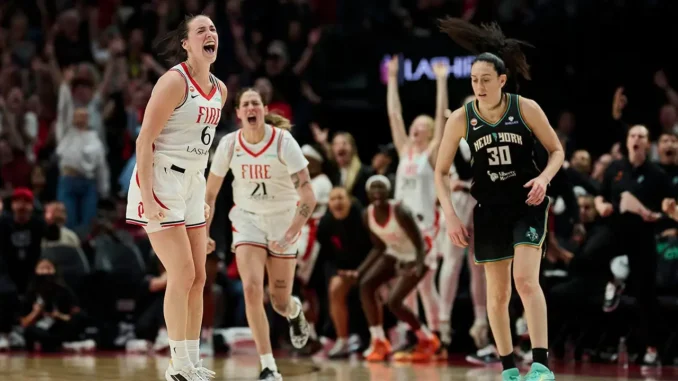
Through three games, the Fire are 1-2, and honestly, that feels about right. They opened with a 98-83 loss to the Chicago Sky, followed it with a thrilling 98-96 win over the New York Liberty, then got a rematch dose of reality in a 100-82 loss to New York two nights later. That is basically the expansion-team sampler platter: excitement, chaos, a little magic, and then a reminder that the WNBA is rude to new people.
The best thing about the Fire so far? They play hard. That sounds simple, but for an expansion team, it matters. There are going to be nights when the offense gets clunky, the rebounding gets ugly, and the rotations feel like everyone is still learning each other’s coffee orders. But effort travels. Effort keeps fans engaged. Effort gives a new team an identity before the wins fully arrive.
That showed up in the Fire’s first win, when Sarah Ashlee Barker put back the game-winner at the buzzer against the Liberty. It was the kind of moment that turns a new franchise into something real. Not a logo. Not a schedule. Not a ticket package. A team. Portland rallied from a double-digit deficit that night, forced 18 Liberty turnovers, and turned those mistakes into 25 points. That is the blueprint. Defense, pressure, transition, and enough shot-making to survive the final few minutes.
Bridget Carleton owns the best single-game performance for Portland so far. She scored 26 points in that win over New York, knocked down five threes, and looked like the kind of veteran expansion teams desperately need. Not flashy for the sake of being flashy. Just steady, smart, and useful in basically every way. She can defend, shoot, move without the ball, and give Portland a player who does not seem overwhelmed by the moment. For a team still trying to form an identity, that matters a lot.
Carla Leite has also been fun. She had 18 points in the opener against Chicago, then followed that with 21 points in the win over New York. There is still plenty to clean up, because young guards in a new system usually do not arrive as finished products. Shocking, I know. But Leite already looks like someone who can create pressure, attack gaps, and make defenses react. On a team that can go cold in the half-court, that is huge.
Barker has also made an early impression beyond the buzzer-beater. She had 13 points on 6-for-9 shooting in the opener against Chicago, then delivered the biggest shot of the season two games later.
Megan Gustafson gave Portland a lift in the second Liberty game, leading the Fire with 14 points in the 100-82 loss. That game was a good example of where Portland is right now. The Fire were competitive early and even had a nine-point lead, but New York adjusted, went to a zone, and Portland’s offense started to bog down. The Liberty then hammered them in the third quarter, 31-16, and that was basically that.
That brings us to what is not working.
The biggest early issue is defense, and more specifically, finishing possessions. Through three games, Portland is allowing 98.0 points per game, last in the WNBA. The Fire also got hammered on the glass in their opener against Chicago, losing the rebounding battle 56-34, including 14-3 on the offensive boards.
Portland can survive some of that when it forces turnovers and gets hot from three, like it did in the win over New York. But over a full season, those extra possessions will add up quickly. Good teams do not need help. Great teams definitely do not. And right now, Portland is giving opponents too many second chances.
The three-point shooting is another swing area. In the win over New York, Portland got enough timely shooting to keep pressure on the Liberty. In the rematch, the Fire shot just 9-for-31 from three, or 29.0%, while New York hit 15-of-38, or 39.5%. That difference explains a lot. Portland does not yet have the margin for error to survive cold shooting nights, especially against deeper teams that can adjust defensively and punish mistakes.
Still, the early signs are encouraging. The Moda Center crowd has already shown up in a major way. Portland’s opener drew 19,335 fans, the largest crowd for a WNBA team’s inaugural game. That matters. Expansion teams need patience, but they also need energy. Portland is already providing that part.
So where are the Fire right now?
They are scrappy. They are flawed. They are fun. They have a few players worth watching every night, especially Carleton, Leite, Barker, and Gustafson. They can pressure teams into mistakes. They can get rolling from three. They can also get stuck, lose the glass, and give up 100 points before everyone has finished their first beer.
In other words, they look exactly like a new team should look.
The goal this season should not be instant dominance. That would be nice, sure, but let’s not get greedy three games into existence. The goal should be progress. Build an identity. Find the core pieces. Make the Moda Center a tough place to play. Give fans moments that make them come back.
So far, the Fire have already done that.
Now comes the harder part: doing it again, and again, and again.