We finally made it. After months of hand‑wringing, speculation, mock drafts, and pro days, the most televised name‑calling event in modern media has come and gone. The Las Vegas Raiders kicked things off by taking Fernando Mendoza first overall—a surprise to absolutely no one. The draft really began at pick No. 2, when my New York Jets selected Texas Tech pass rusher David Bailey, and from there, things got weird.
For the first time in a long time, the Seahawks entered the draft with a pick at the end of the first round—a spot every team wants to be in. So who did they take, and how do these players fit into the roster? Let’s break it down.
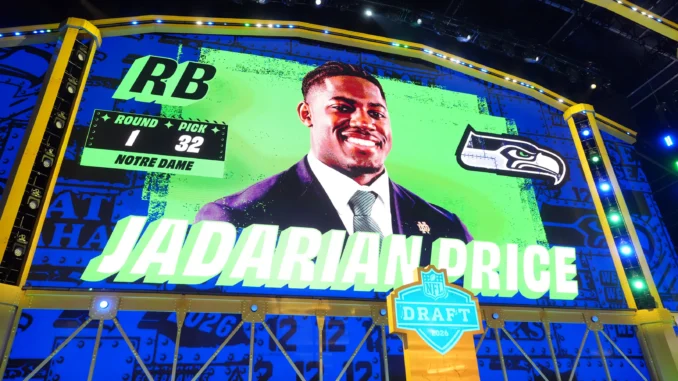
Round 1: Pick 32 – RB Jadarian Price, Notre Dame
This was arguably the cleanest match of fit and need in Seattle’s entire draft. With Super Bowl MVP Kenneth “K9” Walker III departing and Zach Charbonnet recovering from a torn ACL, running back was a glaring hole. Price’s vision and cutting ability give him a reliable floor as a starter, and with only 280 collegiate carries (playing behind No. 3 pick Jeremiyah Love), he brings plenty of untapped upside. Given the thin RB class, this was a popular and widely predicted pick. Sometimes the obvious move really is the right one.
Round 2: Pick 64 – S Bud Clark, TCU
In my mock draft last week, I almost slotted Clark here. Ultimately, I leaned toward EDGE because of the depth at that position, but this pick says a lot about Mike Macdonald’s defensive philosophy. His scheme is built from the back end out, and Clark fits that mold perfectly.
NFL analyst Chad Reuter describes Clark as a defender with “the ball skills of a wide receiver,” which shows up in his production (15 picks over four seasons as a starter). He’s rangy, instinctive, and quick to trigger in the run game. The concerns: he’s a bit light, and his tackling can be inconsistent. But Seattle’s staff loves molding versatile DBs, and Clark brings exactly that.
Seattle originally held pick 96 but traded back three spots with Pittsburgh, adding a sixth‑rounder (216).
Round 3: Pick 99 – CB Julian Neal, Arkansas
Seattle has long favored long‑armed, physical corners dating back to the Legion of Boom, and Neal fits the prototype. A former Fresno State safety who transferred to Arkansas, he blossomed as a starting corner, posting 55 tackles, 10 pass breakups, and two interceptions.
His length and explosiveness make him a natural fit for Seattle’s Cover 3 looks, but he’ll need technical refinement—especially in press—to earn early snaps. Bigger corners often struggle with fluidity and double moves, and Neal is no exception. Still, with Seattle’s track record of developing DBs, he’ll have every chance to carve out a role alongside Devon Witherspoon, Josh Jobe, and the two corners added on Day 3.
Round 5: Pick 148 – G Beau Stephens, Iowa
Even championship teams have weak spots, and the Seahawks’ offensive line—particularly right guard—was one of them. Trading a 2027 fourth‑rounder to Cleveland to land Stephens signals a desire to inject real competition into the interior.
Stephens started at both guard spots for Iowa, one of the nation’s premier O‑line factories. A first‑team All‑American and All‑Big Ten selection, he didn’t allow a sack last season. His shorter arms and average athleticism cap his ceiling, but he’s a steady, technically sound lineman who fits Brian Fleury’s zone‑based scheme. He’ll compete with Christian Haynes, Bryce Cabeldue, and Anthony Bradford for the starting job.
Round 6: Pick 199 – WR Emmanuel Henderson Jr., Kansas
The Dareke Young replacement—at the Tom Brady pick, no less. Henderson brings legit speed (4.4 at the Combine) and big‑play potential, averaging 17 yards per catch in his lone season of major production.
A former running back, he’s electric with the ball in his hands, making him a natural fit for the West Coast‑style offense Seattle will run next season. He also contributes on special teams as both a returner and a gunner—sometimes in the same game. With Young now in Las Vegas, Henderson has a clear path to that role while offering situational explosiveness on offense.
This pick came after Seattle traded back from 188, acquiring 199, 216, and 242 from the Jets. Late‑rounders are lottery tickets—the more you have, the better your odds. Seattle is trying to stay hot.
Round 7 Pick 236 – CB Andre Fuller, Toledo
A quintessential Mike Macdonald pick. Fuller is a long, physical defensive back with experience at safety, nickel, and outside corner. He excels in press but lacks the long speed to hold up in man coverage consistently. Scouts project him best in deep zone concepts—conveniently, a Seattle staple.
This is a “competition in the DB room” pick, not a fast track to playing time. But in today’s NFL, you can never have too many corners.
Round 7 Pick 242 – NT Deven Eastern, Minnesota
Defensive tackle has been a quiet need for Seattle, and Eastern brings size (6’5″, 320), length (34″ arms), and rotational upside. With Jarran Reed andLeonard Williams aging, adding fresh legs behind Byron Murphy II was essential.
Eastern earned All‑Big Ten Honorable Mention with 38 tackles, five TFLs, and 2.5 sacks. If he plays with better pad level, he could become a versatile piece—possibly even kicking out to big defensive end in odd fronts, which Seattle uses in its base looks.
Round 7 Pick 255 – CB Michael Dansby, Arizona
Seattle closes out its draft with yet another corner, surprising fans who expected an EDGE addition to replace Boye Mafe. But the board didn’t fall that way, and Seattle may address pass rush in post‑deadline free agency (reports say Dante Fowler recently visited).
Dansby is a self‑described “speedster” with strong coverage instincts, evidenced by 10 pass breakups and two interceptions in 2025. He’ll compete with Henderson Jr. for gunner duties and provide depth in a crowded CB room.
This draft sent a clear message: Seattle is doubling down on its identity. A versatile, disguise‑heavy secondary paired with a bruising, run‑first offense. Jadarian Price sets the tone for the post‑Super Bowl era, and the additions of Clark, Neal, and Stephens reinforce the blueprint.
This is a team built to hit you—on offense and defense. And with the pieces they added this weekend, the champs might just have a puncher’s chance at going back‑to‑back.