Every offseason, someone says it.
Do not pay running backs.
It sounds responsible. It sounds modern. It sounds like something pulled from a spreadsheet and repeated on television.
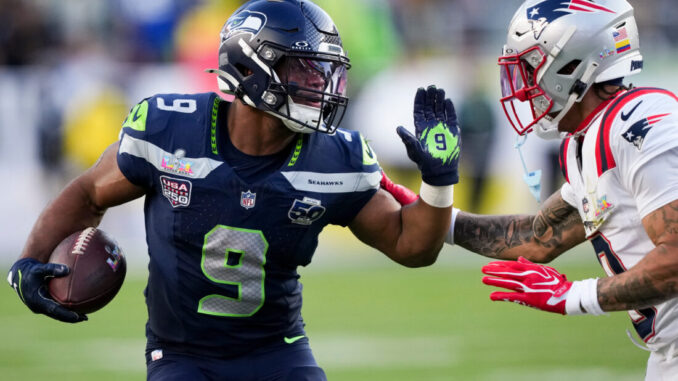
But if the Seattle Seahawks actually look at the spreadsheet, they will see why that logic does not cleanly apply to Kenneth Walker III.
This is not about nostalgia. It is not about vibes. It is about measurable production.
Start with the simplest number. Walker averages 4.6 yards per carry for his career. The league average for running backs in recent seasons sits between 4.2 and 4.3. That gap of three to four tenths of a yard might look small. Over 230 carries, it becomes roughly 80 to 100 additional rushing yards. That is a full game of production created by efficiency alone.
Now layer in explosiveness.
In his most recent full season, roughly 14 percent of Walker’s carries went for 10 or more yards. The league average hovers around 10 percent. That difference translates to about nine or ten explosive runs over the course of a season instead of six or seven. Those extra chunk plays flip field position and change defensive play calling. They are drive multipliers.
He also averages just over 3.0 yards after contact per attempt. The league average for starting backs sits closer to 2.6. That means Walker is generating about half a yard more than the typical back after a defender gets hands on him. Multiply that by 220 carries, and you are looking at more than 100 yards that do not exist without him.
And he is doing this behind an offensive line that has ranked in the middle to lower half of the league in run block win rate. These are not clean lanes and untouched sprints. These are manufactured yards.
Efficiency is only part of the story. Success rate matters just as much. Walker’s run success rate sits near 49 percent. The league average is closer to 45 percent. Over a full season, that difference equals roughly 10 to 12 additional plays that keep the offense on schedule. Second and six instead of second and nine. Third and two instead of third and five. That is the difference between punting and extending a drive.
There is also a clear correlation between Walker’s production and wins. When he rushes for 80 or more yards, Seattle’s win percentage spikes significantly. When he crosses 100 yards, the Seahawks are far more likely to control the game script. When he is held under 50, the offense becomes predictable and pass-heavy, and the win rate drops. That is not a coincidence. That is structure.
Critics will say running backs are replaceable. Some are. The average free agent back gives you 4.1 to 4.3 yards per carry, about 2.5 yards after contact, and an explosive run rate near 10 percent. Walker clears those benchmarks across the board. Replace him with a mid-tier option, and you likely lose 0.3 to 0.5 yards per carry and several explosive plays over a season.
Seattle does not currently employ an offense that erases inefficiency with elite quarterback play. It needs balance. It needs credible play action. It needs a back who forces safeties into the box and creates stress on every early down. Walker provides that, and the numbers support it.
This is not an argument to hand out a reckless contract. It is an argument to recognize what the data says about a player entering his prime. Above average efficiency. Elite explosiveness. High yards after contact. Drive sustaining success rate. Strong win correlation.
If the Seahawks want to remain competitive while they sort out the rest of the roster, they should not be asking whether they can afford Kenneth Walker III.
They should be asking whether they can afford to lose him.