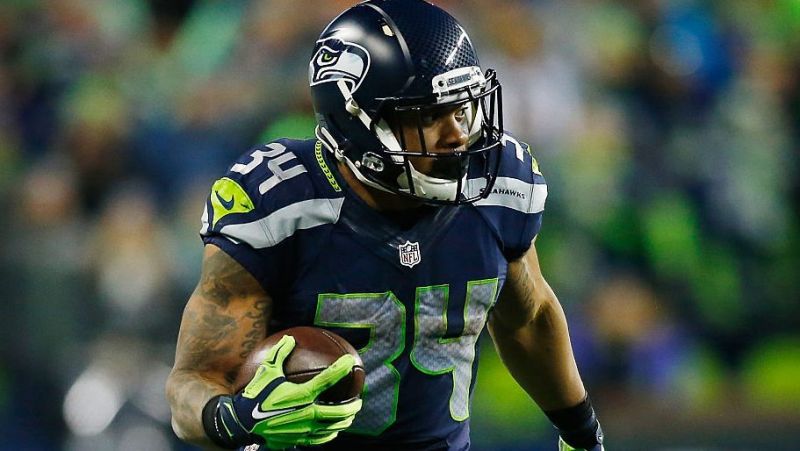
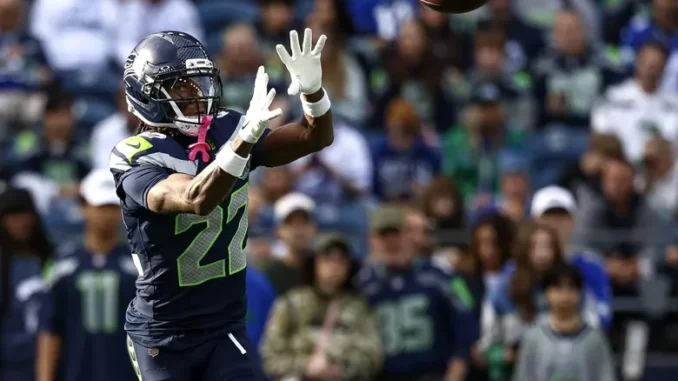
The Seattle Seahawks’ 2026 free‑agency period wasn’t about splash moves or headline‑grabbing signings. It was about reconciling what the tape shows, what the analytics say, and what the salary cap allows. Coming off a Super Bowl win, Seattle faced the classic contender’s dilemma: keep the band together or start planning for the next album.
They chose the latter — and the decisions make more sense when you blend tape study with cap math.
Retaining Key Contributors
One of Seattle’s biggest priorities was identifying key talent for value. The biggest deal of the legal tampering period was the re-signing of wide receiver (and Pro Bowl returner) Rashid Shaheed, who returned on a three‑year, $51 million deal with $34.7 million guaranteed. On the surface, that’s a hefty price for a non‑WR1. But from a schematic standpoint, the move makes sense.
Shaheed ranked among the league leaders in yards per route run, explosive‑play rate, and EPA (expected points added) per target. His speed and versatility were essential to their postseason run, and keeping him in the building ensures continuity for Sam Darnold and an offense that thrives on explosive plays.
With new offensive coordinator Brian Fleury keeping the so-called “Shanahan” offense in the Pacific Northwest, the classic “jet sweep/vertical threat/ YAC monster” type of receiver is crucial for keeping the defense honest while setting up the explosive perimeter threat this system relies on.
Cornerback Josh Jobe, who started in 15 games of the 16 he played in, came back to the Emerald City after agreeing to a three-year, 24 million pact. An undrafted free agent, the former Crimson Tide worked his way up from special teamer to dependable member of the secondary after being released by the Philadelphia Eagles and winding up on Seattle’s practice squad in 2024. Last season, starting 15 of the 16 games he played in, Jobe recorded 54 tackles, 12 deflections, 2 QB hits, 1 pick, and 1 half-sack.
Under head coach Mike Macdonald, Seattle’s defense has evolved into a hybrid, matchup-driven scheme that blends pattern-match zone coverage with aggressive man coverage. Jobe’s physicality, tackling reliability, and proficiency in press-man lines up well with Macdonald’s preference for corners who can disrupt timing at the line of scrimmage and set the edge in run support.
While Jobe lacks Tariq Woolen’s (now a member of the Philadelphia Eagles) rare length and ball-hawking traits, he offers steadier technique and fewer coverage busts. He profiles as a CB2 to second team All-Pro Devon Witherspoon in a thin secondary (especially corner) that will surely be addressed with multiple picks in the upcoming draft.
Other than that, General Manager John Scheider responded with smart signings to fill out the roster, agreeing to modest deals with restricted free agent linebacker Drake Thomas, receiver Jake Bobo, and safety AJ Finley. While these moves won’t necessarily move the needle in March, these are the type of transactions that lead to clutch plays in January and February.
Notable Departures
The most emotional loss of the offseason was Super Bowl MVP Kenneth Walker III, who cashed in on the best season of his career (1027 rushing yards, 5 touchdowns with a healthy 4.6 per tote average) and with the Kansas City Chiefs, inking a three-year contract worth up to $45 million, the richest free agency deal for a running back in NFL history. Defensively, their biggest loss was Edge Boye Mafe, who agreed on a three-year, $60 million deal with the Cincinnati Bengals, replacing defensive end Trey Hendrickson, who went to the Baltimore Ravens unexpectedly.
Meanwhile, starting safety Coby Bryant will be making his home in the Windy City for the next three years as a Chicago Bear, offering his services in the back end for $40 million. The aforementioned Woolen will play on a one-year prove-it deal in the city of Brotherly Love for defensive whiz Vic Fangio.
While all these players leaving all at once may make the 12s raise their eyebrows, firstly, there’s always a talent drain on a Super Bowl team, from executives to the coaching staff to players. Additionally, each of them had reasons they were on the open market—positional value for Walker, Mafe’s lack of traditional counting stats (44 pressures and 40 hurries, with just 2.0 sacks in 2025), Bryant’s lone year of starting production, and Woolen’s inconsistency—that Seattle didn’t feel comfortable overpaying, a strategy the best teams adopt (let them walk a year too early rather than a year too late). And lastly, with only $55 million to play around with at the start of free agency, a strong player development pipeline, and more than 10 draft picks in the 2027 Draft (including potentially four compensatory selections), the Seahawks are indicating their belief in their system on both sides of the ball and trust in the front office to acquire impact contributors at premium value, whether it’s the offseason, training camp or the trade deadline.
Final Thoughts
Seattle’s 2026 free-agency class wasn’t sexy—but it’s smart. They kept a dangerous offensive weapon that matches their scheme to a tee, and solidified the boundary without breaking the bank. They were mindful of the cap, putting themselves in a position of sustainability by moving from certain players who didn’t fit their analytical model while opening their books for potential rookie extensions with superstars Jaxon Smith-Njigba and Witherspoon. This is how champions stay champions: not by chasing headlines, but by doubling down on identity. And the Seahawks did just that.