Two Seasons, No Progress – Now What?
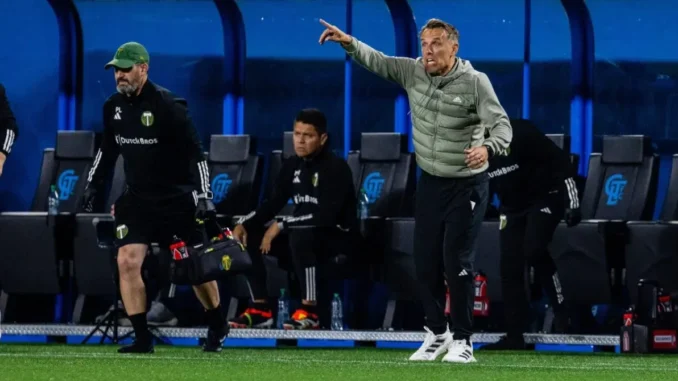
The Portland Timbers head into the 2026 MLS season at a crossroads. Sure, the club — and the MLS scribes who follow them religiously — won’t call this a make-or-break year for head coach Phil Neville. But that’s because they’re either polite, employed by the club in some capacity, or incapable of reading between the lines.
Let’s be honest: 2026 needs to be a success for Neville to prove he can actually coach in MLS.
Is that harsh? Maybe. He’s taken Portland to the playoffs in each of the last two seasons, but let’s not pretend those were impressive campaigns. The Timbers backed into the postseason with ninth- and eighth-place finishes. That’s not dominance. That’s attrition, outlasting teams just as bad if not worse.
And in both cases? They exited the playoffs with a whimper. Neville now enters Year Three. This is the season where excuses expire.
If there’s one thing the Timbers have been under Neville, it’s consistent mediocrity.
- 2024: 12W–11L–11T
- 2025: 11W–12L–11T
- Overall (81 games): 30W–29L–22T
That’s not terrible. It’s also not good. It’s the definition of stuck in neutral. Portland has become a team that exists in the margins. They don’t collapse, but they don’t contend. They just hover above the playoff qualification line. In MLS, making the playoffs is often seen as success. If you are a true fan, making the playoffs should be seen as bare-fucking-minimum.
Nine out of 15 teams make the playoffs in the Western Conference. It took just 41 points to make the Western Conference playoffs last season. You don’t have to be very good to make the postseason. Rather, you need to hover. For a club that once set standards in the Western Conference, hovering isn’t good enough.
Preseason Optimism
Portland wrapped up the Coachella Valley Invitational with a thrilling 4–3 win over the Chicago Fire, courtesy of a Felipe Mora stoppage-time winner.
That was their only win in Coachella:
- 0–0 vs. D.C. United
- 2–3 loss to San Jose Earthquakes
For a team supposedly built on defensive structure, and often playing soccer that feels laborious, conceding six goals in the final two preseason games isn’t ideal. If the defense wobbles, what exactly is the Portland Timbers’ identity under Neville?
Where Are the Goals Coming From?
The Timbers scored just 41 goals in 2025. Only Austin FC and Real Salt Lake scored fewer. Portland’s joint top scorers were Antony and Kevin Kelsy with seven goals each. Seven. If this club has Supporters’ Shield or MLS Cup ambitions, seven-goal leading scorers aren’t going to cut it.
David Da Costa, one of the three designated players in 2025, chipped in four goals and six assists. Sure, it was respectable, but was it worth $3.425 million? Not even close.
Da Costa is talented, no question, but designated players are supposed to tilt seasons. Portland needs him to change games more than twice all season.
Kristoffer Velde signed from Olympiacos late last season and occupies another DP slot. He will make around $3 million this season. He played sparingly after arrival, making eight appearances and tallying two assists. There were flashes of quality that could turn into longer phases in 2026.
Portland Timbers made a big roster move in the final week of preseason: releasing Jonathan Rodriguez.
The Uruguayan midfielder played just 149 minutes in 2025 due to a serious knee injury. But let’s not forget that, in 2024, Rodriguez scored 17 goals and recorded 8 assists in 35 games. That’s actual designated player output.
General manager Ned Grabavoy clearly decided the injury risk wasn’t worth the investment in a 32-year-old midfielder. Expect Portland to pursue a new DP in the summer window, when the European market reopens.
Fixing the Defense
Portland conceded 48 goals last season — sixth-fewest in the Western Conference. They kept seven clean sheets and allowed one goal or fewer in 23 matches.
That’s solid. It’s also the reason so many games were borderline unwatchable. Neville, a former defender himself, has built a side that soaks up pressure and plays not to lose. Sometimes that’s smart. Sometimes it’s just dull as hell.
The club reinforced the back line in the offseason. Center-back Alex Bonetig arrived from Western Sydney Wanderers. Right-back Brandon Bye joined from the New England Revolution, bringing 189 MLS appearances of veteran reliability. But the most intriguing addition isn’t in defense.
Cole Bassett: The Statement Signing
Cole Bassett might be the most important signing Portland has made in years in terms of American players. The former Colorado Rapids academy product logged 172 appearances, 31 goals, and 21 assists across competitions. He’s a true box-to-box No. 8. He can create, score, and inject tempo into a midfield that often feels stuck in second gear.
His loan spells with Feyenoord and Fortuna Sittard prove he’s capable of playing in Europe. Colorado selling him to a Western Conference rival for $2.65 million? That’s either financial necessity or foolishly thinking the move won’t come back to bite them on the ass.
Either way, Portland benefits. Bassett will make the midfield more dynamic if Neville uses him correctly.
The Goalkeeper Carousel
Maxime Crepeau is gone, having moved to Orlando City after 15 appearances in 2025. That leaves James Pantemis as the undisputed No. 1, entering the final year of his contract.
Pantemis has conceded 58 goals in 41 appearances for Portland. Those numbers don’t scream elite. Yet. Goalkeeper analysis without context is lazy. Defensive structure, shot quality, and coaching decisions all matter.
And Neville’s goalkeeper management last season? Stupid is one word to describe it. After conceding four goals on opening day to the Vancouver Whitecaps, Crepeau was benched, and Pantemis got the job. Then injuries. Then more benchings. After a 3–0 loss to Toronto FC, the switch flipped again.
It often felt reactionary — swapping keepers after heavy defeats rather than backing one through adversity. To Neville’s credit, he stuck with Pantemis in the playoffs, even after a 4–0 final-day loss to San Diego.
But will we see the same stop-start management in 2026? If so, instability should follow.
The Shadow of the Past
Neville followed two of the most successful coaches in Portland history: Caleb Porter was an MLS Cup winner with Portland. Giovanni Savarese took the Timbers to two MLS Cup Finals.
Both averaged over 1.50 points per game. Neville averages 1.38 points per game. That gap matters.
Porter later won the MLS Cup with the Columbus Crew in 2020 before flaming out. Savarese is currently out of work. However, the standard they set in Portland remains.
Neville also carries baggage from his time with Inter Miami, where he struggled during the club’s chaotic early years. He spent two-and-a-half seasons as Inter Miami coach. His appointment as Portland coach surprised fans, and it likely still does.
The Reality of the Western Conference
When Neville arrived, the Western Conference was competitive but manageable. In 2026, it’s brutal. Ninth place won’t cut it. Eighth won’t inspire supporters over the long, arduous MLS regular season.
If Portland wants to be taken seriously again, they need:
- 50+ goals scored
- Defensive stability without sacrificing ambition
- A clear No. 1 goalkeeper
- Designated players who actually change games
This roster has pieces. Bassett could be a difference-maker. Da Costa and Velde have proven themselves when the team plays attacking football. The defense is structured. If Portland is going to sign attacking designated players, then they need their coach to play soccer on the front foot.
A poor start, and Neville might not see October. That’s simply reality. After two seasons of hovering around the playoff line, the Timbers either push toward the top of the West or ownership decides it’s time for a new voice.
Portland doesn’t lack talent. It lacks an identity. The 2026 season is about proving this project is going somewhere or admitting it isn’t.