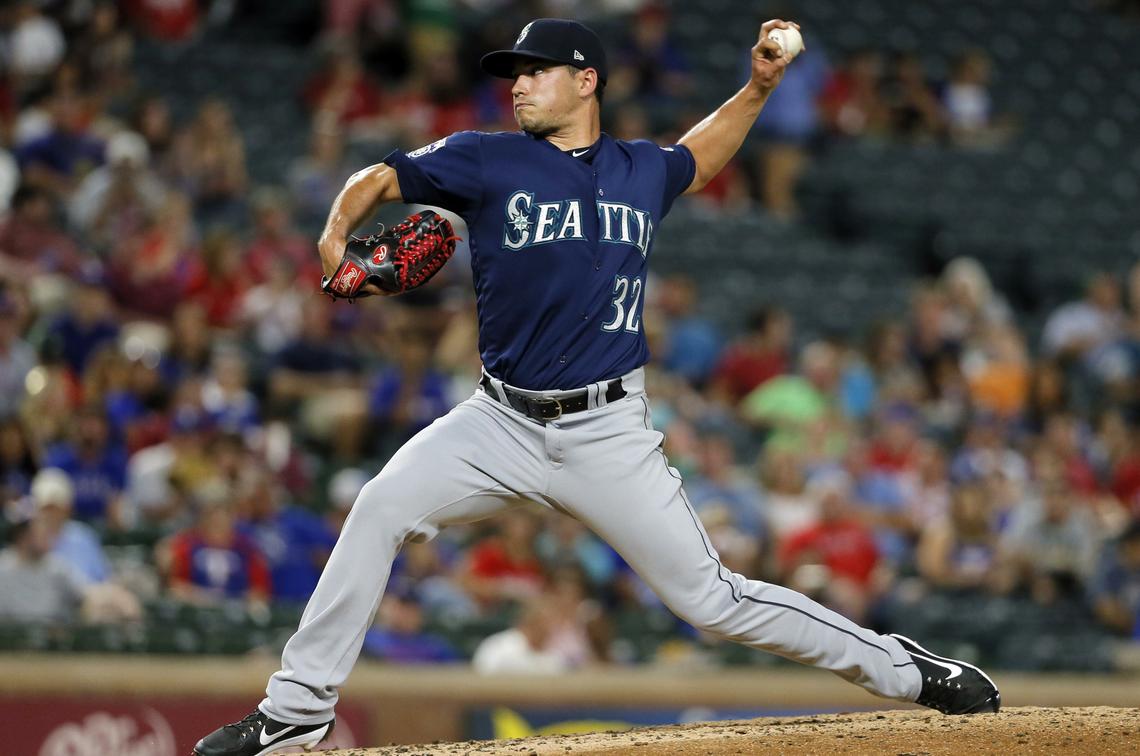
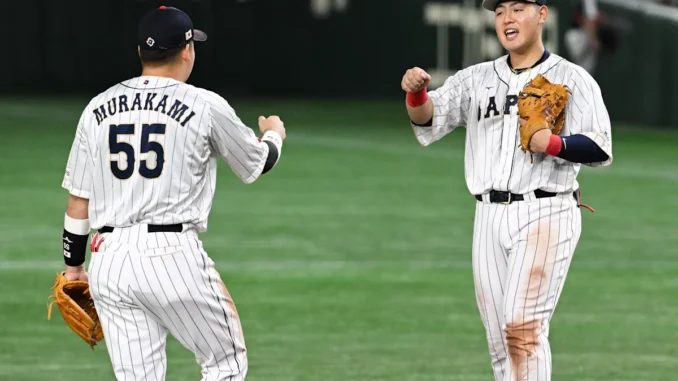
After falling short to the Toronto Blue Jays in the 2025 ALCS, the Seattle Mariners enter the 2026 campaign at a crossroads—a club with gaining momentum but also one with glaring needs. They’ve re-signed one of their postseason heroes in Josh Naylor and added to the bullpen, but they still lack a reliable middle-of-the-order bat with the departure of third baseman Eugenio Suarez and versatile infielder Jorge Polanco to the New York Mets. As the posting window almost closes on two of Japan’s brightest stars—Yakult Swallows slugger Munetaka Murakami and Yomiuri Giants stalwart Kazuma Okamoto—they come into focus as tantalizing, cost-effective options to fill the void.
Kazuma Okamoto: Mr. Consistency
Okamoto has been the model of reliability for the Yomiuri Giants ever since his full-time debut. Over the first six seasons of his career, he’s averaged more than 30 home runs and 90 RBI, while keeping his strikeout rate manageable. The captain of the “Japanese Yankees”, battled injury in 2025, playing in just 69 out of 143 games (but still put up a slashline of .327/.416/.598, good for a .992 OPS), but in his last full season in 2024, he posted .280/.362/.501, a .863 OPS with 27 homers, 83 RBI, and 70 runs scored. That’s not too far off from his banner year in 2018: a .309 batting average with an absurd on-base percentage of .394, 33 bombs, 100 RBI, 82 trips across home plate, and 120 strikeouts versus 72 walks.
Generally, he’s considered to have a better hit tool than Murakami, with fewer whiffs (63rd percentile in Zone Contact, and 56th in Swinging Strike percentage), so his transition to higher velocity pitching should be smoother. Given the dimensions of notoriously pitcher-friendly T-Mobile Park, and Okamoto’s tendency to pull the ball as a right-handed hitter (since 2021, he leads all of Japanese baseball in air percentage with 67), he fits perfectly in Seattle, especially with their short porch in left field. His ability to adjust and make consistent contact ensures he won’t be neutralized by the deeper (401 feet) center field.
Okamoto plays the hot corner reasonably (measuring in the 88th percentile for range and 74th for Defensive Value at third base), but his Baseball Reference page lists first base and left field as positions he’s logged time at as well, adding that word we love so much in baseball: versatility.
Okamoto’s steady production and ability to play multiple roles make him an ideal fit for Seattle’s roster. He’s not just a slugger—he’s a dependable run producer who can adapt to different lineup needs.
Munetaka Murakami: Superstar Potential, But Risky Profile
Murakami, at 25, is younger and has already shown flashes of generational talent. His 2022 season was historic: a sizzling .318 average, with a ridiculous 1.168 OPS and 56 (the most ever hit by a Japanese-born player) dingers. Oh, he also added 134 RBI in a league with a dead ball, no big deal. But since then, his numbers have dipped while the strikeouts have ballooned:
- 2023: .256 AVG, 31 HR, 84 RBI, 168 strikeouts
- 2024: .244 AVG, 33 HR, 86 RBI, 180 strikeouts
Murakami’s strikeout totals are concerning. His swing‑and‑miss profile (third percentile in Swinging Strike percentage and in the zero percentile for Zone Contact percentage) raises questions about how he’ll handle MLB pitching, especially high velocity. While his OBP remains strong, Seattle already has high‑strikeout hitters like Julio Rodríguez and Cal Raleigh. Adding another could unbalance the lineup.
Like Okamoto, he also battled injury during 2025, playing in just 56 games but still socking 22 taters in his abbreviated walk year. Considering he bats from the left side of the plate but boasts opposite-field power, he could take advantage of the short right-field line (326 feet). T-Mobile Park’s dimensions may mute his swing-and-miss tendencies and reliance on deep drives to right-center.
Murakami’s bat is elite, but his glove is not. He’s considered below average at third base, with limited range, a lack of lateral quickness, and inconsistent footwork, though his strong arm allows him to make plays on routine balls. Many scouts and publications project him as better suited for first base or designated hitter in MLB. While Naylor is manning the cold corner for the next five years, a DH, especially an unproven one at that, is something Jerry Dipoto and the rest of the front office can fill at a later date.
MLB Translations: Projected Performance
Projection systems like ZiPS and Steamer offer estimates of how NPB stars might perform in MLB. While they’re far from perfect (remember Yoshi Tsutsugo?), translating their stats to account for major league pitching provides a clearer picture of their fit.
| Player | AVG (MLB Proj.) | HR | RBI | OBP | SLG | Strikeouts |
| Kazuma Okamoto | .255 | 25–30 | 80–90 | .330 | .450 | ~110–120 |
| Munetaka Murakami | .235 | 30–35 | 85–95 | .340 | .470 | ~160–180 |
From this chart, the key takeaway is that Murakami offers slightly more raw game power, but Okamoto offers more consistent contact and nearly half the strikeouts. Seattle’s offense in 2025 was explosive at times—Cal Raleigh hit 60 HR, Julio Rodríguez posted a 30‑30 season—but streaky. The team struggled with consistency in clutch moments. While Murakami could add fireworks to a lineup in need of some, Okamoto’s offensive reliability, plate discipline, and positional flexibility make him a better match for where the Mariners are currently in their pursuit of an American League pennant.
Conclusion
The Mariners don’t just need another big bat—they need the right kind of bat. While Murakami’s ceiling is immense, his recent decline and strikeout issues make him a risky investment. Kazuma Okamoto, on the other hand, comes ready to contribute to a championship contender. While he’s three years older than Murakami, he offers a more complete offensive profile that could be the final piece for the M’s to finally break through.