
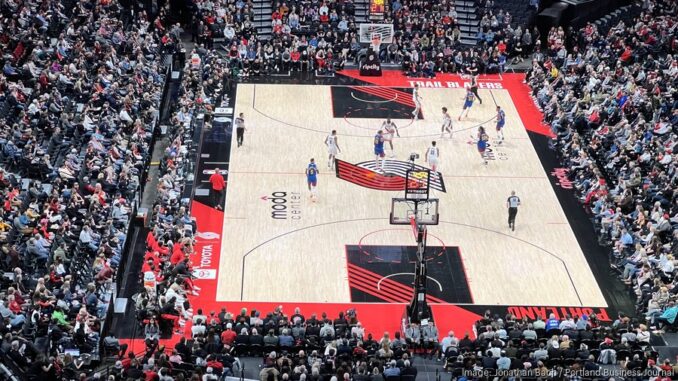
The easiest argument against spending public money on the Moda Center practically writes itself.
Tom Dundon’s ownership group paid $4.25 billion for the Portland Trail Blazers, with the NBA approving the sale in March. Why should Oregon residents help renovate an arena that could increase the revenue and long-term value of his investment?
It’s a fair question. In many stadium debates, it should end the discussion.
This situation is more complicated.
Oregon isn’t deciding whether to build Dundon a privately owned basketball palace from scratch. The City of Portland owns the Moda Center, and the current proposal would limit public funding to eligible arena renovation expenses. Portland’s public materials specifically exclude tenant-only luxuries, such as an owner’s suite, from the public contribution.
Oregon should help pay for the renovation. However, it should only do so through a strong agreement that limits public exposure, makes the team responsible for overruns and operating costs, gives taxpayers meaningful oversight and legally ties the Trail Blazers to Portland for at least another generation.
The Moda Center Is Already a Public Asset
One important detail often disappears from this debate: Tom Dundon doesn’t own the Moda Center.
Portland acquired the arena and the land beneath it in 2024. The adjacent office and retail building remains privately owned, but the arena itself belongs to the city and is operated by Rip City Management. The current operating lease runs through October 11, 2030, with an option for a five-year extension through 2035.
That changes the nature of the conversation.
Governments regularly spend money maintaining and improving publicly owned buildings. The question isn’t whether Oregon should subsidize every request made by a professional sports owner. It is whether the state should help modernize a heavily used public facility in exchange for keeping its primary tenant in Portland.
The Moda Center opened in 1995 and has never undergone a comprehensive renovation. Portland and state officials describe it as the oldest NBA arena that has not received a major renovation. Many of its building systems are approaching the end of their useful lives, while proposed improvements include accessibility, seating, energy efficiency, concessions, concourses, concert rigging and event technology.
Doing nothing wouldn’t make those costs disappear.
According to Portland’s current estimates, simply maintaining the arena in roughly its existing condition would cost approximately $482 million over the next 20 years. The more extensive renovation plan is currently estimated at $573 million upfront, followed by another $285 million to $300 million in maintenance over 20 years. Those are city estimates, not a guarantee of what the final costs will be, but they demonstrate that Portland already owns a building with significant long-term financial needs.
Oregon isn’t choosing between spending money and spending nothing. It is choosing what kind of arena it wants to own and what commitments it receives in return.
The Blazers Aren’t Leaving Tomorrow, But the Risk Is Real
No one has announced that the Trail Blazers are relocating.
That distinction matters. Fans shouldn’t treat every difficult negotiation as proof that moving trucks are waiting outside the practice facility.
NBA Commissioner Adam Silver has said the league wants the Blazers to have a long-term future in Portland. He has also said the renovation talks have gone “off track,” acknowledging that important issues remain unresolved between the team and local governments.
The Blazers are contractually committed to the Moda Center through 2030, with the potential extension through 2035. That provides time, but it doesn’t provide permanent security. Oregon’s state funding is conditioned on a new lease of at least 20 years, which explains why the arena renovation and the team’s long-term future have become inseparable parts of the same negotiation.
Portland already has one of the NBA’s 30 franchises. Losing it would not guarantee the city another team through expansion. It would place Portland in competition with other markets, many of which could offer new arenas, wealthy ownership groups and aggressive public financing packages.
The team isn’t packing its bags. Still, Oregon would be foolish to assume the franchise’s history alone will keep it here forever.
Professional sports don’t reward sentimentality. They reward revenue, premium seating, sponsorship opportunities and modern facilities. Oregon can complain about that reality, and probably should, but ignoring it won’t make the pressure disappear.
The Economic Argument Requires Honesty
Supporters of the renovation often highlight the Moda Center’s economic impact.
Portland estimates that the arena attracts approximately 1.5 million visitors to about 150 events annually and generates around $600 million in regional economic activity. State materials have used a slightly higher estimate of $670 million. These are gross economic-impact estimates, however, and shouldn’t be mistaken for proof that every public dollar invested will produce an equal or greater return.
Research on publicly subsidized stadiums and arenas remains overwhelmingly skeptical. Studies generally find that sports venues don’t produce the sweeping regional growth, income increases or job creation promised by subsidy advocates. A substantial portion of spending at games simply replaces money residents would otherwise spend on restaurants, movies, concerts or other entertainment.
Oregon shouldn’t pretend basketball will solve Portland’s economic challenges.
The case for renovating the Moda Center is narrower. The city already owns the building. It already faces hundreds of millions of dollars in projected maintenance costs. The arena hosts basketball, concerts, family shows and major events throughout the year. A renovation would also help Portland prepare for the 2030 NCAA Women’s Final Four and support the Portland Fire, which began playing at the arena in 2026.
This isn’t a guaranteed economic-development jackpot. It is an effort to protect and modernize an existing public asset while securing its most important tenant.
That’s a much more defensible argument.
The State’s Money Comes With Conditions
Oregon has already created a legal framework for participating in the renovation.
Governor Tina Kotek signed Senate Bill 1501 in April. The law creates a pathway for shared state and city oversight of the arena, establishes the Oregon Arena Fund and directs certain tax revenue generated by Rose Quarter workers, construction activity and performers toward the fund.
The state’s potential contribution is up to $365 million. That money cannot move forward until several requirements are met, including the creation of a joint arena authority, approval of the project’s scope and budget, financial commitments from Portland and Multnomah County and a lease keeping the Blazers in Portland for at least 20 years.
Portland’s current draft term sheet lists a total public renovation budget of $573 million:
The State of Oregon would contribute up to $365 million. Portland would contribute up to $120 million. Multnomah County would contribute up to $88 million.
Those figures remain proposals. Portland City Council and the Multnomah County Board have not approved their full contributions, and the term sheet released in July is only a first draft. It will need to be negotiated and replaced by final, binding agreements.
That means Oregon shouldn’t celebrate a completed deal yet. There isn’t one.
Dundon Shouldn’t Receive a Blank Check
Dundon has said he doesn’t plan to contribute personal or private money toward the public renovation package. Considering his group just purchased the franchise for $4.25 billion, that position understandably irritates taxpayers and elected officials.
However, Portland’s draft proposal would still place significant financial obligations on Rip City Management.
Under the draft, Rip City would be responsible for all renovation expenses above the $573 million public contribution, including cost overruns, funding gaps and team-requested changes. It would also cover post-renovation operating losses and demonstrate that it has a viable financing plan before construction moves forward.
The proposal would require Rip City to pay Portland $3 million annually as a property-tax offset, with that payment increasing by 5% each year. The money would be distributed among Portland, Multnomah County and Portland Public Schools. Rip City would also remain responsible for taxes, arena operations, repairs and maintenance under the proposed lease.
Those provisions don’t erase the enormous public contribution. They do make the arrangement more balanced than simply handing the owner $573 million and hoping he remembers where Portland is.
The final agreement should retain every one of those protections.
Oregon Must Purchase Permanence
Public funding only makes sense if Oregon receives a firm, enforceable commitment from the team.
The city’s draft requires the Trail Blazers to play their preseason, regular-season and playoff home games at the Moda Center for the term of the agreement, subject to limited exceptions. The nonrelocation provisions would survive a sale or change in ownership.
The draft also gives public agencies several potential remedies if the team tries to leave, including court orders preventing relocation, repayment of public investments, liquidated damages, clawbacks and reimbursement of enforcement expenses.
Those protections are critical.
A vague promise to remain in Portland isn’t worth hundreds of millions of dollars. Neither is a short lease filled with easy escape clauses. Oregon must receive a contract that is expensive, difficult and legally painful to violate.
The city should also retain its proposed audit rights, financial transparency provisions, parking revenue and user-fee income. Public agencies shouldn’t fund the building and then lose the ability to understand how it performs financially.
Oregon isn’t purchasing basketball tickets. It is purchasing certainty.
The Renovation Should Benefit More Than Premium Customers
A publicly funded renovation must provide more than luxury seating, upgraded clubs and additional sponsorship inventory.
Portland’s draft includes proposed community-benefit agreements involving local organizations such as Albina Vision Trust and the 1803 Fund. It also calls for local hiring, labor agreements, environmental standards, public transportation improvements and community access to the arena. One preliminary proposal would reserve at least 10 community events per year at the Moda Center without rental charges, although organizers would still cover direct operating costs.
Those commitments should remain central to the final deal.
The Rose Quarter sits in Lower Albina, a historically Black neighborhood deeply affected by displacement and urban-renewal projects. Oregon shouldn’t repeat the familiar pattern of using public money to improve a district while allowing the surrounding community to receive few of the benefits.
The renovation should create jobs, support local businesses, improve connections to transit and complement Albina’s redevelopment. It should make the arena a better civic facility, not merely a more profitable place to sell courtside cocktails.
Pay for the Arena, But Demand a Real Return
It is reasonable to feel uncomfortable about public money supporting a sports franchise owned by billionaires.
Dundon and his partners can afford to contribute. Their decision not to fund the base renovation directly deserves criticism. Oregon leaders should negotiate accordingly, not approach the discussion as grateful fans asking for an autograph.
Still, walking away carries costs of its own.
Portland would remain responsible for an aging public arena that already requires substantial maintenance. The state would risk losing major events. Local leaders would weaken Portland’s long-term ability to retain the Trail Blazers and keep the Moda Center competitive as a sports and entertainment venue.
Oregon should help fund the renovation, but only in exchange for a binding long-term lease, powerful nonrelocation provisions, strict limits on public spending, team responsibility for overruns, financial transparency and meaningful benefits for the surrounding community.
That isn’t charity for a billionaire. It is a calculated investment in a publicly owned building and an Oregon institution that would be extraordinarily difficult to replace.
The goal shouldn’t be to give the Blazers everything they want.
The goal should be to keep the Blazers while making sure Oregon gets what it pays for.



I do not belive we should have to pay for any of it.let the revenue from ticket sales pay for it. Just another tax we cannot afford