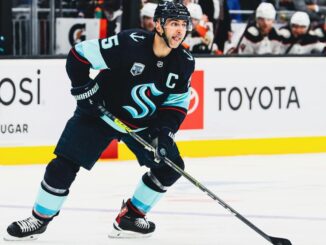
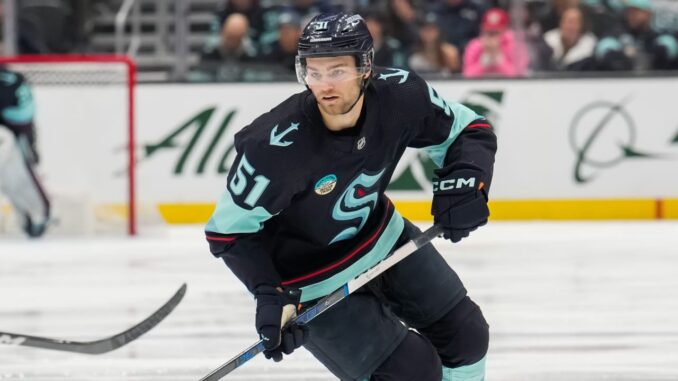
While the 2026 Stanley Cup Playoffs are ongoing, the NHL’s eliminated teams are looking ahead to the 2026 offseason with designs on being the ones playing into June next season. The Seattle Kraken are among the clubs that experienced a disappointing end to the 2025-26 campaign, playing at a 53-point pace from the beginning of February to miss the playoffs for the third year in a row and for the fourth time in five seasons.
Among the biggest issues derailing the Kraken’s season was their continued lack of offense, with the team scoring the fifth-fewest goals per game (2.73). Though the team’s lack of bona fide stars up front has been well documented, Seattle’s fecklessness in attack is not helped by shunning their young talent, such as former fourth-overall pick Shane Wright.
Related: Seattle Kraken – 3 Keys To A Successful 2026 Offseason
I once wrote a column about how the Kraken were mishandling Wright’s development, and nearly four years later, the sentiment still rings true as he’s progressed into full-time NHL duty. The Wright situation is a microcosm of the thinking that has plagued the organization through its half-decade of existence and has hobbled its hopes of contending soon after its inaugural season.
Let’s dive into Wright’s 2025-26 season and how the team can better utilize his abilities and reach his potential going forward, rather than dangling him as trade bait this summer.
Wright Grades Out Favorably Compared to Draft Class Peers
Despite the stuttering start to his NHL career, Wright shouldn’t be mentioned in the same breath as some of the biggest busts in NHL draft history just yet. Wright is only a year removed from tallying 19 goals and 44 points in his first full season in the NHL. The 22-year-old forward ranks fourth in games played and goals scored, sixth in assists, and seventh in points-per-game among the players hailing from the 2022 draft class.
While Wright’s counting stats dropped to 12 goals and 29 points in 74 games, a look under the hood at his individual five-on-five shot- and chance-generation suggests he suffered from a streak of poor puck luck, rather than a drop-off in performance.
| Statistic (Per-60-minutes) | 2024-25 | 2025-26 |
| Shots | 4.2 | 5.3 |
| Chances | 6 | 6.9 |
| High-Danger Chances | 3.4 | 3.6 |
| Expected Goals | 0.7 | 0.8 |
Though Wright’s creation saw an uptick in every meaningful category, both his own finishing and that of his teammates regressed after an unsustainable run last season. Wright converted on 10.4% of his shots this season after torching goalies to the tune of an 18.8% conversion rate in 2024-25. His on-ice shooting percentage (OiSH%) also fell from 11.8% to 8.2%, a metric that accounts for every shot taken while Wright is on the ice, including both his own and those of his linemates. The league average shooting percentage (SH%) was 9.6% in 2025-26, which shows how drastically out of line Wright’s conversion was last season.
Another factor that suggests Wright progressed in his development rather than taking a step back is that his individual offensive generation increased despite receiving about the same ice-time per game at five-on-five within a few seconds of last season. That aspect of his deployment remains concerning and puzzling, as he also improved on his on-ice share of shots and chances at five-on-five, seeing a significant uptick in high-danger chances and expected goals over last season.
| Statistic | 2024-25 | 2025-26 |
| Shot Share | 48.1% | 47.8% |
| Chance Share | 46.2% | 47.2% |
| High-Danger Chance Share | 45.5% | 48.2% |
| Expected Goals Share | 45.8% | 50.4% |
Among qualified Kraken forwards (minimum 300 minutes at five-on-five this season), Wright ranks 11th in average ice time (11:42) despite ranking third among that group in both goals and expected goals for share, and the only Kraken forward to be above 50% in both departments.
The difference becomes starker when isolating his relative metrics, which show how the Kraken fare with him on the ice versus when he’s on the bench. He’s a net-positive relative to his teammates in shots (plus-2.9%), expected goals (plus-8.1%), scoring chances (plus-3.1%), and high-danger chances (plus-7.7%) but has yet to be given ice time commensurate with those results.
Wright Included in Trade Discussions
The same reasons for giving Wright a bigger role are the same as those the media have offered up as reasons to fold him into a larger trade package for a true star. He’s under 25 years of age, carries a strong draft pedigree, and has been shackled by an organization that has yet to turn towards its burgeoning youth fully.
For teams in need of a top-six center, gambling on a yet-to-blossom player still under team control via restricted free agency is likely a better use of resources than splashing a ton of cash on an aging free agent.
The problem is that the Kraken are one of those teams, but have reportedly been ready to dangle the likes of Wright to snag a bigger fish. Ignoring a problem before it becomes overwhelming is often a death knell in sports, and it could cost the Kraken one of their top young players.
Wright Has Earned a Greater Role
There’s something to be said for whether his results would translate to more difficult and frequent deployment, but the Kraken have been so poor over the last few seasons that there is, and has been, little to lose in the results department.
Assuming they do not trade their 2026 first-round pick, they will have picked in the top 10 of five of the six NHL drafts they have taken part in, and are still on the rebuilding track when it comes to their competitive timeline.
That the Kraken committed hefty contracts to the likes of Chandler Stephenson ($6.25 million per year through 2030-31) and Brandon Montour ($7.14 million per year through 2030-31) in a futile attempt to chase a playoff spot despite being nowhere near true Stanley Cup contention, rather than embrace a full-scale rebuild and lean on the youth movement.
The Kraken have and will continue to pay the price of languishing in the league’s mushy middle, and giving up on Wright at this stage would only be a continuation of that failed philosophy.
Data courtesy of Hockey Stats, Natural Stat Trick, and the NHL.