
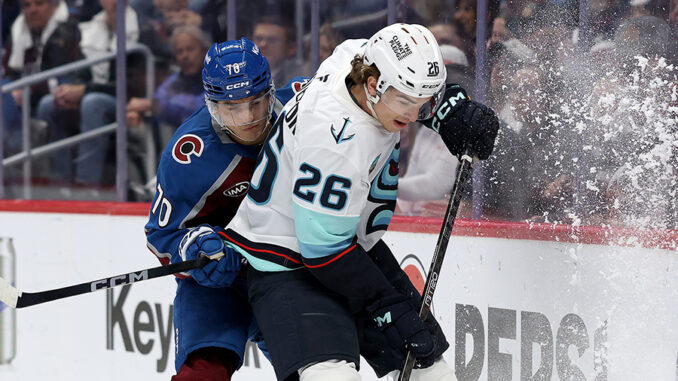
With their 2-0 loss against the Colorado Avalanche, the Seattle Kraken’s frustrating 2025-26 season has officially – and mercifully – concluded. Despite improving by three points from last season (76), the team will miss the playoffs for the third consecutive season, and the fourth of five seasons overall since joining the league as an expansion team in 2021-22.
The fact that Seattle was in a playoff spot as recently as March 11th is frustrating, given the team’s tremendous struggles since the beginning of February. They had the second-worst points percentage in the league over that span, ahead of only the last-place Vancouver Canucks, despite trading for winger Bobby McMann at the trade deadline. The team’s rapid collapse shortly thereafter raises questions about management’s judgment.
The Kraken’s season was defined by organizational turmoil, with Lane Lambert named the team’s third head coach in five seasons last summer. The switch from former head coach Dan Bylsma didn’t result in significant improvements in overall five-on-five play. It contributed to Ron Francis’s resignation as the team’s first general manager and president of hockey operations. His conservative roster construction and hesitancy have plagued his entire NHL management career, and his departure puts Jason Botterill in the driver’s seat.
The Kraken’s expansion cousins, the Vegas Golden Knights, began play during the 2017-18 season and have enjoyed much greater success as a franchise. While Seattle has counted only a single season of 90 points or more (100 in 2022-23), Vegas has done so in seven of nine seasons of existence, has the second-most playoff wins in the league since 2018 (62), and has reached two Stanley Cup Finals, winning in 2023.
It’s an unfair standard to apply to any franchise, given Vegas’ unique circumstances, but they have quickly become a model organization when it comes to taking huge swings in pursuit of a championship, and frame Seattle’s missteps in a much harsher light. Let’s dive into three key factors that contributed to the Kraken missing the postseason once again.
Kraken Still Can’t Score Enough
The biggest factor in the Kraken’s downfall this season is a familiar one: a lack of offense. They finished in the bottom five in goals per 60 minutes in all situations and bottom 10 at five-on-five, continuing a trend that has plagued the team since its inception.
Only the Chicago Blackhawks scored fewer goals than the Kraken over the course of their freefall from February onwards. However, significant injuries to Jared McCann and Jaden Schwartz certainly didn’t help.
McMann held up his end of the bargain since joining the Kraken. The 29-year-old tallied 10 goals and 14 points in 18 games since the trade, and offered a different dimension to a stagnant attack with his speed and physicality. There was some percentage luck involved in his increased production, but bringing him back next season at a manageable number (which is unlikely) would improve the team’s fortunes.
What is undoubtedly true is that Seattle can’t go into next season with Jordan Eberle as its top scorer (he had 55 points in 80 games) and expect to be a Stanley Cup contender.
Kraken League’s Worst Penalty Kill
While a lack of scoring is enough to hamstring most teams’ playoff hopes, the Kraken did themselves no favors with their abysmal penalty kill.
The Kraken finished 31st in the league with a penalty kill success rate of 72.2%, only 0.7% better than the terrible Vancouver Canucks, who tied for the eighth-worst regular-season points percentage of the past decade.
Seattle’s goaltenders didn’t help matters, as the team finished with the second-worst save percentage while shorthanded. Still, the Kraken’s penalty kill allowed among the highest rates of shots, expected goals, and scoring chances against per-60.
For all of the hoopla surrounding Lane Lambert’s defensive prowess coming into the season, the Kraken’s new bench boss fell flat in that department.
Kraken’s Young Players Fail to Take Next Step in Development
When Matty Beniers is a team’s top center, their ceiling is limited. The former second-overall pick is a good two-way player, but has yet to eclipse the 24 goals and 57 points he scored in his rookie season three years ago when he won the Calder Trophy. He tallied 20 goals and 50 points in 2025-26, a slight improvement on the meager 43 points he accrued in 82 games last season.
That’s not enough production for someone playing over 19 minutes a night in the top six and seeing regular power-play deployment. Beniers may not live up to his billing as a second-overall pick. Still, his seven-year, $50 million contract ($7.14 million average annual value) means the team needs much more from the young American pivot.
Shane Wright, the fourth-overall pick in 2022, faced a similar predicament. After flashing his potential with 44 points (19 goals and 25 assists) in 79 NHL games last season, the 22-year-old fell to 27 points (12 goals and 15 assists) over 74 games this year. Most of that drop is owed to limited usage since Wright’s underlying numbers actually suggest he had a better season than in 2024-25, but tangible production is the name of the game in the NHL.
Other than those two bigger names, three of the Kraken’s key under-30 players either saw a reduction in goals (Eeli Tolvanen and Kappo Kakko), assists (Kakko and Ryker Evans), or points (Kakko and Evans) over the previous season. Injuries and the resulting lack of cohesiveness and stability sent ripples down the lineup, and all five of the aforementioned players will have something to prove in 2026-27 if they remain with the organization.
Kraken Face Uncertain Path Forward
For all of the justifiable hand-wringing about the Kraken’s lack of on-ice success and clear need for more offensive talent, the franchise is in a good place moving forward.
The Athletic recently ranked the Kraken’s prospect pool the seventh-best in the league (a three-spot improvement from the 2025 edition), and the team will pick no worse than eighth in the 2026 NHL Entry Draft. Winning the draft lottery could result in someone like Gavin McKenna joining the organization, representing the kind of potential stardom the franchise has been begging for since day one.
The front office is projected to have nearly $30 million in cap space during the 2026 offseason, depending on which of the Kraken’s pending free agents are re-signed. This year’s free agent class is thin, but the Kraken should have both the room and the assets to be active in trade discussions around the league.
It’s time to be decisive regarding the franchise’s plans over the next few years. If not, a continued sentence in NHL purgatory awaits.
Data courtesy of HockeyStats, Natural Stat Trick, and the NHL.